 Exclusive sponsor
FAA Clears Electric Aircraft for Passenger Demonstrations, Not Commercial Air-Taxi Service
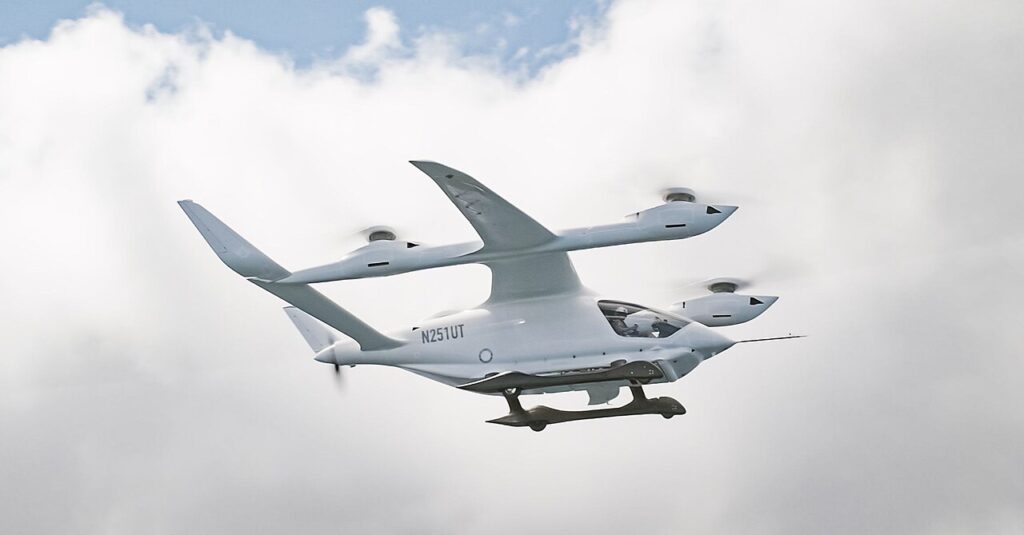
The FAA has approved BETA Technologies' ALIA A250 electric vertical-takeoff aircraft for demonstration flights with prospective customers. Commercial air taxi service has not yet been authorized.
Get the week’s jobs, development, housing and growth stories from across the Sun Belt in one email.
An electric aircraft that rises from the ground like a helicopter and cruises on its wings like an airplane can now carry prospective customers on demonstration flights in the United States. It cannot yet operate as a commercial air taxi.
The Federal Aviation Administration this week granted BETA Technologies a first-of-its-kind special airworthiness certificate for market surveys involving an electric vertical-takeoff-and-landing aircraft. The permission covers the company’s ALIA A250 and allows operators and other prospective customers to evaluate it in flight, subject to FAA limits.
It is a narrow but important change. Instead of relying only on presentations or watching test flights, potential buyers and operating partners can experience the aircraft as the company works toward the broader certification needed to carry regular paying passengers.
BETA put the authorization to use on Oct. 20. Its A250 took off vertically from Plattsburgh International Airport in New York, shifted to wing-supported flight and landed vertically at Patrick Leahy Burlington International Airport in Vermont. The 34-nautical-mile trip took 20 minutes, the company said. It did not establish that paying passengers flew on the trip.
What the new permission actually allows
Market-survey flights are demonstrations, not scheduled airline service. The special certificate permits flights with prospective operators and other approved participants under specified conditions. It does not mean the aircraft has completed full type certification or that an operator may start selling seats for routine flights.
That distinction is easy to lose in the excitement around electric aircraft. An aircraft might be technically capable of flight and still have years of regulatory and operational work ahead before it becomes an everyday transportation option. Pilots, maintenance procedures, landing and charging facilities, and commercial operating approvals must all fit together.
The A250 is built for places where runway access may be limited. BETA says the aircraft is designed to carry up to five passengers or more than 1,200 pounds of cargo, with potential uses in regional travel, medical transport and freight. Its architecture shares batteries, controls, propulsion technology and charging equipment with the company’s conventional-takeoff ALIA model.
The A250’s latest flight authorization follows years of development, including a crewed transition flight in 2024, when the aircraft demonstrated the shift between vertical lift and forward flight. The conventional-takeoff version had already received permission for market-survey operations.
Why cities are watching
The potential appeal is easy to understand in sprawling metropolitan regions where a short flight could connect airports, business centers or outlying communities without a conventional runway at each end. Medical and cargo operators could also use the ability to land in places that cannot accommodate an ordinary airplane.
But neither a route between Sun Belt cities nor a public ticket price was announced with this certificate. There is no basis yet for promising an air-taxi commute in Dallas, Phoenix or any other city simply because demonstration flights have been authorized.
The FAA is separately advancing an advanced-air-mobility testing initiative spanning 28 states, with projects examining passenger transportation, cargo, emergency response and other uses. The effort points to the scale of industry interest, not to an immediate launch date for any particular service.
For now, the meaningful advance is simpler: a prospective operator can experience an electric vertical-takeoff aircraft in flight while its maker continues the certification process. Turning those demonstrations into reliable, affordable transportation for the public remains the harder test.
Community Voice
A snapshot of reader views, not a scientific survey.
Explore Community Voice →About the Desk