 Exclusive sponsor
How School District Boundaries Work in North Fulton & Forsyth County
Major local stories and useful updates, once a week.
What determines zoning, why boundaries shift, and what parents should actually check
For families moving to — or already living in — North Atlanta, few topics cause more confusion than school district boundaries. Two homes on the same street can feed into entirely different elementary schools. A neighborhood listed as “Alpharetta” might not be zoned for the schools parents assume. And boundaries that seem fixed today can quietly change a few years down the line.
Understanding how school zoning actually works in North Fulton and Forsyth County helps families make better housing decisions, avoid surprises, and plan ahead realistically.
This guide explains how boundaries are set, why they change, and what parents should verify before relying on any school assignment.
The Two Systems at a Glance
At a high level, North Atlanta is served by two separate public school systems, each operating under different pressures and growth patterns.
- Fulton County Schools
Serves Alpharetta, Johns Creek, Milton, Roswell, Sandy Springs, and surrounding unincorporated areas. - Forsyth County Schools
Serves Cumming and all of Forsyth County.
Each district controls its own zoning, enrollment caps, construction plans, and redistricting schedules. Boundaries never cross county lines — but city names, ZIP codes, and mailing addresses often confuse families into thinking they do.
What Actually Determines a School Boundary
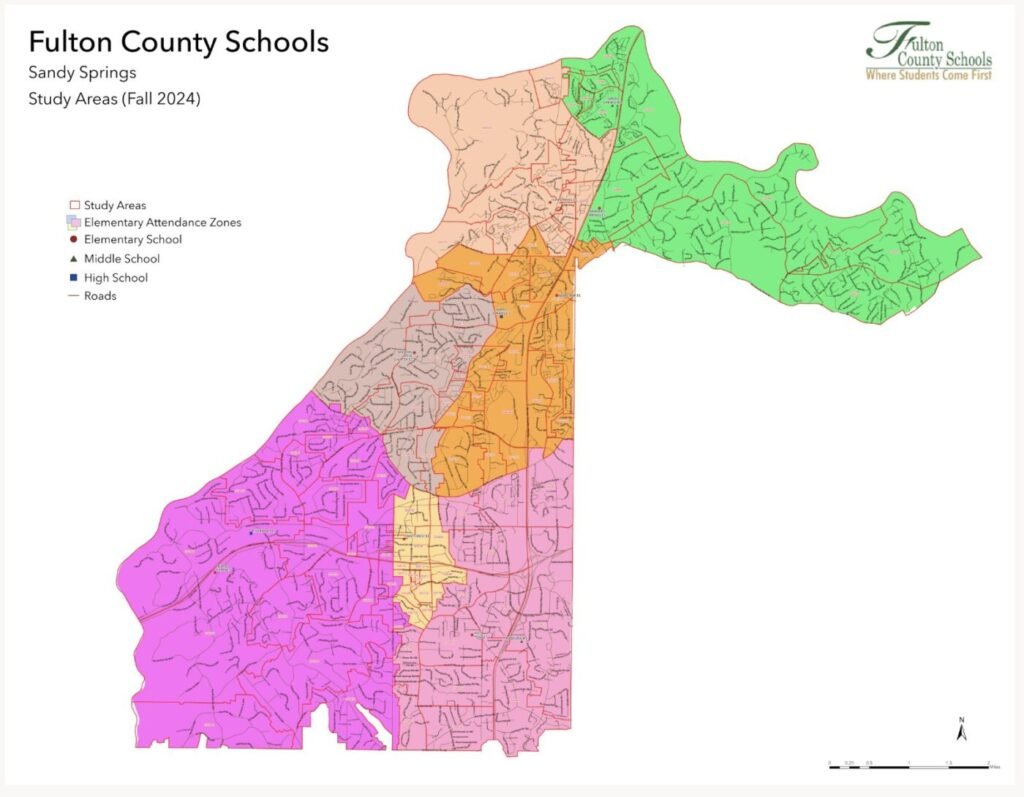
Despite common assumptions, school zoning is not based on city limits, ZIP codes, or real estate listings. Boundaries are drawn by districts using a combination of operational factors.
1. Student Capacity and Enrollment Balance
The primary driver of zoning is capacity.
- Schools are built to serve a specific number of students
- Districts try to keep enrollment within manageable ranges
- When one school becomes overcrowded, boundaries may shift to redirect students elsewhere
This is why brand-new schools or school additions often trigger rezoning nearby — even for established neighborhoods.
2. Geographic Practicality (Not Convenience)
Districts prioritize:
- Road access and traffic flow
- Emergency response routes
- Bus travel times
- Natural barriers (creeks, highways, major roads)
A closer school isn’t always the assigned school if reaching it safely or efficiently is difficult.

3. Long-Term Growth Projections
Both North Fulton and Forsyth County rely heavily on population forecasts.
- Approved housing developments
- Zoning changes at the city or county level
- Birth rate trends
- Historical enrollment growth
Forsyth County, in particular, plans years ahead due to rapid residential expansion.
4. Feeder Patterns
Districts aim for continuity:
- Elementary → Middle → High school groupings
- Keeping cohorts together when possible
However, feeder patterns are guidelines, not guarantees. When enrollment pressure rises, these patterns can be altered.
Why Boundaries Shift Over Time
Many parents assume that once they buy a home, the assigned schools are permanent. In reality, boundary changes are normal, especially in fast-growing areas.
New Schools Change Everything
When a new school opens:
- Nearby neighborhoods may be reassigned
- Existing schools may shrink their zones
- Feeder patterns may be reorganized
Forsyth County has added multiple schools over the past decade, and zoning adjustments often accompany each opening.
Overcrowding Triggers Redistricting
In North Fulton, limited space for new construction means districts sometimes:
- Rebalance enrollment between existing schools
- Adjust lines incrementally rather than build new campuses
These changes are usually subtle — affecting only certain streets or subdivisions — but they can still matter greatly to families.
Policy and Program Changes
Special programs (dual language immersion, STEM tracks, magnet-style offerings) can influence zoning decisions, even if indirectly, by redistributing demand across schools.
North Fulton: Why Zoning Feels Especially Confusing
North Fulton includes multiple cities, overlapping identities, and long-established neighborhoods. This creates unique challenges.
City Name ≠ School Assignment
A home with an Alpharetta address might be zoned for:
- Roswell schools
- Milton schools
- Johns Creek schools
Mailing address is not a reliable indicator.
Older Neighborhoods, New Pressures
Many North Fulton schools were built decades ago, long before current population density. Instead of building new schools, the district often relies on:
- Additions
- Boundary tweaks
- Temporary enrollment caps
This makes zoning feel less predictable year to year.
Forsyth County: Faster Growth, More Frequent Changes
Forsyth County’s growth has been faster and more recent — and zoning reflects that reality.
Countywide Planning, Centralized Decisions
Unlike North Fulton’s city-heavy layout, Forsyth County operates as a more unified system. This allows for:
- Larger rezoning initiatives
- Clearer long-term planning
- More frequent new school openings
However, it also means boundary changes are expected, especially in developing areas of Cumming and west Forsyth.
New Developments Often Trigger Reassignment
If a subdivision is built near a planned school:
- Initial zoning may be temporary
- Families may later be reassigned once the school opens
This is one of the most common surprises for new homeowners.
What Parents Should Actually Check (And When)
Before buying, renting, or even assuming future school assignments, parents should verify information directly.
1. Official District Zoning Tools
Both districts maintain online lookup tools using exact street addresses. These are the only authoritative sources.
- Do not rely on:
- Realtor listings
- Zillow/Redfin school tabs
- Neighborhood Facebook groups
Those sources are often outdated.
2. Current vs. Future Zoning
Ask:
- Is this assignment guaranteed for future years?
- Are rezoning studies underway?
- Is a new school planned nearby?
District board agendas and planning documents often reveal changes well before families notice them.
3. Grade-Level Differences
Some zoning changes affect:
- Incoming kindergarten only
- New middle school transitions
- Specific cohorts
Two families in the same home may experience different assignments depending on timing.
4. Transfer and Variance Policies
Both districts allow limited transfers under specific conditions, but:
- Approval is not automatic
- Transportation is usually not provided
- Policies can change year to year
Transfers should be viewed as exceptions, not planning tools.
Common Myths Worth Letting Go
“This neighborhood has always gone to that school.”
Past patterns do not guarantee future assignments.
“The school is walking distance, so it must be ours.”
Distance alone is rarely decisive.
“The realtor confirmed it.”
Unless verified through the district tool, it’s not confirmed.
“Once enrolled, my child can stay even if boundaries change.”
This depends on the specific rezoning plan — there is no universal rule.
How Families Use This Information Wisely
Experienced local families often:
- Choose homes with multiple acceptable school options
- Focus on adaptability rather than perfection
- Track district planning meetings periodically
- Separate emotional attachment from zoning assumptions
Flexibility matters more than certainty in fast-growing regions.
School Boundary Updates to Know (2026 Snapshot)
As of 2026, there are no large-scale, countywide rezoning plans announced for North Fulton or Forsyth County. That said, both districts remain in active planning mode, and boundary changes tend to appear locally and gradually, not all at once.
Fulton County Schools (North Fulton)
In Alpharetta, Johns Creek, Milton, and Roswell, the district continues to manage enrollment through targeted adjustments rather than broad redistricting. When changes occur, they are typically street-level or neighborhood-specific, often tied to enrollment pressure at individual schools. No systemwide North Fulton rezoning has been formally announced for the 2026–2027 school year, but ongoing monitoring is standard practice.
Forsyth County Schools
Forsyth County remains in a growth phase. Several schools are operating near or over capacity, and the district continues to plan new schools, additions, and future boundary reviews as part of long-term expansion. In Forsyth, boundary changes are most commonly connected to new school openings or major additions, rather than small incremental shifts.
What this means for families:
Boundary changes rarely come as sudden surprises. Discussions usually begin a year or more in advance, with public meetings and draft proposals before anything is finalized. Families in fast-growing areas should expect periodic reviews, even if no immediate change is planned.
This reflects publicly available district planning information as of 2026. Always confirm school assignments using official district address-lookup tools.
New & Planned School Openings (2026 and Beyond)
Forsyth County Schools — Planned & Potential Future Sites
Planned Possibilities (Forsyth)
Forsyth County Schools is actively planning for growth and has identified land for future school construction, though specific school names or opening years have not yet been finalized by the district.
- District officials have identified a 145-acre site in Forsyth County that has been cleared with the intention of future school construction to meet long-term enrollment demand. This land is part of ongoing growth planning, but no official timeline or school designation has been publicly published yet.
New Facilities Through ESPLOST Funding
Forsyth County voters approved and continue to support the education sales tax (ESPLOST), which funds major capital projects, including new school facilities, expansions, and additions across the district. While this funding paves the way for future openings, district planning documents for ESPLOST VII include expansion and construction priorities rather than specific 2026 opening dates.
Summary (Forsyth):
- Future schools are expected based on projected growth and planned facilities sites.
- A large development site has been earmarked for potential future construction.
- ESPLOST funding supports these projects, but official opening dates and school names have not yet been released as of early 2026.
Fulton County Schools — Replacement/Conversion Projects
Fulton County’s Capital Plan (ESPLOST V/Capital Plan 2027)
Fulton County Schools lists several replacement schools and major projects under its current capital planning cycle. These projects are aimed at expanding capacity or modernizing facilities rather than creating brand-new standalone schools — but they may affect zoning when they come online:
- S.L. Lewis Elementary School (replacement) — part of planned capital improvements.
- Camp Creek Middle School (replacement) — designated for student capacity and modernization.
- North Springs High School (facility improvement).
- Haynes Bridge Middle School and Holcomb Bridge Middle School (major updates).
- Palmetto Elementary / K-8 STEAM conversion planning has also been discussed as part of instructional model realignment.
These projects are part of the district’s multi-year plan but do not yet have confirmed opening dates tied to new attendance boundaries for 2026.
Summary (Fulton):
- Fulton County Schools has major renovation and replacement projects planned that may affect capacity and future zoning, but no brand-new school openings are confirmed for 2026 at this time.
- School name changes, conversions, and replacements are part of the district’s capital plan, not immediate 2026 boundary drivers.
What Parents Should Know
Fulton County: Several replacement and major improvement projects are underway under the district’s Capital Plan, and these may eventually influence boundary changes, but no new standalone school openings for North Fulton are scheduled for 2026.
Forsyth County: Land has been set aside and district planning continues for future schools, supported by ESPLOST funding. However, no new school has an officially published opening date for 2026 yet — most projects are still in planning.
Community Voice
A snapshot of reader views, not a scientific survey.
Explore Community Voice →About the Author


In North Atlanta
Free Tuition in North Atlanta: What Families Actually Qualify For (and What’s Not Free)

Private & Faith-Based Schools in North Atlanta: A Guide for Families

Why North Atlanta Suburbs Keep Ranking Among the Wealthiest in Georgia

Before Johns Creek and Alpharetta: The Cherokee and Creek Lands of North Atlanta
Why So Many Neighborhoods in Johns Creek and Alpharetta Are Called “Plantation”
The Landscape Behind the Name: How Johns Creek Got Its Identity
IN NORTH ATLANTA