 Exclusive sponsor
Banks Are Betting Big on North Atlanta’s Growth Corridor
Banks are boosting their presence in North Atlanta, opening new branches and advisory centers to meet the needs of a fast-growing population and economy.

Major local stories and useful updates, once a week.
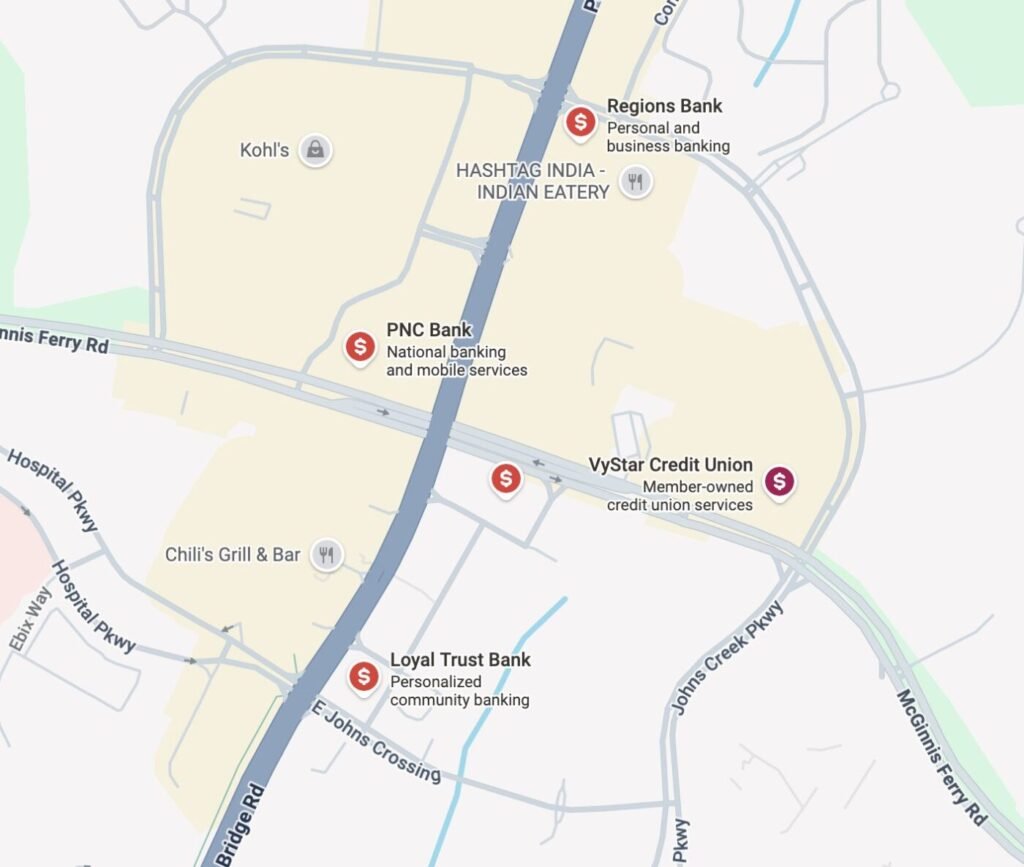
A steady stream of new bank branches, credit union offices, and financial advisory hubs has been appearing across Alpharetta, Johns Creek, and South Forsyth over the past few years. The expansion reflects a deeper shift in how major financial institutions are positioning themselves in one of the fastest-growing parts of the Southeast.
A Competitive Market Backed by Real Numbers
Georgia has become one of the most competitive banking markets in the country, with national institutions competing aggressively for deposits and long-term customer relationships. The scale of these players is striking. JPMorgan Chase holds more than $2.1 trillion in domestic deposits, while Bank of America manages roughly $1.97 trillion, and Wells Fargo about $1.39 trillion.
These institutions are not simply maintaining a presence in Georgia—they are expanding it. JPMorgan Chase alone has committed to a multi-billion-dollar branch modernization strategy, aiming to bring physical locations within reach of 75% of the U.S. population by 2026.
The underlying driver is demographic. Georgia’s population is growing at roughly twice the national rate, creating a steady pipeline of new households, businesses, and investable income.
Why the Focus Is Moving North
That growth is increasingly concentrated along the GA-400 corridor, where suburban expansion continues to reshape the economic map. Alpharetta, Johns Creek, and South Forsyth offer what banks value most: high household incomes, business formation, and long-term residential stability.
Forsyth County provides one of the clearest examples. Consistently ranked among the fastest-growing counties in the United States, it has become a focal point for financial institutions following both population and infrastructure investment.
Recent moves illustrate the pattern. Delta Community Credit Union opened a 7,000-square-foot branch in Cumming, serving more than 3,000 existing members in the area. Meanwhile, Georgia United Credit Union relocated to a redesigned full-service hub focused on financial advisory services rather than traditional teller transactions.
Regional players are also doubling down. Ameris Bank, with approximately $26.6 billion in assets, has targeted the Cumming corridor as part of its Southeast expansion strategy, while Truist Bank continues to build out its presence in suburban markets to capture what it describes as “Premier Banking” customers.
The Branch Is Being Rebuilt, Not Replaced
Despite the dominance of mobile banking, physical branches are not disappearing. They are evolving.
Truist Bank has committed to adding 100 new “insights-driven” branches and renovating 300 more as part of a five-year plan, focusing heavily on high-growth areas like metro Atlanta. These locations emphasize advisory services, with trained specialists handling mortgages, wealth management, and small business lending.
At the same time, JPMorgan Chase is introducing “community center” branches that double as financial education hubs. By the end of 2025, the bank had hosted roughly 14,000 workshops attended by more than 240,000 people nationwide.
The shift reflects a broader reality: while 42% of new customers now join through digital channels, complex financial decisions still require in-person interaction.
A $72 Billion Backbone Few Residents See
Beyond local branches, Georgia plays an outsized role in the national and global financial system. Metro Atlanta’s “Transaction Alley” is home to six of the ten largest payment processing firms in the United States, forming a core piece of the infrastructure that powers electronic transactions worldwide.
Companies such as Global Payments, Fiserv, and NCR Corporation anchor an industry that generates more than $72 billion in annual revenue in Georgia alone.
For North Atlanta, that means more than just jobs. It creates a financial ecosystem where capital, technology, and talent intersect—reinforcing the region’s attractiveness to both residents and businesses.
Bigger Banks, Stronger Regional Players
Consolidation is also reshaping the landscape. The merger between Synovus Financial Corp. and Pinnacle Financial Partners has created a combined institution with approximately $116 billion in assets, headquartered in Atlanta.
The strategy is clear. By scaling up, regional banks aim to compete with national institutions while maintaining the relationship-driven approach that still resonates in suburban markets.
What the Numbers Suggest About What Comes Next
The broader economic outlook supports continued expansion. Georgia’s GDP is projected to grow at around 2.4%, compared to 1.6% nationally, while personal income growth is expected to reach 4.7%.
For banks, those numbers translate into lending opportunities, deposit growth, and long-term client relationships—particularly in high-growth suburban areas.
A Long-Term Bet, Not a Short-Term Trend
The pattern emerging across North Atlanta is consistent: banks are following population growth, but they are also shaping it. Each new branch, advisory center, and financial hub reinforces the region’s role as a key economic corridor.
For residents in Alpharetta, Johns Creek, and South Forsyth, the increase in banking presence is not just about convenience. It reflects a deeper reality—that these communities are now central to how financial institutions see the future of growth in Georgia.
And based on the scale of current investments, that bet is only getting bigger.
Community Voice
A snapshot of reader views, not a scientific survey.
Explore Community Voice →About the Author


In North Atlanta

After Isaias, North Atlanta’s Focus Shifts From Warnings to Repairs

North Atlanta’s Bachelor’s-Degree Gap Reaches 52 Points Across 18 Cities

More North Atlanta Residents Are Working, Yet Unemployment Rose

Sugar Hill Has North Atlanta’s Longest Average Commute

What North Atlanta Should Know Today. Friday, Sept. 11, 2026
North Atlanta’s Retail Divide: Sales Range From $8,909 to $49,222 Per Resident
IN NORTH ATLANTA