Milton Creates a New Power Center for Deerfield’s Transformation
Milton activated a new Deerfield-Focused Development Authority to coordinate redevelopment and public projects in its largest commercial area, aiming for a connected, mixed-use future.
Major local stories and useful updates, once a week.
 Exclusive sponsor
Milton has spent years designing a future for Deerfield. It now has a separate public authority intended to help make that future happen.
The City Council voted Aug. 17 to activate the Deerfield-Focused Development Authority of Milton, creating a new vehicle for coordinating redevelopment, public improvements and private investment in the city’s largest commercial district.
The vote does not approve a particular building, tax break or public expenditure. It begins the process of establishing an authority with powers that ordinary planning committees do not possess—including the ability under Georgia law to acquire property, enter contracts, receive grants and issue revenue bonds.
That makes the decision potentially more consequential than another design plan. It changes not only what Milton wants Deerfield to become, but how the city may pursue that transformation.
North Atlanta Star previewed the authority proposal before the vote. The remaining questions now concern who will govern the new body, what limits Milton will place on its work and which projects it will pursue first.
Deerfield’s office-park model is under pressure
Deerfield developed largely before Milton incorporated in 2006. Its office campuses, commercial buildings and major roads give it a markedly different character from the city’s rural north and historic Crabapple area.
That office concentration once made Deerfield Milton’s economic center. Post-pandemic work patterns have weakened the model.
By October 2024, the district contained more than 550,000 square feet of vacant commercial space, according to the city’s Destination Deerfield overview.
Leaving those properties unchanged creates its own risks. Aging buildings can remain partly empty for years, individual sites can be redeveloped without useful connections to adjoining properties and Milton can lose commercial activity to newer mixed-use districts elsewhere in North Fulton.
The city’s response has been to concentrate much of Milton’s future commercial and higher-density growth in Deerfield while protecting the lower-density character of other areas.
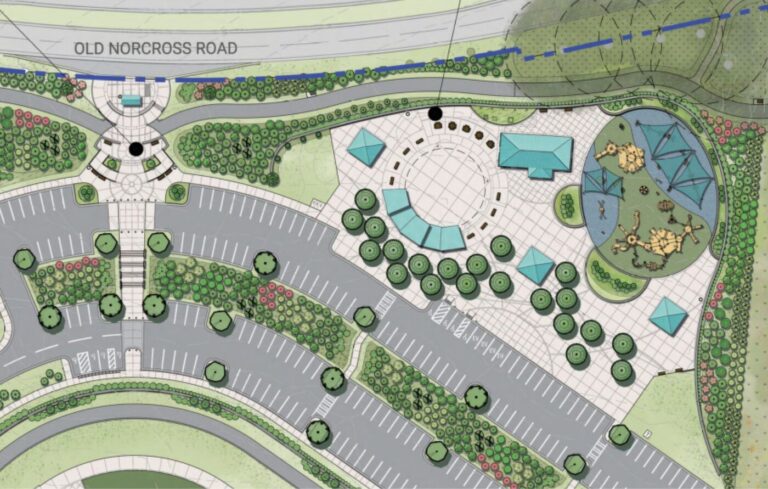
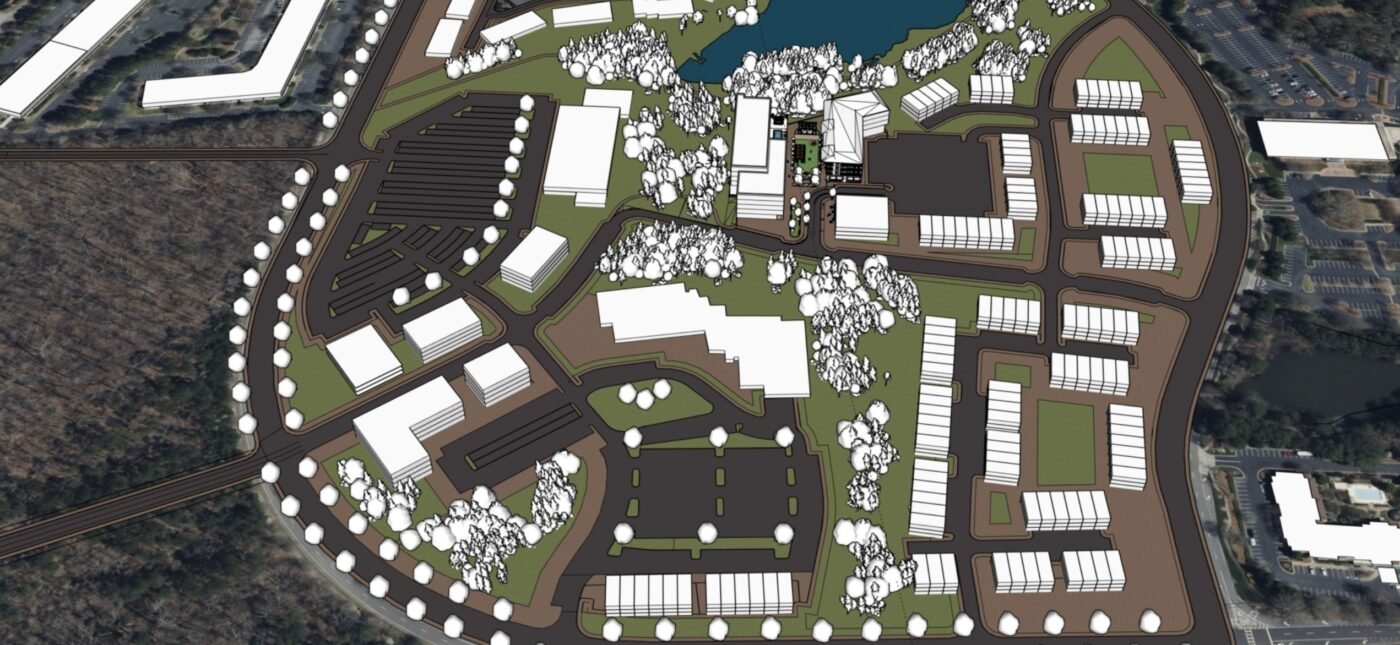
The long-range vision replaces isolated office campuses with a connected district containing workplaces, residences, shops, public spaces and trails. Plans call for expanded sidewalks, internal street and pathway connections, parks, plazas and links toward the Big Creek Greenway.

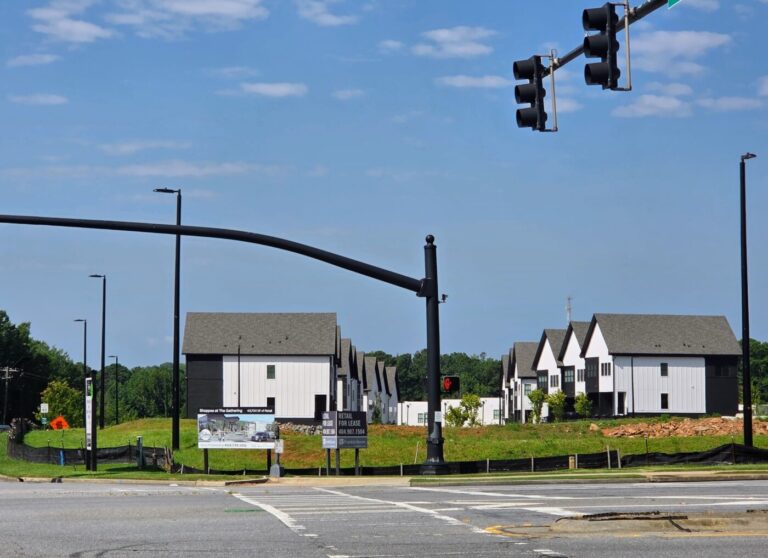
One major mixed-use redevelopment near Morris Road, Webb Road and Deerfield Parkway received city approval in February. Other properties are likely to advance separately over many years.
That piecemeal timing is the reason Milton says another institution is needed.
What the authority can do
A development authority is a legally separate public body—not simply an advisory committee within City Hall.
Under Georgia’s Development Authorities Law, authorities can acquire and improve property, execute contracts, accept grants and finance qualifying projects.
They can also issue revenue bonds. Those bonds are generally repaid from project revenue or property pledged for the financing, rather than automatically becoming ordinary city debt.
Such tools can help assemble land, finance shared infrastructure or negotiate agreements that would be difficult for individual property owners to coordinate.
For Deerfield, the practical use could involve infrastructure crossing property lines: a trail that must continue through several developments, a new street connection, a public plaza or another improvement that no single developer has sufficient reason to build alone.
The authority could also participate in incentive arrangements intended to attract desired investment. Any such proposal would require careful attention because incentives can reduce tax collections or shift part of a project’s financial risk.
Activation alone grants no specific company an incentive. No bond, land purchase or financing package was approved through the Aug. 17 vote.
Why planning rules are not enough
Milton already has a Deerfield Urban Design Manual, related development rules and a multi-stage review process.
Prospective projects must proceed through applicable zoning or use-permit hearings, city review of concept plans, Design Review Board consideration and final land-disturbance and building permits. The city’s current implementation process continues to apply after the authority’s creation.
Those rules can control building design, landscaping, placement and connections. They cannot necessarily solve every financial or property-ownership obstacle.
A trail may be required on one parcel but remain useless until the next parcel redevelops. A desired road connection may cross land controlled by several owners. An empty office building may remain economically difficult to reuse even when the city has adopted an attractive plan for its surroundings.
The authority gives Milton a possible way to work across those boundaries. It could coordinate separate projects around a common public plan instead of waiting for each developer to act independently.

That additional power also makes transparency important. Residents will need to see proposed contracts, property transactions, bonds and incentives early enough to understand who benefits, who assumes risk and what the public receives in return.
The authority is not fully operational yet
The council’s resolution initiates activation; it does not instantly produce a staffed organization with projects ready to begin.
Milton must complete the legal activation process, appoint directors and establish how the authority will operate. Georgia law requires authority directors to be local taxpayers and allows no more than one member of the municipal governing body to serve as a director.
The authority will also need officers, bylaws, meeting procedures and a defined working relationship with city staff. Its board meetings and official actions will become important places for residents to follow Deerfield decisions that may not begin as conventional zoning cases.
City officials have indicated that the body will have a limited Deerfield-focused mission and that the council will retain influence through appointments, staffing and its ability to deactivate the authority.
Those protections will matter more once a specific financing or property proposal reaches the board.
The authority’s first actions will reveal whether it functions mainly as a coordinator, an infrastructure-financing body or an active participant in private redevelopment.
Roads and trails will shape what Deerfield becomes
The authority is only one part of a larger transition.
Georgia’s Highway 9 expansion will alter the district’s primary corridor. Milton is also preparing a more detailed urban-design plan for South Deerfield Parkway and selected Highway 9 properties.

On the same night it activated the authority, the council approved a property settlement connected with extending the Big Creek Greenway Connector from Bethany Bend to Morris Road. The agreement brings the total cost of the parcel to $42,000, according to the Alpharetta-Milton Chronicle’s meeting account.
The city identifies the Highway 9 work and Greenway extension as central pieces of Deerfield’s implementation stage. Without those connections, the district could gain new buildings while remaining a collection of projects separated by wide roads and parking lots.
For residents, the important issue is therefore not simply how many apartments, offices or stores arrive. It is whether the public pieces promised between them—trails, sidewalks, roads, greenspace and gathering places—are completed as redevelopment proceeds.

Milton has now created an organization capable of helping coordinate and finance those pieces. The next test is whether it uses that power to deliver a coherent district rather than a series of individually attractive but disconnected developments.
About the Author

In North Atlanta
Milton Plans Cash Purchase of Verizon Campus, With Decision Likely in November
What Suburban Budgets Reveal About North Atlanta’s Next Phase of Growth
Milton Is Reconsidering How Every Home’s Trash Gets Collected

Gwinnett’s New Blight Tax Could Make Neglected Properties Much More Expensive to Hold

Is Socialism Coming to North Atlanta? The Answer Is More Complicated

Orchid Grove Receives Fresh Demolition Permits Near Duluth
Community Voice
A snapshot of reader views, not a scientific survey.
Explore Community Voice →IN NORTH ATLANTA
Most popular