How Forsyth County Spent Tax Dollars in 2025
Forsyth County’s 2025 budget prioritizes public safety, government operations, parks, and libraries as it manages growth and rising service demands.
Get major local stories and development updates.
Forsyth County’s latest annual report tells a familiar story for one of metro Atlanta’s fastest-growing suburban counties: public safety comes first, growth is expensive to manage, and the services residents notice most — parks, libraries, courts, permits, animal services and senior programs — are all competing for space inside a government budget shaped by population pressure.
The county’s 2025 Annual Report, released in print and digital form, is part year-in-review and part taxpayer ledger. It highlights department projects, county statistics and financial data from a year when Forsyth continued to balance its reputation for relatively low county tax rates with the daily costs of running a larger, busier suburb.
The clearest way to understand the numbers is to look at the county’s General Fund, the main operating account for many core services. For fiscal year 2025, Forsyth County’s adopted General Fund budget was about $215.5 million. On a simplified $100 scale, the county budgeted $36 for public safety, $21 for general government, $12 for culture and recreation, $10 for judicial services, $10 for other financing services, $7 for housing and development, and $4 for health and welfare.
Public Safety Remained the Largest Priority
Public safety was the dominant General Fund category in 2025, with about $77.6 million budgeted. Most of that went to the Forsyth County Sheriff’s Office, which accounted for about $72.8 million by itself. Other public safety costs included ambulance service, animal services, emergency management, the coroner’s office and the public safety radio system.
That spending pattern is not unusual for a growing suburban county. As neighborhoods expand, commercial corridors fill in and traffic increases, the cost of emergency response grows with them. More residents mean more calls, more patrol coverage, more jail and court coordination, more animal-control needs and more pressure on countywide communication systems.
For taxpayers, the takeaway is straightforward: the largest share of county operating property-tax dollars is not going to visible amenities first. It is going to the basic machinery of safety and response.
Government Operations Take the Second-Largest Share
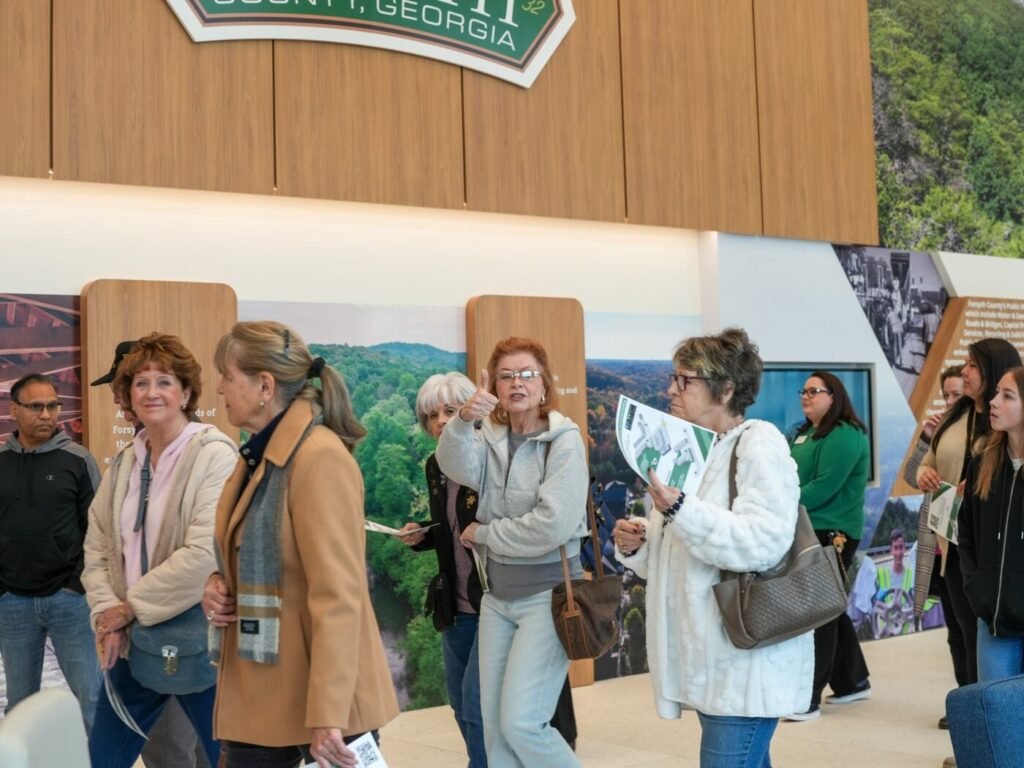
General government accounted for about $44.4 million in the 2025 General Fund budget. That category includes administration, finance, information technology, employment services, public facilities, tax offices, voter registration, procurement and other functions that keep the county operating.
This is the part of local government many residents rarely see directly but rely on constantly. It includes the systems that process payments, maintain buildings, support elections, manage county technology, assess property, collect taxes and handle the administrative side of public services.
In a county like Forsyth, that back-office work is tied closely to growth. A larger county does not simply need more parks or deputies. It needs more capacity to manage records, permits, technology, facilities, staffing and public communication.
Parks and Libraries Are a Major Quality-of-Life Expense
Culture and recreation received about $26.5 million in the 2025 General Fund budget. Parks and Recreation accounted for about $15.9 million, while the library system accounted for about $10.2 million.
That spending reflects one of Forsyth County’s biggest suburban realities. Residents expect a high quality of life, and in a family-heavy county, parks and libraries are not extras. They are part of the public infrastructure that makes the county attractive to homeowners, young families, retirees and businesses.
The annual report also highlights the county’s expanding specialty recreation work, including outdoor recreation and therapeutic recreation programs. That signals a broader shift in how suburban recreation is being understood. Parks are no longer only ballfields, trails and playgrounds. They are also places for wellness, inclusion, outdoor access and community identity.
Courts, Development and Welfare Programs Fill Out the Budget
Judicial services accounted for about $21.2 million in the 2025 General Fund budget, covering courts, the clerk of courts, district attorney, indigent defense, juvenile court, probate court, magistrate court and related functions.
Housing and development spending totaled about $14.9 million. That category includes building and licensing, business licenses, code compliance, planning and community development, park rangers, capital project management and natural-resource conservation services.
Health and welfare made up a smaller share of the General Fund, at about $9.5 million. That included senior services, public transportation, animal services, the pet resource center and related general-government support. These programs may not dominate the budget, but they often touch residents at more personal moments: aging, mobility, animal care, transportation needs and support services.
A Low Rate Does Not Mean No Pressure
Forsyth County’s 2025 combined county millage rate was 7.896 mills. The county has described its millage rates as among the lowest in metro Atlanta.
But the tax picture is more complicated than the rate alone. Forsyth County reported tax digest growth of 9.54%, with 3.46% tied to new construction and 6.08% tied to reassessments. That means the county can collect more overall revenue even when the headline rate remains steady. For individual homeowners, the final bill depends on property value changes and homestead exemptions.
Growth brings new revenue, but it also brings new costs. New homes, subdivisions and commercial areas add to the tax base, but they also increase demand for roads, public safety, planning, parks, courts and administrative capacity.
What the Annual Report Really Shows
The 2025 Annual Report is best read as a growth document. It shows a county trying to preserve the appeal that brought residents there in the first place while paying for the services that appeal now requires.
The largest dollar amounts are not surprising. Public safety leads. General government follows. Parks and libraries remain substantial. Courts, development services, senior programs, transportation and animal services fill out the picture.
For South Forsyth residents, especially those living along the GA-400 corridor, the McGinnis Ferry area, Windermere, Vickery and the fast-growing edges of Cumming, the numbers help explain what local government is actually buying. It is buying deputies and dispatch capacity. It is buying parks, libraries and senior programs. It is buying permit review, code compliance, court operations and the administrative systems needed to manage a county that no longer feels small.
The broader question is not whether Forsyth County is spending money. Every growing county is. The more useful question is whether the spending is keeping up with the pace and shape of growth. In 2025, Forsyth’s budget shows a county still leaning heavily on public safety while trying to maintain the amenities and systems that make suburban growth manageable.
If this felt close to home, these stories may be worth your time too.
About the Author

In North Atlanta
Forsyth Added Jobs. Its Wage Growth Ranked Last Among Georgia’s Large Counties

Maepole Is Coming to West Forsyth With a First-of-Its-Kind Drive-Thru
South Forsyth Roads and Development Take Center Stage at Forsyth County Meeting
5 Coffee Trucks and Mobile Cafés Worth Finding Around North Atlanta
Simple Man Distillery Hiring Ahead of Cumming City Center Opening

North Atlanta’s NHL Race Is No Longer Just Alpharetta vs. South Forsyth
IN NORTH ATLANTA