Who Fixes North Atlanta’s Potholes? It Depends on Who Owns the Road
Pothole repairs in North Atlanta depend on whether the road is managed by the state, county, city, or a private group. Knowing who owns the road helps direct service requests to the right agency quickly.
Get major local stories and development updates.
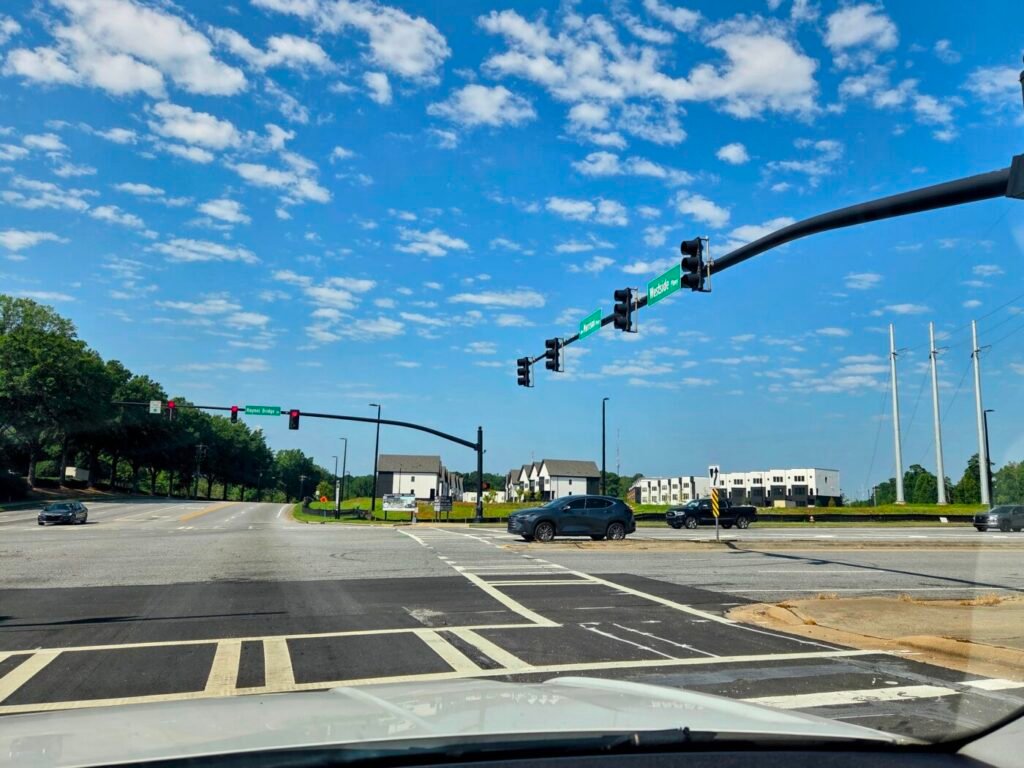
The pothole does not care whether it is in Alpharetta, Johns Creek or South Forsyth. The repair crew does. A street can run through a city without belonging to that city. Another may look public but remain privately maintained by a homeowners association. Major corridors can change names several times while remaining part of the same state highway.
The government responsible for the pavement—not the mailing address or city-limit sign—determines where a repair request belongs.
Start with the road, not the city
North Atlanta’s streets generally fall into four groups: state highways, county roads, city streets and private roads.
| Road type | Best first contact | Common local examples |
|---|---|---|
| State highway | Georgia Department of Transportation | Ga. 400, Ga. 9, Ga. 20, Ga. 120, Ga. 140 and Ga. 141 |
| County-maintained road | County transportation or road department | Public roads in unincorporated Fulton, Forsyth and Gwinnett |
| City-maintained street | City public works department | Most public neighborhood streets inside incorporated cities |
| Private street | HOA, developer or property owner | Some gated communities, apartment developments and private subdivisions |
The name on a road sign is not always enough to settle the question. Old Milton Parkway in Alpharetta is also Ga. 120. Peachtree Parkway and Medlock Bridge Road carry Ga. 141 through different parts of the region. Alpharetta Highway and portions of Main Street are part of Ga. 9.
Those numbered routes remain part of the state highway system even when they pass through an incorporated city. GDOT controls the pavement and larger maintenance decisions, although local governments may handle certain work through agreements with the state.
Drivers can use GDOT’s maintenance contact system for potholes, damaged signs, signal trouble, debris and other problems on state routes. The department’s highway maps can also help determine whether a familiar local road carries a state designation.
Cities handle many streets—but not every street inside their limits
Turn from a state highway into an ordinary public subdivision, and responsibility usually shifts to the local government.
Johns Creek accepts requests for potholes and malfunctioning signals through Public Works. Alpharetta uses SeeClickFix for potholes, graffiti and other nonemergency problems. Roswell residents can submit a location and photograph through the city’s service-request system, while Milton provides a similar online reporting tool.
Suwanee and Duluth maintain their own city streets as well. Both accept direct reports for pavement damage through their public works departments.
But a city address does not prove that the city owns the road. A state route remains a state route inside municipal boundaries, and some streets may belong to another public agency or remain private.
That is why a city may close a request with instructions to contact GDOT, a county or an HOA. It does not necessarily mean the problem was ignored; it may have reached the wrong owner.
County crews cover thousands of miles
Outside incorporated cities, road maintenance generally falls to the county unless the street is state-owned or private.
Forsyth County’s Roads and Bridges division maintains approximately 1,200 miles of asphalt roads. Its work includes pothole repairs, deep patching, roadside drainage, mowing and coordination of larger resurfacing projects. Residents can send the location through the county’s problem-reporting page or contact Roads and Bridges directly.
Gwinnett accepts pothole and sidewalk requests through Citizen Self Service. The county evaluates pavement across its road network and gives resurfacing priority to streets with the lowest condition scores.
That helps explain why a crew may patch one hole without repaving the entire road.
Patching is intended to address a specific failure in the pavement. Resurfacing is a larger, more expensive project that can require milling, drainage work, utility adjustments, fresh asphalt and new markings. Gwinnett generally prioritizes roads scoring 55 or lower on its 100-point pavement scale, while streets in better condition receive repairs until a future evaluation.
A patched road may still be rough. It simply has not deteriorated enough—or ranked high enough against other streets—to receive a full overlay.
Some streets belong to the neighborhood
Private roads create the most frustrating calls because no public works department is responsible for fixing them.
A street may remain private when it serves a gated subdivision, apartment community or development whose roads were never accepted into a government road system. Maintenance then falls to the owner, developer or homeowners association.
Georgia law prevents counties from using public road crews to maintain private streets. An HOA may need to collect dues or levy a special assessment before repairing extensive pavement damage.
Homeowners can check their subdivision plat, closing documents or HOA covenants when ownership is uncertain. A gate is a strong clue that the road is private, but it is not the legal test. Some ungated communities also contain privately maintained streets.
A pothole report needs more than a street name
A useful report gives crews the precise location: the nearest address or intersection, direction of travel and lane. A photograph can help when it can be taken safely.
“Pothole on Peachtree Parkway” leaves miles of road to search. “Northbound right lane of Peachtree Parkway just south of McGinnis Ferry Road” gives a crew a workable location.
Reports should also distinguish a pavement hole from a broken utility cover, water leak, fallen power line or blocked travel lane. The first agency contacted may need to involve a water provider, electric utility or another government.
Immediate dangers belong in a different category. A crater forcing vehicles into oncoming traffic, a tree blocking the roadway or a signal that has gone completely dark can require an emergency response. Drivers should call 911 when the condition presents an immediate threat rather than waiting for an online work order.
For an ordinary pothole, the quickest route to a repair begins with one question: Who owns the road?
The answer may be the state, a county, a city or the neighborhood itself. Finding the right one can save a repair request from spending days traveling between governments while the hole remains exactly where it was.
If this story caught your attention, here are a few more local reads worth your time.
About the Author


Good Friend Mortgage
Good Friend Mortgage has spent 21 years turning hopes into homes. With unmatched service, expert guidance, and a dedication to your future, we make...
Notice an update, correction, or detail we should include? Tell the editor. Seen something new around you? Send us a local tip.
Most Popular
 A $5.8 Billion Steel Mill Is Coming to Louisiana. The Average Job Is Expected to Pay $95,000Business & Development
 Siemens’ Alpharetta Rail Operation Is Hiring From $20 an Hour to $95,000 a YearBusiness & Development