Exclusive sponsor
Your Neighbor’s Tree Fell on Your House. Who Pays in Georgia?
Georgia law treats storm-downed trees as accidents unless prior knowledge of danger is proven. Homeowners should contact insurers promptly and document damage carefully to handle liability and cleanup.
Major local stories and useful updates, once a week.
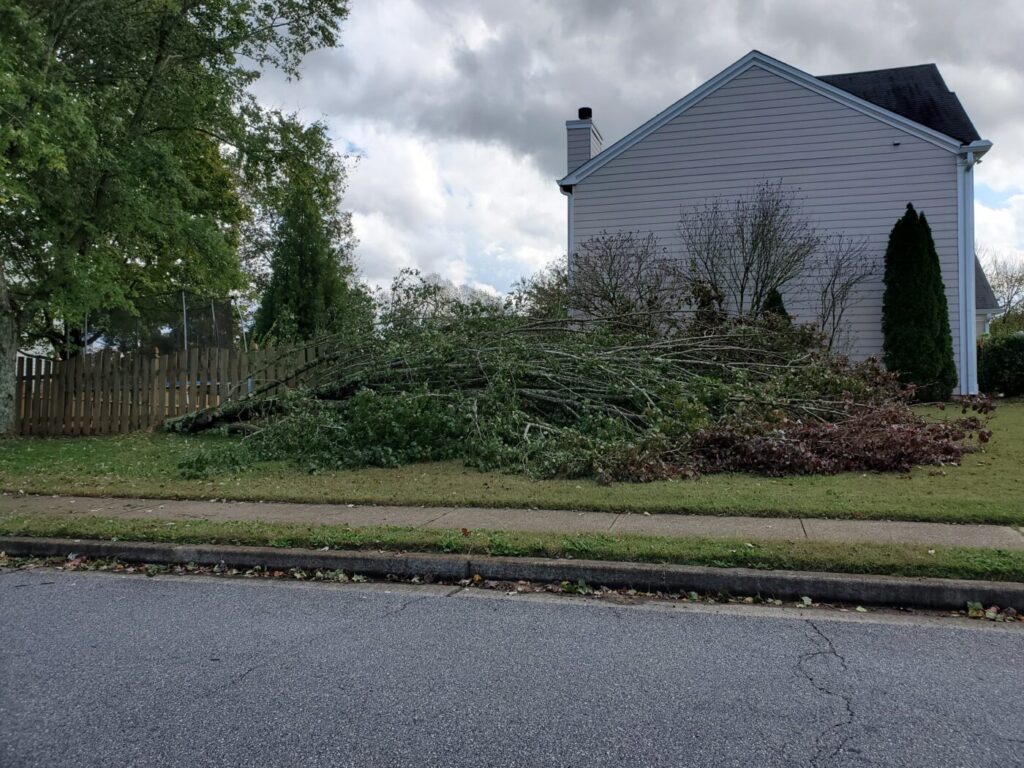
A tree crossing a property line during a storm does not automatically send the bill to the person who owned it.
In Georgia, responsibility usually depends on the tree’s condition before it fell, what its owner knew and which property suffered the damage. That distinction is especially relevant after Hurricane Isaias brought down trees and power lines across North Atlanta.
A storm does not automatically make the tree owner liable
Georgia generally treats a healthy-looking tree brought down by severe weather as an accident rather than negligence.
The tree’s owner may be responsible when that person knew, or reasonably should have known, that the tree was diseased, decayed or otherwise dangerous before it fell. Without that prior warning, the owner is generally not at fault merely because the trunk stood on the owner’s property.
The state does not impose a routine inspection schedule on residential tree owners. A homeowner is not automatically negligent for failing to hire an arborist every year.
That means a large tree that appeared healthy before being uprooted by extraordinary wind is different from a dead tree that had been leaning toward a neighbor’s house for months.
The University of Georgia’s guidance on tree responsibility identifies prior knowledge as the central liability question.
The first insurance call usually follows the damage
If the tree lands on your house, garage, fence or another insured structure, contact your own insurance company promptly. Do not wait for the neighbor and the neighbor’s insurer to decide who may be responsible.
A standard homeowners policy generally covers damage caused by windstorms, although the deductible, limits and exclusions depend on the individual contract. The policy may also distinguish between repairing a covered structure and removing a tree that fell harmlessly in the yard.
Georgia’s insurance regulator advises property owners to document storm damage and contact their insurer before permanent repairs begin. Temporary work needed to prevent additional damage, such as covering a damaged roof, may be appropriate, but photographs should be taken first and every receipt should be saved.
If evidence later shows that the neighbor ignored a known hazard, your insurer may pursue reimbursement from the responsible party or that party’s insurer. That process should not delay the initial claim.
Damage caused by rising or surface floodwater is different. Standard homeowners policies generally exclude flooding, even when the flood follows a hurricane or tropical storm. Separate flood insurance is required for that loss.
Prior warning can change the outcome
A dispute often turns on what can be proved about the tree before it fell.
A dated letter or email warning the owner about a dead, leaning or visibly damaged tree can help establish prior notice. So can an arborist’s assessment, photographs showing deterioration or previous reports from tenants, neighbors or an homeowners association.
A complaint alone does not automatically prove that the tree was dangerous or that its owner was negligent. An arborist’s professional evaluation carries more weight than a general statement that a tree looks tall, old or frightening.
Residents concerned about a neighboring tree should identify the specific problem, communicate in writing and retain copies. If an inspection finds a serious defect, both households then have a clearer basis for deciding what work is needed and who should arrange it.
Waiting until after the tree falls makes knowledge and condition much harder to reconstruct.
The trunk determines ownership
Tree ownership follows the location of the trunk, not the direction of the branches, roots or falling debris.
A trunk entirely within one parcel belongs to that property owner. A trunk growing directly on the boundary can create joint ownership, making removal or major work a decision for both property owners.
A neighbor may generally trim branches extending over the property line, but the work should not unnecessarily damage or kill the tree. UGA recommends discussing the work with the owner and obtaining professional advice before cutting substantial limbs.
Property lines are not always where fences, landscaping or residents assume they are. When ownership is genuinely disputed, a property survey may be necessary.
Cleanup and liability are separate questions
The party legally responsible for an unsafe tree is not always the party who must arrange the immediate cleanup.
A tree lying across two yards may require both households to coordinate access, contractors and insurance inspections. A tree touching electrical lines should not be approached by either homeowner. Downed or low-hanging wires should be treated as energized and reported to the utility or 911 when they present an immediate danger.
Residents should also avoid cutting storm-damaged trees without the proper experience. Bent trunks and suspended limbs can hold enough pressure to move suddenly when cut.
Before hiring a tree service, request proof of liability insurance and workers’ compensation coverage. An uninsured crew injured on private property can create another dispute after the original storm damage.
Storm-repair contracts deserve extra scrutiny
Storm damage attracts contractors who travel through affected communities offering immediate tree removal, roofing and repair work.
Georgia’s storm-repair fraud guidance advises homeowners to avoid unsolicited door-to-door offers, obtain several written bids and reject contractors demanding full payment in advance or cash only.
Tree removal companies are not licensed by Georgia in the same way as electricians, plumbers and general contractors. Homeowners can still verify professional arborist credentials, request local references and insist on written terms covering the work, cleanup and payment schedule.
Georgia law also gives homeowners additional protections for certain repair contracts signed within a year of a natural disaster. If an insurer later determines that all or part of the work is not covered, the homeowner may have a limited right to cancel after receiving that decision. The required cancellation notice should be included with the contract.
The practical order is straightforward: make the area safe, photograph the damage, notify the insurer and then obtain written estimates. Questions about who ultimately bears the cost can be resolved after people, pets and structures are out of danger.
Community Voice
A snapshot of reader views, not a scientific survey.
Explore Community Voice →About the Author


In North Atlanta
Gwinnett’s New Blight Tax Could Make Neglected Properties Much More Expensive to Hold

What North Atlanta Should Know Today
What North Atlanta Should Know Today

Forsyth Property Assessments Are Arriving. Here’s What Homeowners Should Check
Is Socialism Coming to North Atlanta? The Answer Is More Complicated
What Suburban Budgets Reveal About North Atlanta’s Next Phase of Growth
IN NORTH ATLANTA