SpaceX Caught Starship at Its Texas Tower for the First Time. The Booster Was Lost.
SpaceX successfully caught its Starship spacecraft using the Texas launch tower’s mechanical arms after a 22-hour orbit. Yet, the accompanying booster was lost over the Gulf of Mexico. This milestone marks a big step toward reusable spaceflight.
Get the week’s jobs, development, housing and growth stories from across the Sun Belt in one email.
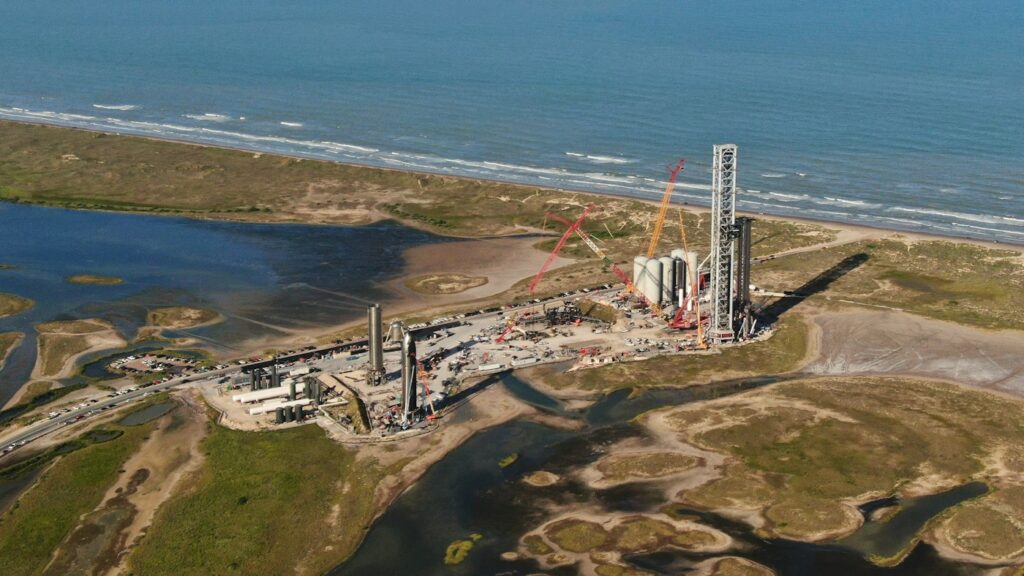
For the first time, a spacecraft returning from orbit has been caught in midair by the mechanical arms of its launch tower. SpaceX accomplished the maneuver Saturday, November 14, at Starbase in South Texas, bringing its Starship upper stage home after more than 22 hours in space.
The ending was extraordinary, but the mission was not a complete success. The Super Heavy booster that launched Starship on Friday failed to make its planned return to the same tower. Instead, it diverted over the Gulf of Mexico and was destroyed.
The contrasting outcomes of Starship Flight 15 leave SpaceX with a major achievement and a major question: Can it turn a dramatic first catch into a reliable system that recovers both stages, refurbishes them quickly and flies them again?
Fourteen trips around Earth, then a catch
Starship lifted off Friday, November 13, at 4:47 p.m. Central time. The two-stage rocket separated as planned, and its upper-stage spacecraft continued into orbit, deploying 26 next-generation Starlink satellites before making 14 trips around Earth.
On Saturday afternoon, the spacecraft fired an engine to begin its return. It then descended through Earth’s atmosphere, endured the intense heat of reentry and maneuvered back toward the tower near Boca Chica. At about 3:20 p.m. Central, Starship turned upright, fired its engines to slow its descent and settled into the tower’s two enormous catching arms.
SpaceX had planned Flight 15 as its first attempt to bring both stages back to the launch site. Its 171-foot spacecraft was the harder new recovery challenge: the company had previously caught Super Heavy boosters, but it had never caught Starship itself after an orbital flight.
Saturday’s recovery followed a roughly 22½-hour flight and offered a striking demonstration of the control required to return a spacecraft from orbital speed to an exact position above a launch pad. The Associated Press reported that the stainless-steel vehicle appeared intact after the catch, with the tower holding it above the ground.
Why the booster did not come home
The booster failure began much earlier in the mission. Super Heavy separated from the spacecraft and started its return toward Starbase, but the flight computers detected that the vehicle was not in the correct condition or position to proceed with a tower catch. It was redirected to a contingency landing area offshore.
SpaceX initially discussed a possible guidance issue. Later updates pointed to a low-fuel-mass alarm and a return burn that ended early. The guidance system appears to have recognized the problem and carried out its programmed diversion, rather than causing the initial failure. The booster was destroyed near the water’s surface, and engineers are still investigating why the return sequence fell short.
The distinction matters. Space.com’s account of the aborted booster catch traces the company’s changing explanation as engineers reviewed the flight. A loss during a test is not unusual for Starship’s development program, but a fully reusable launch system must be able to recover the lower stage as routinely as the upper one.
Catching a spacecraft is not the same as flying it again
Starship is intended to work differently from conventional rockets. Instead of throwing away a rocket stage after each mission, SpaceX wants to retrieve the hardware, inspect it, prepare it and launch it again with as little delay as practical.
Saturday’s catch establishes that the upper stage can return to its launch site and be supported by the tower. It does not yet establish that the same spacecraft can fly another mission without extensive repairs. Engineers must examine the heat shield, engines, flaps, structure and other systems for damage from launch and reentry.
That is especially important for the heat shield. The spacecraft travels through the atmosphere at enormous speed, producing temperatures capable of damaging its protective tiles and surrounding surfaces. Even a successful landing can leave behind work that prevents the quick turnaround SpaceX is pursuing.
Reuters reported that the return was a major step toward full reusability while noting the remaining refurbishment and recovery challenges.
Why the result matters beyond Texas
The progress is significant for SpaceX’s satellite business, which increasingly depends on delivering larger payloads to orbit. It also matters to NASA. Starship is part of the agency’s Artemis plans to carry astronauts to the lunar surface, though lunar missions will require additional demonstrations, including transferring propellant between spacecraft in orbit.
A successful tower catch does not resolve those challenges or establish a new lunar landing date. It does, however, remove one technical uncertainty from a program that has yet to demonstrate a fully reusable launch from start to finish.
SpaceX is also preparing to expand Starship operations to Florida, linking the South Texas test program more directly with the country’s established space-launch corridor.
For now, the defining image of Flight 15 is a spacecraft suspended above the Texas coast in the arms of the tower from which it departed. The mission proved that Starship could come all the way back from orbit. The next milestone is less theatrical but more important for the program’s future: showing that it can do so repeatedly, with both stages intact and ready to fly again.
Community Voice
A snapshot of reader views, not a scientific survey.
Explore Community Voice →About the Desk

Across the Sun Belt

Texas Wins Largest Rural Health Award as States Face a Bigger Test

Texas Cities See New Leverage on Housing, Transit and Local Control
Texas Built a New Rural Hospital. It Couldn’t Afford a Place to Deliver Babies
North Texas Is Opening a Third Commercial Airport. Voters Rejected the Original Plan

A $950 Million Solar Factory Plan Could Turn a Texas Campus Into a Domestic Supply Hub