 Exclusive sponsor
Sprouts Is Following Sun Belt Growth Into the Next Ring of Suburbs
Sprouts Farmers Market is growing beyond major metros, opening new stores in fast-expanding Sun Belt suburbs. This trend signals how suburban growth is attracting specialty retailers.
Get the week’s jobs, development, housing and growth stories from across the Sun Belt in one email.
Sprouts Farmers Market is opening stores at a pace that offers an unusually clear map of where suburban America is growing.
In Texas, new stores have recently opened in Waco and Weatherford, with The Woodlands scheduled for Sept. 12 and Waxahachie for Oct. 30. In Arizona, Sprouts opened stores this summer in fast-growing Buckeye and at CityNorth in Phoenix, with another Mesa location scheduled for Sept. 18.
More are coming to Clarksville and Smyrna, Tennessee; Concord, North Carolina; and several other communities across the South and Southwest.
The pattern is not simply Sun Belt expansion. Sprouts is increasingly moving into places that spent the past several years adding houses and residents and are now attracting the retail that follows them.
That makes a new grocery store something more than another opening.
It can be a sign that a growing suburb has reached its next stage.
Forty-two more stores in one year
Sprouts had 490 stores in 25 states at the end of June, after opening seven during the second quarter. The Phoenix-based company expects to add 42 net new stores during 2026.
That follows 37 new stores in 2025, when the chain ended the year with 477 locations.
The expansion is continuing even as shoppers have become more cautious.
Sprouts reported $2.3 billion in second-quarter sales, up 5% from a year earlier, but sales at stores open at least a year fell 1%. For the full year, the company expects comparable-store sales to range from a 0.5% decline to a 0.5% increase.
In other words, Sprouts is not relying entirely on existing stores selling dramatically more groceries.
It is still putting new stores in new places.
And many of those places are familiar names on the Sun Belt growth map.
Buckeye nearly doubled in 15 years
Consider Buckeye, Arizona.
Sprouts opened there this summer in Verrado, one of the major master-planned communities west of Phoenix.
Buckeye had 50,876 residents in 2010.
By 2020, it had more than 91,000.
The Census Bureau estimates that the population reached 125,445 in 2025 — a 37% increase in just five years.
Retail tends to lag residential growth. Houses can appear quickly, while supermarkets, restaurants, medical offices and other daily services take longer to follow enough households to justify a location.
That makes Buckeye almost a textbook example of the progression.
First come subdivisions and families.
Then come the businesses built around serving a population that is no longer small or temporary.
Sprouts is also adding another Mesa store this month, while its new Phoenix flagship at CityNorth opened in July alongside the company’s new corporate headquarters. The CityNorth store anchors a larger development with restaurants and other retail.
The company is expanding outward and investing heavily at home at the same time.
South of Dallas, Waxahachie is changing quickly
The same pattern is visible outside Dallas.
Sprouts plans to open in Waxahachie on Oct. 30 at the intersection of Highways 77 and 287.
Waxahachie had 41,140 residents in the 2020 Census.
By 2025, its population was estimated at 50,090 — growth of almost 22% in five years.
For decades, communities like Waxahachie sat beyond the primary suburban ring of major Texas cities. Today, population growth is pushing the economic geography of Dallas-Fort Worth farther outward.
People can move farther from central Dallas for newer homes, more space or lower prices. Retailers eventually follow that purchasing power.
Sprouts joins a much broader wave of grocery, restaurant, medical and service businesses moving into communities that once felt distinctly separate from the metropolitan core.
Weatherford, west of Fort Worth, offers another example. Sprouts opened there July 31, just off Interstate 20.
The common feature is not simply geography.
It is a growing population with enough households to support a specialized grocery concept.
Tennessee is another growth front
Sprouts’ next Tennessee opening is scheduled for Oct. 23 in Clarksville, northwest of Nashville.
Clarksville has grown from 166,722 residents in 2020 to an estimated 188,829 in 2025, an increase of more than 13%.
The store will sit near Interstate 24 and Martin Luther King Jr. Parkway. Construction began earlier this year on a development that also includes additional retail space.
Another Sprouts is coming to Smyrna, southeast of Nashville, and the company is preparing a location in Concord, North Carolina, outside Charlotte. Hiring is already underway for both.
Concord itself has grown from about 105,000 residents in 2020 to an estimated 114,598 in 2025.
These are not remote towns disconnected from metropolitan economies.
They are the communities increasingly absorbing the population growth around some of the Sun Belt’s strongest cities.
Why a Sprouts is different from another supermarket
Sprouts occupies an interesting position in the grocery business.
It is not trying to duplicate a Walmart Supercenter or a conventional neighborhood supermarket.
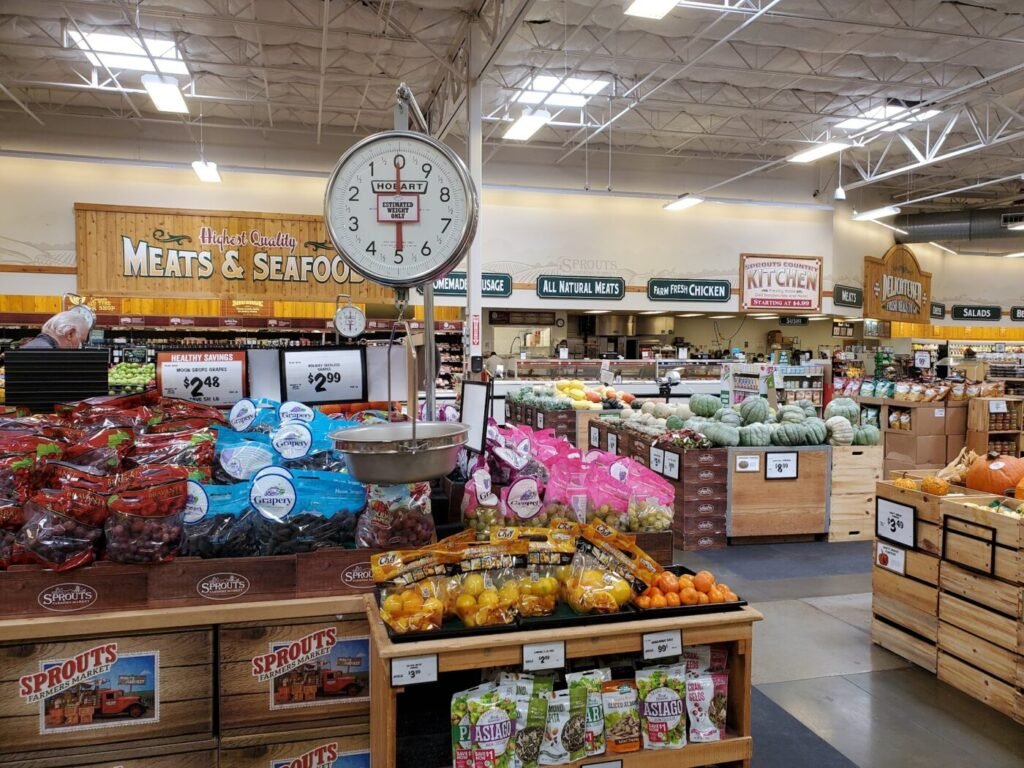
Its stores emphasize produce, organic foods, supplements, specialty diets and smaller brands, with a customer base built partly around health and wellness.
That makes its expansion useful as a measure of something beyond population alone.
A community needs enough people to support a grocery store.
A specialty grocer also needs enough of the right shoppers.
That often means households with discretionary income, interest in health-oriented products and enough density within a manageable drive of the store.
For a fast-growing suburb, attracting this kind of retailer can therefore mark a transition.
The place is no longer simply somewhere people are moving because houses are available.
It is becoming a complete consumer market of its own.
Growth is moving farther out
For much of the past generation, Sun Belt growth was described through major metros: Phoenix, Dallas, Austin, Nashville, Charlotte, Atlanta and Orlando.
Increasingly, the more revealing names are one step farther down the map.
Buckeye.
Waxahachie.
Clarksville.
Concord.
Weatherford.
These communities differ enormously, but they share a position on the outer edges of metropolitan growth.
Many have spent years adding subdivisions and residents. Now they are adding the kinds of businesses that allow people to shop, eat, work and spend more of their lives without traveling back toward the urban core.
Sprouts is hardly alone in following that movement.
But its plan to add 42 stores this year makes the chain a particularly visible marker of it.
Even during a year when consumers are watching their spending and sales growth at established stores has cooled, Sprouts is continuing to plant new locations across the country.
A remarkable number of them are landing exactly where the Sun Belt has been planting new households.
If you’ve been following growth and change around here, these stories are worth a look too.
Community Voice
A snapshot of reader views, not a scientific survey.
Explore Community Voice →About the Desk

Across the Sun Belt

How 4.5 Million Border Migrants Reshaped the Sun Belt’s Population Map

The Sun Belt’s Battery Belt Is Losing Jobs as EV Factory Plans Shrink and Shift

Phoenix Can Survive the Colorado River Cuts. The Water Fix Won’t Be Cheap

Elon Musk Is Building Something Close to a Company Town on the Louisiana Coast

A Tiny Texas Community Is Becoming a $1.2 Billion Data Center Hub