A Fulton Teacher’s 1915 Contract Offered $50 a Month. Marriage Meant Resignation.
Addie Cash’s $50-a-month teaching contract reveals why Fulton County women could lose their jobs for marrying, and how teachers fought to end the rule.
Major local stories and useful updates, once a week.
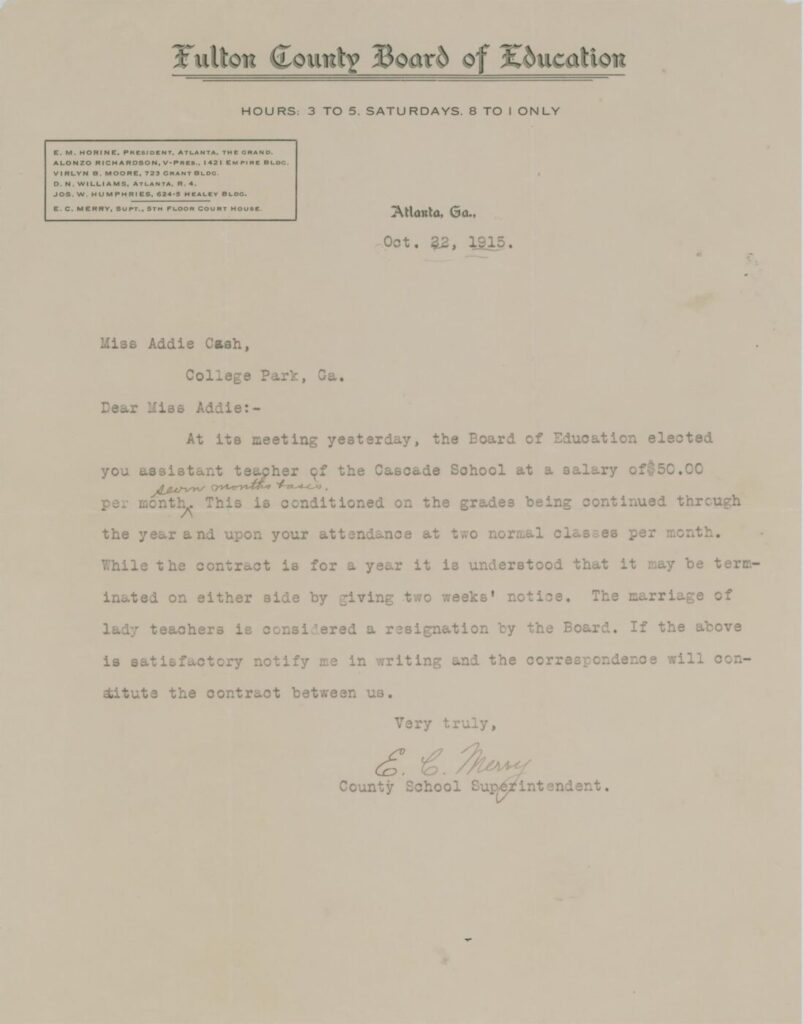
The letter offered Addie Cash a teaching job at $50 a month. A few lines below the salary, it set a condition on her private life.
“The marriage of lady teachers is considered a resignation by the Board.”
Fulton County Schools Superintendent E. C. Merry sent the letter on October 22, 1915, appointing Cash an assistant teacher at Cascade School. She would need to attend two training classes each month. Either side could terminate the contract with two weeks’ notice.
More than a century later, the document survives in the Fulton County Schools Archives, now housed at the former Spalding Drive Elementary School in Sandy Springs.
A rule the board chose to keep
Why should a wedding have anything to do with a teacher’s job? Fulton’s archive history traces the rule to the belief that a married woman belonged at home, caring for her family rather than pursuing a career. Women could marry, but the school system could make them give up their jobs for doing so.
Fulton was far from alone. Across the country, school boards and other employers imposed restrictions known as marriage bars. During the Great Depression, they spread further under the argument that scarce jobs should go to “breadwinners,” economic historian Claudia Goldin explains. The assumption behind that national argument was that a husband would support his wife. Fulton’s rule was already in Cash’s contract in 1915, well before the Depression.
Fifteen years after Cash received her letter, the board was still insisting on the restriction.
On May 27, 1930, the Fulton County Board of Education met to select teachers for the coming school year. Members discussed whether to retain teachers who had married during the current year, then voted unanimously to keep the rule and “enforce it rigidly,” according to minutes supplied by district archivist Michael Santrock.
Even the superintendent could not secure an exception for one teacher. She had lost her position after marrying, then been re-employed. When he asked the board to keep her, it refused.
The board left married teachers one narrow opening: substitute or emergency work. They could finish an unexpired term when a vacancy arose, but they would not be retained afterward.
Santrock, the district’s archivist and museum collections manager, said in written responses to North Atlanta Star that he has not established when Fulton first adopted the rule. His research suggests it was enforced most heavily from the years after World War I through the 1930s.
A teacher who refused to sign
Marie Long had taught at Center Hill Elementary School for 13 years when she refused to sign a contract containing the marriage rule in the summer of 1937. She had no plans to marry. She objected to the restriction itself.
After the district dismissed her, Long challenged the board in court. Her case, Marie Long v. Jere A. Wells, et al., helped rally other teachers against the policy, according to the district archive’s detailed history.
The fight continued into 1938. That October, representatives of the teachers association and the board agreed to bring another case to settle the dispute. By January 1939, the rule had been removed from employee contracts, according to that account.
The career behind the contract
Cash went on to spend decades in Fulton’s schools, teaching children and serving as principal at E. P. Howell and Ben Hill. In 1951, she listed 37 years of teaching experience, beginning with a year in Berrien County before she joined Fulton.
Her family’s connection to Fulton education reached back to the district’s beginnings. Her father, John H. Cash, was among its first 13 teachers in 1871. Her sister Pauline also became a principal.
The Cash family collection preserves more than employment records. It includes student notebooks, family history and wartime savings documents, along with contracts and certificates spanning generations.
Santrock has not found paperwork identifying who donated the family’s papers. Much of the collection has yet to be digitized.
The $50 salary still catches students’ attention, Santrock said. One or two teachers who have discussed the letter with him told him that students tend to notice the pay first and miss the marriage clause until an instructor points it out. Then the discussion opens up.
The clause takes just one sentence, tucked between a notice requirement and instructions for accepting the job. Fulton offered Cash a place in the classroom while reserving the right to remove her for a decision about her life at home. More than 20 years later, other teachers would force the district to abandon the rule.
North Atlanta Star thanks Michael Santrock, Amanda Hilliard Smith and Anne Boatwright of Fulton County Schools for their help with this story.
Community Voice
A snapshot of reader views, not a scientific survey.
Explore Community Voice →About the Author

In North Atlanta

School Capacity in North Atlanta. Is There Enough Room for the Next Generation?

Fulton Opens North Fulton School Closure Review; First Forum Is Oct. 7
How School District Boundaries Work in North Fulton & Forsyth County

Georgia’s Juneteenth Story Includes a Promise That Lasted Only Months

Why So Many Neighborhoods in Johns Creek and Alpharetta Are Called “Plantation”

The Landscape Behind the Name: How Johns Creek Got Its Identity
IN NORTH ATLANTA