Georgia’s Juneteenth Story Includes a Promise That Lasted Only Months
Georgia’s story of emancipation reveals a unique history tied to military occupation and the brief promise of land for formerly enslaved families. The "40 acres and a mule" policy offered hope but was dismantled within months, shaping the state’s complex path to freedom beyond Juneteenth.
Get major local stories and development updates.
Juneteenth is remembered each June as a celebration of freedom, centered on the arrival of Union Gen. Gordon Granger in Galveston, Texas, on June 19, 1865. His General Order No. 3 declared that enslaved people in Texas were free, more than two years after President Abraham Lincoln’s Emancipation Proclamation had taken effect.
But freedom did not move across the South on a single date, and Georgia’s story followed a different route.
Here, emancipation arrived unevenly through military occupation, whispered news, escape from plantations and the actions of enslaved people themselves. Then, for a brief period in 1865, Georgia became the center of one of the federal government’s most consequential experiments: reserving Southern land for formerly enslaved families.
The plan became known as “40 acres and a mule.” It began in Savannah, extended along the Georgia coast and was largely dismantled before the year was over.
Freedom Did Not Arrive Everywhere at Once
The Emancipation Proclamation took effect on Jan. 1, 1863, declaring enslaved people free in states then rebelling against the United States. Georgia was included, but the proclamation did not immediately remove enslavers’ control across the state.
A presidential order from Washington could establish the legal direction of the war. Enforcing it in Confederate territory required Union troops, military authority or the ability of enslaved people to reach freedom themselves.
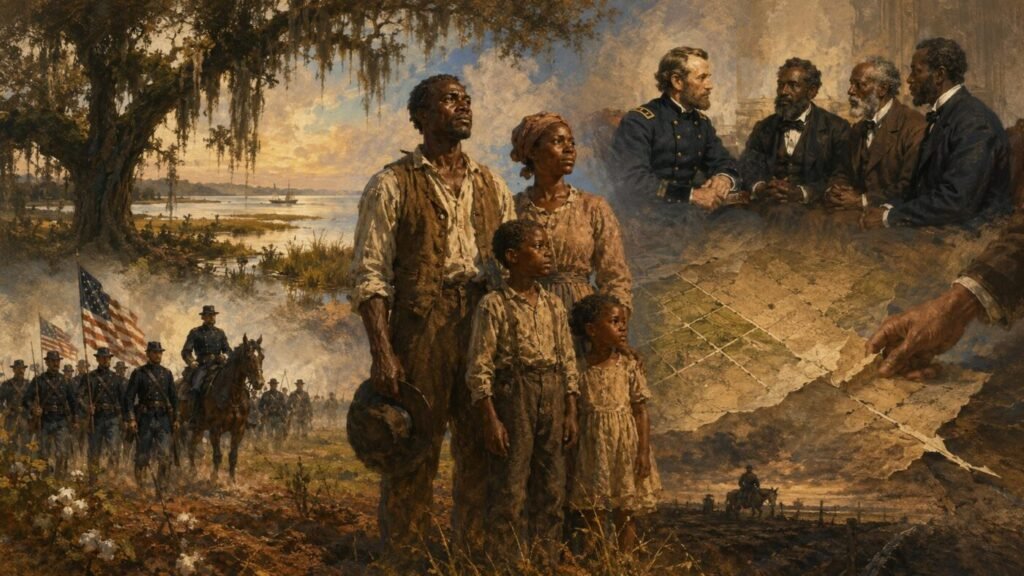
Across Georgia, many did exactly that. Some left farms and plantations and made their way toward Union lines. Others followed Gen. William T. Sherman’s forces during the march from Atlanta to Savannah. News passed through conversations, churches, work camps and the quarters where enslaved families lived.
By the time Sherman reached Savannah in December 1864, thousands of Black Georgians had attached themselves to the Union advance. They were legally free under Lincoln’s proclamation but often had no land, money, permanent home or clear protection once the army moved on.
Even after the Confederacy collapsed in the spring of 1865, slavery did not disappear instantly from every part of Georgia. Some former enslavers attempted to conceal the news or maintain the old system. In remote areas, especially in southwest Georgia, bondage continued into the summer until federal authority or local knowledge made it impossible to sustain.
That makes Juneteenth easier to understand not simply as the day someone delivered news, but as the moment government power arrived to enforce freedom in a place where enslavers had resisted it.
A Remarkable Meeting in Savannah
Four months before Juneteenth in Texas, an extraordinary discussion took place in Savannah.
On Jan. 12, 1865, Sherman and Secretary of War Edwin Stanton met with 20 Black church leaders to ask what formerly enslaved people needed. Most were Baptist or Methodist ministers. Some had recently been freed by the arrival of Union troops. Others had purchased their freedom years earlier.
The group selected Garrison Frazier, a 67-year-old Baptist minister who had bought freedom for himself and his wife, to speak for them.
Frazier gave a direct answer. “The way we can best take care of ourselves is to have land, and turn it and till it by our own labor.”
He was not asking merely for temporary relief. Land offered the possibility of independence: a home, a crop, an income and a future not controlled by the people who had previously claimed ownership over Black labor.
Four days later, Sherman issued Special Field Orders No. 15.
Where “40 Acres” Came From
The order reserved a vast coastal corridor stretching from the Charleston area through Georgia’s Sea Islands and south toward Florida. It included abandoned rice fields and mainland property extending as far as 30 miles inland.
The territory totaled roughly 400,000 acres. Black families could settle on plots of up to 40 acres, manage their own communities and receive military protection while Congress considered how permanent ownership would be handled.
The famous mule was not actually included in the original order. It entered the story later, when the Army allowed some settlers to use surplus military mules. Together, the land and animals produced the phrase that survived: “40 acres and a mule.”
The order had practical military purposes. Sherman was preparing to move north into South Carolina and did not want thousands of displaced people following his army. But whatever his motives, the result was historically significant. About 40,000 Black people settled on land covered by the order, many of them along the Georgia and South Carolina coasts.
For a moment, emancipation appeared capable of delivering more than release from legal bondage. It offered a path toward property, self-government and economic independence.
The Promise Is Taken Back
The experiment did not last.
Lincoln was assassinated in April 1865, and Andrew Johnson became president. Johnson favored restoring property to former Confederates who received presidential pardons. During the fall of 1865, his administration overturned Sherman’s policy and directed the Freedmen’s Bureau to return much of the coastal land to its prewar owners.
Families who had begun planting crops and building independent communities were told that their claims would not stand. Some resisted. Federal officials delayed the process in places, hoping Congress might intervene. But by the summer of 1866, most of the Georgia land had been restored to former slaveholders.
The result changed the shape of freedom.
Without property of their own, many formerly enslaved Georgians had little choice but to work land owned by someone else. Wage contracts gave way in many places to sharecropping and tenant farming, systems that could leave families tied to debt and dependent on landowners from one year to the next.
Freedom remained real and transformative. Black Georgians established churches, opened schools, searched for relatives separated by slavery, negotiated wages and built new political institutions. But the economic independence imagined at the Savannah meeting became far harder to achieve.
Georgia’s Final Place in the Emancipation Timeline
Texas gave the country Juneteenth. Georgia holds another important place in the national timeline.
The Emancipation Proclamation had been a wartime order directed at territory in rebellion. Permanently abolishing slavery throughout the United States required a constitutional amendment.
Congress approved the 13th Amendment in January 1865 and sent it to the states. On Dec. 6 of that year, Georgia became the 27th state to ratify it, providing the three-fourths majority required to add the amendment to the Constitution.
That means the legal abolition of slavery nationwide did not occur on Jan. 1, 1863, or even on June 19, 1865. The constitutional process reached its decisive point in Georgia nearly six months after the first Juneteenth.
The sequence is complicated because emancipation itself was complicated. There was a proclamation, military victory, local enforcement, personal escape, federal legislation and finally a constitutional amendment. Freedom emerged through all of them, not through one document or one day alone.
What Georgia Adds to Juneteenth
Juneteenth remains a celebration, but Georgia’s history gives the holiday additional depth.
It reminds us that knowing freedom had been declared was not the same as being able to exercise it. It shows why land mattered so deeply to people leaving slavery and why the reversal of Sherman’s order became one of Reconstruction’s defining lost opportunities.
It also places Black Georgians at the center of the story. The idea behind “40 acres” did not simply originate at a general’s desk. It followed a meeting in Savannah where Black leaders explained, in practical terms, what meaningful freedom would require.
Their answer was clear: the ability to live from their own labor, on land they could eventually call their own.
The promise lasted only months. The question behind it has lasted much longer.
A few more local reads, before you go.
About the Author


In North Atlanta

Fall Is the Right Time to Repair Many North Atlanta Lawns
North Atlanta Weekend Guide: Festivals, Dogs, Live Music and the First Feel of Fall

Dervish Plans 200-Seat Turkish Restaurant in Johns Creek

Dumpling Master Opens at Peachtree Corners Town Center

ANDRITZ Is Hiring Engineers and Project Leaders in Alpharetta

South Forsyth Roads and Development Take Center Stage at Forsyth County Meeting
IN NORTH ATLANTA