 Exclusive sponsor
From Bhangra to Bharatanatyam, Indian Dance Is Thriving Across North Atlanta
Indian dance traditions thrive in North Atlanta through various academies teaching styles like Bhangra, Bharatanatyam, and Kathak. These schools reflect the growing Indian community and cultural vitality across suburban areas like Johns Creek and Alpharetta.
Major local stories and useful updates, once a week.
Drive through the shopping centers along Jones Bridge Road, McGinnis Ferry Road or Buford Highway and the signs tell a story about how North Atlanta has changed. Between restaurants, tutoring centers, yoga studios and neighborhood services, there is another kind of business that appears with striking regularity: the Indian dance academy.
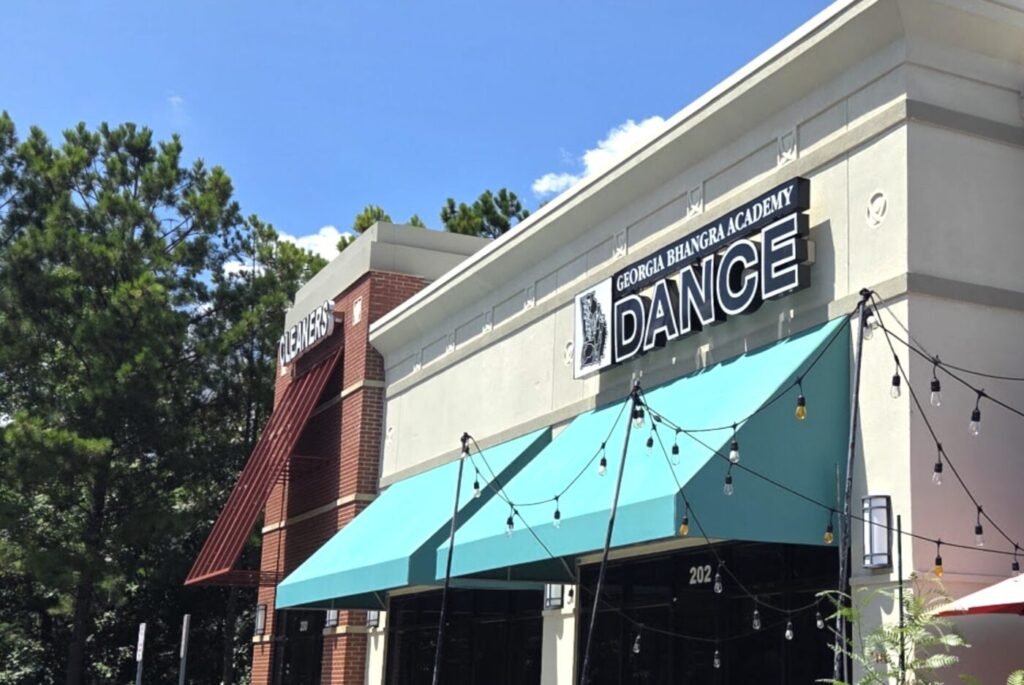
The Georgia Bhangra Academy sign above a storefront on McGinnis Ferry Road is one example. A few miles away, students study Bharatanatyam at Bharathakala Naatya Academy in Johns Creek. Aparna’s Dance Academy has taught Kathak in Alpharetta for years, while Atlanta Nritya Academy operates from Cumming. They are different schools teaching different traditions, but together they reveal something larger: Indian dance has become a substantial part of the after-school and cultural landscape of North Atlanta.
The geography explains a lot
This is not happening randomly. North Fulton and South Forsyth have developed one of Georgia’s strongest concentrations of Indian families. Recent American Community Survey-based estimates place Alpharetta and Johns Creek at roughly 13 percent Asian Indian, with Milton close behind. Cumming also ranks unusually high among Georgia cities.
Johns Creek offers an even broader measure of how international the area has become. About 35 percent of its residents are foreign-born, nearly 30 percent identify as Asian, and almost four in 10 residents age 5 and older speak a language other than English at home.
Those numbers show up in everyday suburban life in ways that census tables cannot capture. They appear in grocery stores and restaurants, temples and festivals, cricket programs and tutoring centers. And increasingly, they appear in dance studios.
What makes the dance schools especially interesting is that they are not simply businesses following population growth. They are places where families are transferring culture from one generation to another.
A child growing up in Alpharetta may spend the morning at an American public school, the afternoon at soccer practice and Saturday learning a dance tradition with roots hundreds or even thousands of miles away. The choreography may come from Punjab, Tamil Nadu or northern India; the student performing it may have been born at Northside Hospital.
Not one kind of “Indian dance”
From the outside, it is tempting to put all of these programs under the same label. Inside the studios, the differences matter.
Bharatanatyam is a highly structured classical tradition involving rhythm, facial expression, hand gestures and storytelling. Kathak comes from a different part of India and emphasizes intricate footwork, turns and narrative performance. Bhangra developed as an energetic Punjabi folk dance and today lends itself naturally to group performances and competitions. Bollywood programs borrow from several traditions and mix them freely with contemporary dance.
That breadth helps explain why the activity has grown beyond a small cultural niche. Some children enter formal classical programs that can continue for many years. Others want the energy of Bhangra or Bollywood. Adults can join recreational classes. Wedding choreography creates another market entirely.
Aparna’s Dance Academy, for example, has operated in metro Atlanta since 2001 and combines formal Kathak education with Bollywood and folk dance. Bharathakala in Johns Creek describes preservation of Bharatanatyam and Indian culture as central to its mission. Atlanta Nritya Academy in Cumming similarly describes its work as preserving cultural heritage while training a new generation of dancers.
The academies are evidence of a community that has moved well beyond the early stage of simply establishing itself. Cultural institutions are now mature enough to specialize.
Dance has moved out of the studio
The phenomenon becomes much easier to see when the dancers leave the shopping centers.
Johns Creek has increasingly incorporated cultural performance into its public identity. The city’s International Festival brings dance, music, food and art from local communities onto a large public stage. Diwali has become part of the city calendar as well, with the 2026 celebration scheduled for Nov. 7 at the Boardwalk at Town Center.
Indian dance is no longer something residents encounter only by attending a private recital. It has become visible at festivals, community celebrations and public events attended by neighbors from many backgrounds.
In that sense, the growth of the studios is part of a larger transition. North Atlanta’s diversity is becoming less about demographic statistics and more about the culture people encounter simply by living here.
For a child whose parents or grandparents came from India, performing Bharatanatyam or Bhangra in Johns Creek may be an act of cultural continuity. For another family watching from the audience, it may simply be part of what a Johns Creek festival looks like in 2026.
A suburban institution hiding in plain sight
There is also something distinctly suburban about the way this culture has developed.
There is no single Indian cultural district connecting Johns Creek, Alpharetta and Cumming. Instead, the community is spread through subdivisions, schools and commercial corridors. Its institutions follow the same pattern. Dance academies occupy ordinary shopping centers, often within a few minutes of the neighborhoods where their students live.
That may be why the phenomenon can remain almost invisible to anyone who does not have a child enrolled in a class.
But add the studios together, then add the rehearsals, competitions, recitals and festival performances, and a substantial cultural ecosystem emerges.
North Atlanta once talked about diversity largely as something arriving here. Indian dance offers a different picture. The institutions have arrived. They have students, teachers, traditions and audiences. Some have been operating for decades. A new generation is growing up inside them.
The evidence is hanging above the storefronts all around us.
If this felt close to home, these stories may be worth your time too.
Community Voice
A snapshot of reader views, not a scientific survey.
Explore Community Voice →About the Author


In North Atlanta

Atlanta Dream Earns First Finals Win, Returns Home Tied

Angel Reese Has Atlanta Dream Chasing Their First WNBA Title
Cosmic Baseball Is Coming to Gwinnett in 2027; Ticket Lottery Opens

Duluth Multi-Employer Job Fair Set for Thursday at Pleasant Hill Career Center
At Home, North Atlanta Speaks Many Languages

A little Chattanooga, five minutes from home: brunch at STIR in Medley
IN NORTH ATLANTA