The Companies Moving Into North Atlanta — And What They Actually Bring With Them
Get major local stories and development updates.
The changes unfolding across Alpharetta, Johns Creek, Roswell, and the surrounding corridor are easiest to understand not through trends, but through the companies themselves. Each move carries its own logic—workforce needs, industry shifts, and a growing preference for environments that feel less like office parks and more like complete places.
Alpharetta: Global Firms, Larger Footprints, and Real Workforce Scale
Kloeckner Metals Corporation’s decision to relocate its North American headquarters to Alpharetta in April 2026 stands out not just for the name, but for what the company represents. It is one of the largest metals distribution and service companies in the region, operating across manufacturing supply chains that touch construction, automotive, and industrial production. The relocation signals that Alpharetta is no longer just a tech hub. It is now attracting companies tied to physical industries that require logistics, engineering, and coordination at scale.
Around the same period, Kawneer—known globally for architectural aluminum systems used in large commercial buildings—chose to move its headquarters here as well. That move connects directly to growth in construction and infrastructure, particularly across the Southeast. For Alpharetta, it means another layer of professional jobs tied to design, engineering, and project management rather than purely software roles.
Hisense’s arrival earlier in 2026 adds a different dimension. The company, a global electronics and appliance manufacturer, established its U.S. headquarters in a 55,000-square-foot office. That presence brings not just administrative roles but marketing, distribution strategy, and product oversight functions into the region. It also reflects a broader pattern of international firms choosing North Atlanta as a U.S. base instead of traditional coastal cities.
Evernex may be less familiar to residents, but its move is one of the more strategically interesting. The company operates in IT lifecycle services—maintaining, refurbishing, and extending the life of enterprise hardware. Its new Alpharetta technology center functions as a North American hub for logistics, testing, and engineering. The facility significantly expands its parts capacity and positions the company to handle enterprise clients across the continent. This kind of operation is different from a typical office relocation; it brings infrastructure, training functions, and technical specialization into the local economy.
Even companies that were already here are reshaping their footprint. Equifax’s $25 million investment into its Alpharetta campus reflects a shift toward modernized, flexible work environments rather than expansion into new markets. UPS, meanwhile, has added jobs locally as part of a broader consolidation strategy, meaning Alpharetta is gaining roles that may have previously been distributed across multiple cities. Morgan Stanley’s large office, now employing around 2,500 people, continues to act as a major employment anchor, drawing talent from across North Fulton and into South Forsyth.
Johns Creek: One Move That Changes the Entire Conversation
For Johns Creek, the story is more concentrated but no less significant. Boehringer Ingelheim’s decision to relocate its U.S. Animal Health headquarters to Medley marks one of the largest corporate commitments the city has seen. The company plans to bring roughly 500 employees into a 73,000-square-foot space when the move is completed in 2026.
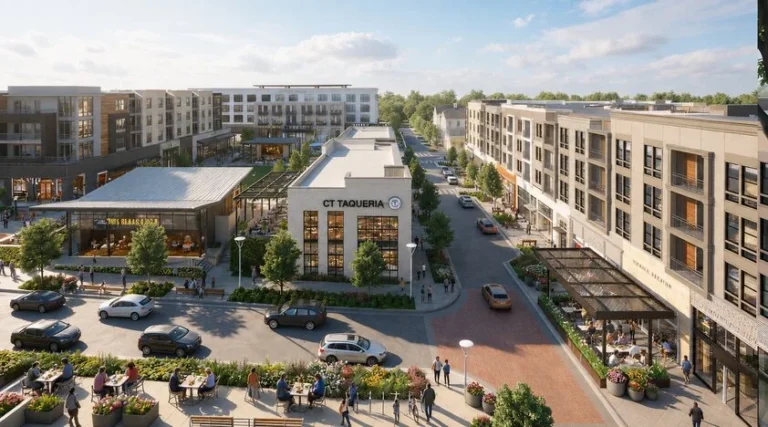
What makes this relocation notable is not only its size, but its context. Boehringer Ingelheim is a global pharmaceutical company with a strong presence in animal health and life sciences. Its choice of Medley suggests that these types of firms are now prioritizing environments where employees can walk to restaurants, gather in public spaces, and live nearby, rather than commuting into isolated campuses.
The project itself reinforces that shift. Medley is already filling with tenants that create a full-day environment—retail, dining, and service businesses that support both office workers and residents. The high pre-leasing rates across office and retail space suggest that this model is not speculative. It is meeting an existing demand that had not previously been addressed in Johns Creek.
The city’s designation as a BioReady Community adds another layer. It positions Johns Creek as a potential destination for additional life sciences firms, especially those that require specialized infrastructure and regulatory readiness. The Boehringer move may be the first of several if that strategy continues to hold.
Roswell: Smaller Moves, Different Feel
Roswell’s corporate arrivals tend to be quieter, but they reveal a different type of demand. GreyOrange, a global automation company focused on robotics and fulfillment systems, relocated its headquarters to Southern Post. The company’s work in warehouse automation connects it to the rapid growth of e-commerce logistics, even if that activity is not always visible at the street level.
Vestis, a workplace supplies and uniform services company, also established its headquarters and support center at Southern Post. The move reflects a broader trend of companies choosing locations where office space is integrated into a lifestyle environment rather than separated from it.
Southern Post itself is part of the story. With loft-style offices and proximity to restaurants and residential units, it appeals to firms that want a more human-scale environment. The upcoming Hill Street redevelopment, expected to add tens of thousands of square feet of commercial space alongside housing, suggests that Roswell is continuing in this direction rather than competing directly with Alpharetta’s larger corporate campuses.
Gwinnett and Suwanee: Bigger Projects, Industrial Scale
In Gwinnett County, the scale of investment shifts dramatically. UCB’s planned $2 billion pharmaceutical manufacturing facility at Rowen introduces one of the largest life sciences investments in the state’s history. The project is expected to create more than 300 permanent jobs, along with over 1,000 construction roles during its buildout.
This kind of development changes the economic profile of the area. It brings high-skilled roles in biotechnology and manufacturing while also supporting a broader ecosystem of suppliers, contractors, and service providers.
In nearby Suwanee, Socomec is investing $10 million into a new facility focused on electrical equipment and energy infrastructure, with plans to create around 300 jobs. The company’s focus on power systems and energy resilience ties into larger global trends around electrification and grid stability.
Meanwhile, companies like AGCO and Primerica remain in Duluth, providing stability and continuity. Their continued presence reinforces the idea that while new firms are arriving, the existing corporate base in North Atlanta is not being replaced—it is being layered upon.
South Forsyth: The Next Wave, Not Yet Fully Formed
South Forsyth’s corporate future is tied more to what is being planned than what has already arrived. The Gathering at South Forsyth, a proposed multi-billion-dollar mixed-use development, is designed to include office space alongside retail, residential, and entertainment components.
Even without its most ambitious elements fully secured, the project represents a shift in how corporate environments are being conceived. Rather than building standalone office parks, developers are creating full districts intended to attract both companies and residents at the same time.
The Collection at Forsyth, already operating at high occupancy levels, offers a preview of that model. Its continued leasing activity shows that demand exists, even before larger projects are completed.
The Companies That Didn’t Move — And What That Means
Not every company is expanding. Some are adjusting.
Layoffs at an Alpharetta-based B2B tech firm and earlier reductions at Hi-Rez Studios reflect pressures within the tech sector, including slower growth and shifts toward automation and AI-driven operations. Larger national firms, including Coca-Cola and Accenture, have also gone through restructuring that affects the broader Atlanta workforce.
What stands out, however, is that these changes rarely involve a full departure from the region. Companies are more often reducing space, consolidating offices, or relocating within North Atlanta rather than leaving it entirely.
Who Could Be Next — And Why They Would Choose Here
The pattern emerging across these moves points to the types of companies most likely to arrive next. International firms looking for a U.S. base, particularly those leaving higher-cost markets like California, continue to see Georgia as an attractive option. Industrial and manufacturing firms are following workforce availability and logistics access along the GA-400 corridor. Life sciences companies are beginning to cluster where infrastructure and zoning allow for specialized facilities.
There is also a growing category of companies that may not fully relocate but will establish regional hubs. Hybrid work has made it possible for firms to maintain smaller, distributed offices closer to where employees live, and North Atlanta fits that model well.
Where This Is Headed
Alpharetta remains the primary destination for large headquarters and global firms. Johns Creek is positioning itself to compete through Medley and life sciences infrastructure. Roswell is attracting companies that value character and smaller-scale environments. Gwinnett is capturing large industrial and research investments. South Forsyth is preparing for a future wave tied to large mixed-use developments.
The common thread is not just growth, but a redefinition of what a corporate location looks like. Companies are choosing places that combine work, daily life, and long-term stability. North Atlanta, increasingly, is being built to match that expectation.
A Breakdown of Salaries and Job Types Tied to These New Arrivals
Company / Sector: Kloeckner Metals (Industrial / Supply Chain)
Typical roles: Executives, logistics managers, supply chain analysts
Estimated salary range: $85K – $180K+
Workforce profile: A mix of senior leadership and operational professionals tied to manufacturing and distribution networks
Local impact: Supports demand for mid-to-upper income housing and professional services
Company / Sector: Kawneer (Construction / Engineering)
Typical roles: Engineers, project managers, corporate leadership
Estimated salary range: $90K – $170K+
Workforce profile: Highly skilled technical and design-oriented workforce supporting large-scale building projects
Local impact: Adds steady demand for family housing and long-term residential stability
Company / Sector: Hisense (Consumer Electronics / Global HQ)
Typical roles: Marketing, product managers, executives, operations
Estimated salary range: $70K – $160K+
Workforce profile: International and corporate workforce with a mix of mid-level professionals and leadership roles
Local impact: Boosts rental demand and executive relocation activity
Company / Sector: Evernex (Tech Services / IT Lifecycle)
Typical roles: Engineers, technicians, logistics specialists
Estimated salary range: $60K – $140K+
Workforce profile: Blended workforce including technical operations and higher-level engineering roles
Local impact: Creates broader income diversity across nearby suburbs
Company / Sector: Equifax (Fintech / Data Analytics)
Typical roles: Data scientists, analysts, corporate roles
Estimated salary range: $80K – $190K+
Workforce profile: Highly educated workforce with strong representation in analytics and finance
Local impact: Supports higher-end housing and premium local services
Company / Sector: Morgan Stanley (Financial Services)
Typical roles: Finance professionals, advisors, support staff
Estimated salary range: $75K – $200K+
Workforce profile: Large corporate workforce spanning entry-level to senior financial roles
Local impact: Sustains demand across mid and high-end residential markets
Company / Sector: Boehringer Ingelheim (Life Sciences)
Typical roles: Scientists, researchers, corporate leadership
Estimated salary range: $90K – $180K+
Workforce profile: Highly specialized workforce with advanced degrees and technical expertise
Local impact: Elevates demand for top-tier schools and executive housing
Company / Sector: GreyOrange (Automation / Robotics)
Typical roles: Engineers, AI specialists, corporate staff
Estimated salary range: $85K – $170K+
Workforce profile: Tech-focused workforce tied to automation and logistics innovation
Local impact: Supports demand in walkable, lifestyle-oriented neighborhoods
Company / Sector: Vestis (Workplace Services)
Typical roles: Corporate staff, operations, management
Estimated salary range: $60K – $140K+
Workforce profile: Balanced workforce across administrative and operational roles
Local impact: Adds stable, middle-income demand across Roswell and nearby areas
Company / Sector: Socomec (Energy / Manufacturing)
Typical roles: Technicians, engineers, production roles
Estimated salary range: $50K – $120K+
Workforce profile: Mixed workforce including technical and manufacturing employees
Local impact: Strengthens housing demand in Gwinnett with broader affordability range
Company / Sector: UCB (Biopharma Manufacturing)
Typical roles: Scientists, engineers, plant operations
Estimated salary range: $70K – $160K+
Workforce profile: Combination of specialized research roles and operational staff
Local impact: Introduces life sciences salary levels into parts of Gwinnett not traditionally defined by them
Where Employees Are Likely to Live
As these companies settle into their new offices, the residential pattern that follows is rarely random. It tends to mirror both commute logic and lifestyle preferences, and in North Atlanta, that usually means a spread rather than a single destination.
For those working in Alpharetta—especially employees tied to companies like Kloeckner Metals, Kawneer, Hisense, and the large financial and tech offices—the immediate draw remains the Alpharetta core itself. Areas around Avalon and downtown Alpharetta continue to attract professionals who want a walkable environment close to work, particularly younger employees or those relocating from out of state. Just beyond that, Milton and western Roswell tend to pull in families and higher-income households looking for larger homes, quieter streets, and top-ranked schools while still staying within a manageable commute.
Johns Creek’s growing job base, anchored by Medley, is beginning to shift some of that gravity eastward. Employees tied to Boehringer Ingelheim and related life sciences roles are likely to cluster within Johns Creek itself, especially near McGinnis Ferry, while also extending into nearby Suwanee and parts of south Forsyth. These areas offer a balance of newer housing, strong schools, and relatively easy access back to the Medley corridor.
Roswell’s employment centers, particularly around Southern Post, create a slightly different pattern. Workers there often lean toward downtown Roswell and its surrounding neighborhoods, where the appeal is less about proximity alone and more about character. There is a noticeable preference for areas that feel established and walkable, even if that means a slightly longer commute. Some spillover into eastern Cobb and Sandy Springs is also likely, especially for those already tied to those communities.
Further north, South Forsyth continues to attract employees who are willing to trade a longer drive for newer construction and more space. This is especially true for mid-career professionals and families working in Alpharetta or Johns Creek who are looking for larger homes and more recent developments along the GA-400 corridor.
In Gwinnett, where companies like Socomec and the large UCB project are shaping the local job market, the residential pattern tends to stay closer to home. Suwanee, Duluth, and Buford offer a mix of housing options at different price points, making them practical choices for a workforce that includes both technical specialists and operational staff.
Related Links
Kloeckner Metals relocation to Alpharetta
Kawneer headquarters move to Alpharetta
Hisense U.S. headquarters in Alpharetta
Evernex North American HQ and Technology Center
Equifax Alpharetta campus investment
UPS Alpharetta expansion
Morgan Stanley Alpharetta office
Boehringer Ingelheim move to Medley in Johns Creek
Medley overview
Medley leasing and second phase
Southern Post momentum in Roswell
GreyOrange and Vestis at Southern Post
Southern Post project website
Hill Street redevelopment in Roswell
UCB facility at Rowen
Socomec expansion in Suwanee
Socomec investment details
The Gathering at South Forsyth
The Collection at Forsyth new leases
Alpharetta tech layoffs
Brookside office park redevelopment
If you’ve been following growth and change around here, these stories are worth a look too.
About the Author


In North Atlanta
What North Atlanta Should Know Today. Friday, Sept. 11, 2026
5 Coffee Trucks and Mobile Cafés Worth Finding Around North Atlanta
Medley Opens First Access to 133 Townhomes in Johns Creek

North Atlanta’s NHL Race Is No Longer Just Alpharetta vs. South Forsyth
Medley Job Fair Looks to Fill 300 Positions Ahead of Johns Creek Opening
ADP Opens New Alpharetta Roles in AI Content, Product Strategy and Internships
IN NORTH ATLANTA