Final Day to Register Sets the Stage for a Competitive Georgia Primary
Get major local stories and development updates.
April 20 is the last day to register to vote ahead of Georgia’s May 19 primary, a deadline that tends to pass without spectacle but carries real consequences across fast-growing suburban communities. By midnight, the voter rolls will be locked, determining who can participate in a primary season that includes an open race for governor, a closely watched U.S. Senate contest, and a series of competitive local elections.
In places like Johns Creek, Alpharetta, Milton, and South Forsyth, where population growth has been steady and in some cases rapid, the size and composition of the electorate is not a fixed reality. It is still being decided, in part, today.
A System That Rewards Timing
Georgia’s open primary system allows voters to choose which party’s ballot to cast, regardless of party affiliation. That flexibility has made suburban voters more strategic over time. But the system only works if the voter is registered.
The deadline also applies to people who have moved, changed their name, or shifted counties—details that matter in a region where relocation is common. New subdivisions along McGinnis Ferry Road and across southern Forsyth County have brought thousands of new residents in recent years. Missing today’s deadline, even by a technicality, means sitting out decisions that will affect school zoning, taxes, and infrastructure for years to come.
A Primary With Unusual Weight
Primary elections typically attract a narrower slice of voters than general elections, often those most engaged or motivated. In Georgia, turnout can dip to around 30 percent in primaries, though suburban areas tend to outperform that figure.
This year, the stakes are higher than usual. The governor’s office is open, the U.S. Senate race is competitive, and multiple state legislative seats are either vacant or closely contested. Those factors tend to draw more participation, particularly in high-income, high-education suburbs where civic engagement is structurally strong.
In Forsyth County, turnout has historically exceeded statewide averages, reflecting both rapid growth and a population that tends to follow local governance closely.
Who’s Running and Where the Races Stand
The statewide picture begins with the U.S. Senate race, where incumbent Jon Ossoff enters the cycle with a financial advantage and relatively stable polling position. On the Republican side, the primary field includes Mike Collins, Buddy Carter, and Derek Dooley, with Collins emerging as the early leader, though a large undecided bloc keeps the race fluid.
The governor’s race is more fragmented. With Brian Kemp term-limited, both parties are navigating open terrain. Keisha Lance Bottoms leads the Democratic field, while the Republican side is split among Burt Jones, Chris Carr, Brad Raffensperger, and Rick Jackson, with no clear frontrunner and the possibility of a runoff looming.
Closer to home, the political map reflects a region in transition. Lucy McBath remains strongly positioned in the 6th Congressional District, while Rich McCormick holds the advantage in the 7th, though demographic shifts in Johns Creek and South Forsyth are being closely watched.
At the state level, the retirement of Jan Jones has opened a rare contest in House District 47, where Brian Cochran, Phoebe Eckhardt, and Jack Miller are competing without a clear favorite. Nearby districts, including those represented by Scott Hilton, Chuck Martin, and Michelle Au, illustrate the region’s mixed political terrain, with some seats remaining stable and others increasingly competitive.
What Issues Are Actually Driving Voters Here
For many suburban voters, the national headlines are not the primary concern.
Conversations tend to circle back to schools, traffic, property taxes, and the pace of development. In South Forsyth, rapid residential growth has brought renewed attention to school capacity and long-term planning. Parents follow school board races closely, often more closely than congressional contests, because class sizes and zoning decisions have immediate consequences.
Traffic remains a persistent issue, particularly along GA-400 and connecting corridors like McGinnis Ferry Road and Old Milton Parkway. Infrastructure projects are discussed not in abstract terms but in minutes added or saved during daily commutes.
Property taxes are another recurring focus. In areas where home values have risen significantly, the question is not only about rates but about how county governments manage budgets and growth. Voters tend to pay attention to candidates who frame these issues in practical terms—millage rates, development approvals, and long-term planning decisions.
Development itself is both an opportunity and a concern. New retail, office space, and housing continue to reshape the landscape, but they also bring questions about density, school capacity, and road systems. In many ways, the political conversation in these suburbs is less ideological and more operational: how to manage growth without losing what drew people to the area in the first place.
For First-Time Voters, What to Expect
For those voting in Georgia for the first time, the process is more straightforward than it may seem, but it does come with a few specifics that matter.
After registering, voters will not declare a party affiliation in advance. Instead, when they arrive to vote—either during early voting or on Election Day—they will choose which party’s primary ballot they want to participate in. That choice applies only to that election cycle and does not permanently align the voter with a party.
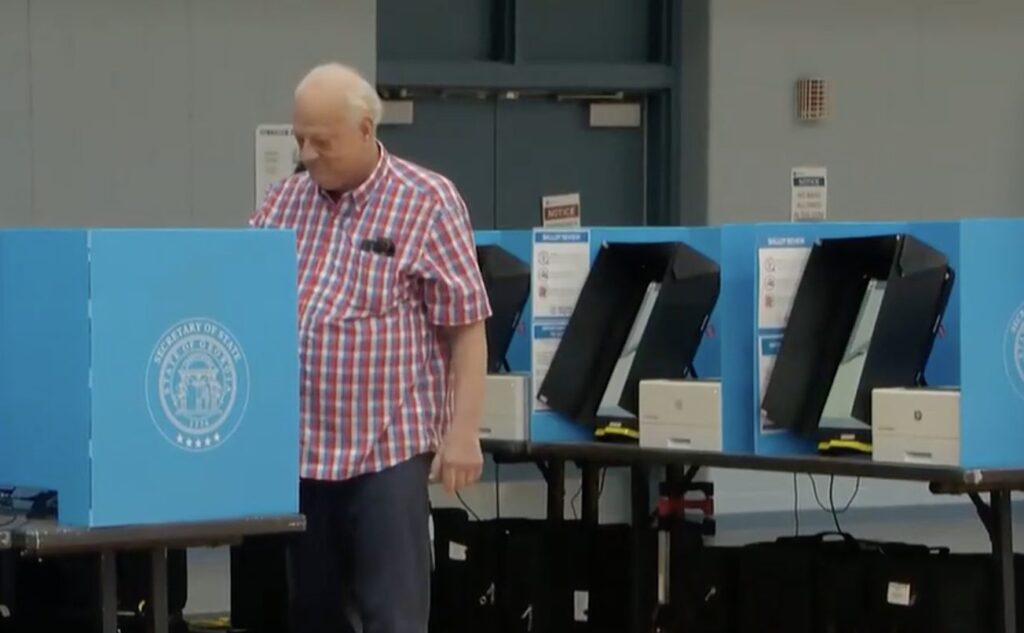
Identification is required at the polling place, most commonly a Georgia driver’s license or another approved photo ID. Poll workers verify registration, provide the selected ballot, and guide voters through the process, which is typically completed on a touchscreen system.
Many first-time voters in these suburbs opt for early voting, which tends to be less crowded and more flexible. Locations are usually set up in familiar public buildings—libraries, community centers, and local government offices—making the experience feel closer to a routine errand than a formal event.
What often stands out is how local the ballot feels. Alongside statewide races, voters will see names tied directly to their own community—school boards, state representatives, county commissioners—positions that shape daily life in ways that are often more immediate than national politics.
Find Your Early Voting Location
Early voting sites can vary by county and may not be the same as your Election Day polling place. Use the official links below to confirm the correct location for your address.
Georgia My Voter Page: Find an Early Voting Location
Fulton County Early Voting Locations
Forsyth County Current Election and Advance Voting Information
The Moment Before the Campaign Accelerates
Once the deadline passes, the administrative phase gives way to a more visible one. Campaign signs multiply, mailers arrive, and candidates move into their final stretch.
But the boundary between participation and absence has already been set.
In suburban districts where margins can be narrow and outcomes consequential, the most important decision may not be made in the voting booth, but in whether a resident completed a registration form before midnight.
Follow this story
Keep me updated
North Atlanta Star will email you when an editor approves a follow-up to Final Day to Register Sets the Stage for a Competitive Georgia Primary.
Story updates only. No newsletter signup.
About the Author


In North Atlanta
South Forsyth Roads and Development Take Center Stage at Forsyth County Meeting

North Atlanta’s NHL Race Is No Longer Just Alpharetta vs. South Forsyth

At Read It Again, the Bookstore Comeback Is About Community
20-Acre Buford Highway Tract Hits Market at $5.08 Million
5 Coffee Trucks and Mobile Cafés Worth Finding Around North Atlanta
Simple Man Distillery Hiring Ahead of Cumming City Center Opening
IN NORTH ATLANTA