 Exclusive sponsor
The Data-Center Boom Is Building a New Factory Workforce in the Sun Belt
Factory jobs are rising in the Sun Belt as manufacturers ramp up production to meet data center power needs. Investments in electrical equipment plants are creating thousands of new roles in Texas, Georgia, and beyond.
Get the week’s jobs, development, housing and growth stories from across the Sun Belt in one email.
For years, the data-center boom was mostly a story about enormous buildings, enormous power demands and enormous checks written by technology companies. Now another part of the boom is becoming harder to miss: the factories needed to make all that computing possible.
The latest example is coming to San Antonio.
Industrial Electric Mfg., better known as IEM, plans to invest $200 million in a major manufacturing operation at Brooks on the city’s South Side, eventually occupying about 1 million square feet and employing as many as 3,000 people by 2030. Texas approved a $3.36 million Enterprise Fund grant tied to 448 of those jobs. Regional economic-development officials describe the project as the San Antonio area’s largest job-producing investment in more than two decades.
IEM does not make computer chips. It makes something less glamorous and increasingly essential: the switchgear, switchboards, remote power panels and control systems that move electricity through data centers and other large facilities.
That distinction matters. The artificial-intelligence economy may live on screens, but physically it is being assembled in factories.
And a growing share of those factories are being built across the Sun Belt.
From Servers to Switchgear
A large data center requires far more than racks of Nvidia processors. Electricity arriving from a utility has to be transformed, distributed, protected, switched and monitored before it ever reaches the servers. AI facilities are pushing those systems particularly hard because new generations of computing equipment pack extraordinary amounts of power into relatively small spaces.
The pressure is showing up in national electricity forecasts. After roughly 15 years of relatively flat U.S. power consumption, electricity demand has begun climbing again, with data centers expected to be one of the major drivers of future growth.
Lawrence Berkeley National Laboratory estimated that U.S. data centers consumed about 176 terawatt-hours of electricity in 2023, or 4.4% of total U.S. electricity use. Depending on the pace of AI deployment and other factors, that figure could reach 325 to 580 terawatt-hours by 2028.
Every additional megawatt creates demand well beyond the data-center site itself. Transformers have to be built. Switchgear has to be assembled. Power-distribution units, busways and control equipment have to be manufactured, tested and delivered.
That is beginning to produce an industrial geography of its own.
Texas Is Becoming a Power-Equipment Factory Floor
IEM’s San Antonio announcement looks much less isolated when placed beside what has already happened elsewhere in Texas.
Siemens opened a $190 million, 500,000-square-foot electrical-equipment plant in Fort Worth in 2025 specifically to help meet demand from data centers and other critical infrastructure. The factory produces low-voltage switchboards and was built to employ as many as 800 people.
Schneider Electric has expanded its El Paso manufacturing campus, where equipment destined for the data-center market includes medium-voltage switchgear. The company also opened a 105,000-square-foot facility in Red Oak, south of Dallas, to assemble prefabricated data-center infrastructure, adding more than 200 manufacturing and related jobs.
Another Texas power-equipment company has demonstrated just how valuable the sector has become. nVent agreed this month to buy McKinney-based Maverick Power for $1.75 billion, with the possibility of another $550 million based on future performance. Maverick employs about 900 people in Texas and Arizona and makes low- and medium-voltage switchgear, switchboards and modular power systems for data centers.
Taken together, these are no longer simply factories that happen to serve technology companies. They are becoming part of the physical supply chain of the AI industry.
The Belt Extends Across the South
Texas may be the clearest concentration, but the same investment pattern is spreading east.
Earlier this month, Siemens announced more than $200 million in new electrical-manufacturing investment in Georgia and Texas, including a $185 million, 550,000-square-foot plant in Pendergrass, Georgia. The Georgia facility will make low-voltage electrical infrastructure for data centers and is scheduled to begin hiring in 2027. Together with an expansion in Grand Prairie, Texas, the projects are expected to add more than 1,500 jobs.
That announcement follows another $165 million Siemens investment across North Carolina and South Carolina this year. The company is expanding production of protection systems, automation equipment, busways and other electrical products as it responds to strong data-center-related demand.
Eaton is making a similar bet. The company is spending $340 million to convert a facility in Jonesville, South Carolina, into a factory for large three-phase transformers, creating about 700 jobs. Eaton has identified data centers, utilities and industrial customers as major sources of the extraordinary demand for transformers.
In Virginia, already the nation’s dominant data-center market, Eaton is also building a 350,000-square-foot manufacturing campus in Henrico County for equipment including power-distribution units, static transfer switches and remote power panels. The project is expected to add about 200 jobs.
Schneider Electric, meanwhile, has opened the first 500,000-plus-square-foot building of a two-building manufacturing campus in Mount Juliet, Tennessee. The facilities will make custom power-distribution products for data centers and other critical infrastructure, with hundreds of manufacturing jobs expected.
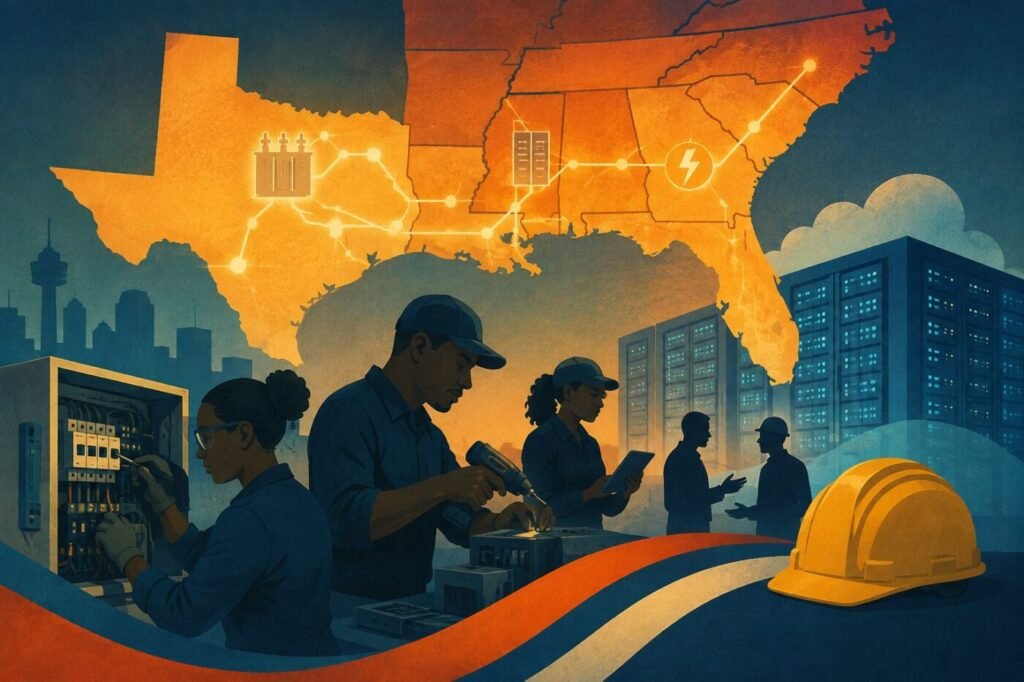
The pattern stretches from Texas through Georgia and the Carolinas into Tennessee and Virginia: the same states attracting population, warehouses, advanced manufacturing and data centers are increasingly attracting the factories that supply the electrical backbone beneath them.
What 3,000 Jobs Actually Look Like
The San Antonio project also offers a clearer picture of the workforce behind that infrastructure.
IEM expects its jobs to span manufacturing, engineering, logistics and corporate support. Bexar County documents filed before the final announcement put the proposed employment at 2,960 jobs, with an average annual salary of about $53,000. The company’s stated minimum hourly wage fell below the county’s living-wage standard, requiring an exception to its normal tax-abatement guidelines, although county officials said roughly 90% of employees were expected to earn above that level.
That creates a more complicated picture than the familiar shorthand of “high-paying advanced-manufacturing jobs.”
Some positions will require engineering degrees and specialized electrical knowledge. Others involve fabrication, wiring, assembly, testing, material handling and logistics — jobs that can provide a path into the industry without a four-year college degree.
Manufacturers increasingly appear to understand that they cannot simply wait for experienced workers to arrive.
Siemens has experimented with hiring workers without previous industrial experience at its Fort Worth factory, using structured training to bring new employees into manufacturing. Its workforce there includes assemblers, machine operators, technicians and engineers. The company has also said it intends to train 200,000 electricians and manufacturing specialists nationally by 2030.
That workforce question may ultimately be as important as the factory announcements themselves. Electrical infrastructure is becoming one of the constraints on the speed of the AI buildout, and expanding factories requires not just buildings and machinery but thousands of people capable of assembling and testing increasingly sophisticated power systems.
AI’s Less Visible Industrial Boom
Data centers remain controversial across the Sun Belt. Communities are debating their electricity consumption, water use, tax incentives, transmission lines and enormous physical footprints. Texas itself is confronting how quickly new computing loads can be connected without undermining grid reliability.
Those debates are unlikely to disappear.
But the emergence of a regional electrical-manufacturing industry changes the economic equation somewhat. A data center may employ relatively few people once construction is finished. A factory supplying data centers can employ hundreds or thousands, while also supporting machinists, electricians, engineers, truckers, contractors and suppliers far beyond its walls.
The relationship should not be overstated. IEM, Siemens, Eaton and Schneider Electric also sell equipment to utilities, hospitals, factories, semiconductor plants and other industries. The broader electrification of the American economy is part of their growth.
Yet the companies themselves repeatedly identify AI and data centers as a reason they are adding manufacturing capacity, and the geography is striking.
San Antonio’s 3,000-job factory is the newest and largest example. Fort Worth has already added hundreds of workers. New production is coming to Georgia. The Carolinas are expanding. Tennessee and Virginia are building capacity. And investors are assigning billion-dollar values to companies that make equipment most consumers will never see.
The AI boom may be centered in computer code and silicon chips. Increasingly, though, some of the jobs it creates look much more familiar: people on Southern factory floors building the electrical machinery that keeps the digital economy running.
If you’ve been following growth and change around here, these stories are worth a look too.
Community Voice
A snapshot of reader views, not a scientific survey.
Explore Community Voice →About the Desk

Across the Sun Belt
Rebuild Manufacturing Plans 150 New Jobs in Rock Hill, With Factory Opening Expected in November
A $400 Million South Carolina Factory Expansion Will Create 105 Jobs
Tesla’s $10.1 Billion Solar Factory Plan Could Bring Nearly 10,000 Jobs to Texas

Georgia’s Battery Belt Is Changing, but It Is Not Disappearing

The Next Sun Belt Highway May Carry Power, Water and Data Alongside Cars