Are We Still Part of Atlanta—Or Becoming Our Own Metro?
North Atlanta suburbs like Alpharetta and Johns Creek are growing into independent centers for jobs and housing, reducing daily reliance on Atlanta’s urban core.

Get major local stories and development updates.
For years, North Atlanta’s identity was simple: live in Alpharetta, Johns Creek, or South Forsyth, and commute into Atlanta. The city was the center. Everything else followed.
That relationship is changing—and the numbers show it.
The most striking shift is in housing. The long-standing “distance discount” is breaking down. In 2026, North Atlanta suburbs are no longer reliably cheaper than the city. In fact, metro Atlanta may soon become the only major U.S. region where exurban home prices exceed those in the urban core.
Look at Alpharetta. Median home prices are around $699,000, with average values above $726,000. Homes are still selling in roughly 40–50 days, even with mortgage rates near 6.4%. Johns Creek sits close behind, with median prices around $665,000 and homes moving faster—often within 25 days.
These are not “suburban discount” numbers.
They are driven by jobs. Alpharetta alone hosts more than 500 tech and fintech companies, anchoring a local employment base that no longer depends on downtown Atlanta. Across the metro, about 19,000 new jobs are expected in 2026, many concentrated in the northern corridor.
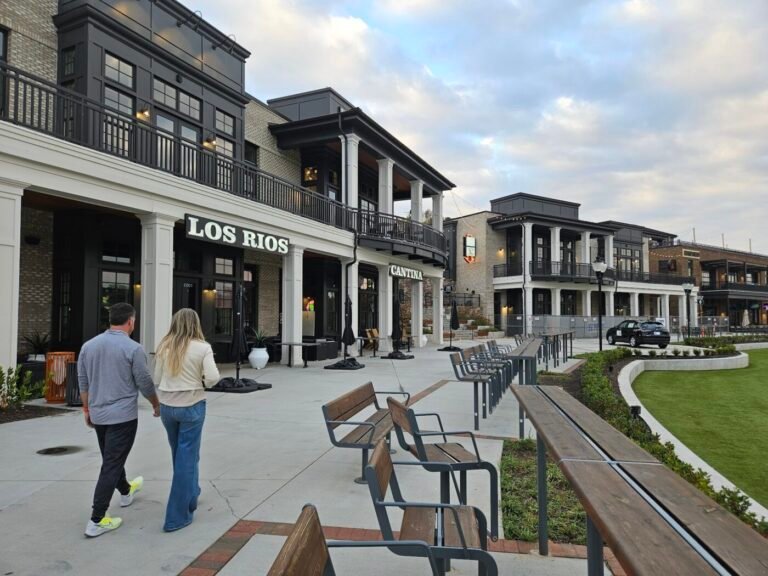
That changes behavior. If you work in Alpharetta, live near Avalon, and spend weekends around Halcyon or the Greenway, Atlanta is no longer part of your daily routine. It’s occasional.
The cost structure reflects that shift.
Buildable land within a 45-minute commute of North Atlanta job centers is largely exhausted, limiting new supply. At the same time, many homeowners are locked into 3–4% mortgages and are not selling, keeping inventory tight. The result is stable or rising prices, even as borrowing costs remain high.
Meanwhile, affordability is moving outward. Duluth and Suwanee have become entry points, with median prices closer to $470,000. In South Forsyth, median prices range roughly from $590,000 to $660,000, supported by lower property taxes—about 0.85% effective rate versus over 1.08% in Fulton County.
That tax difference alone can mean $2,000 to $3,000 per year on a typical home.
But even that outward shift has limits. Families looking for homes under $500,000 are increasingly pushed beyond the core suburbs, often into areas an hour or more from their jobs. The old strategy—drive farther to save money—is becoming less effective, especially with higher fuel costs and longer commutes.
At the same time, the local lifestyle has changed.
Homes near walkable developments like Avalon or trails like the Alpha Loop now command a 10–15% premium. That kind of pricing is typically associated with urban cores, not suburbs. It signals a different kind of demand—one focused on proximity to local amenities rather than proximity to downtown Atlanta.
Put together, the pattern is clear.
North Atlanta is no longer just absorbing growth from the city. It is generating its own. Jobs, housing demand, and lifestyle centers are increasingly self-contained. Daily life for many residents unfolds entirely within the northern corridor.
That doesn’t mean Atlanta is irrelevant. The region still shares infrastructure, culture, and a broader economy. But the dependency has weakened.
So are we still part of Atlanta?
Geographically, yes.
Functionally, less and less.
What has emerged instead is a second center of gravity—one that stretches from Alpharetta through Johns Creek into South Forsyth. Not a separate metro on paper, but increasingly, one in practice.
Keep reading with a few more stories from around North Atlanta.
About the Author


In North Atlanta
The South Has Become America’s Buyer’s Market. The Bargains Come With Questions
Medley Opens First Access to 133 Townhomes in Johns Creek

North Atlanta Added 11,000 Residents, but the Growth Is Concentrated in Three Cities
North Fulton Is Getting Older. Can the Next Generation Still Afford to Live Here?

What North Atlanta Should Know Today. Friday, Sept. 11, 2026

North Atlanta Courthouse Wedding Price Check: A Legal Marriage Can Start at $16
IN NORTH ATLANTA