 Exclusive sponsor
Why Your Johns Creek Mailbox Feels Like It’s Under Attack
Johns Creek and nearby suburbs are experiencing a surge in junk mail, flyers, and door-to-door solicitations. Local rules and federal opt-out options offer residents some relief from this growing clutter in their mailboxes and yards.
Major local stories and useful updates, once a week.
There is a particular suburban moment almost everyone in North Atlanta seems to recognize.
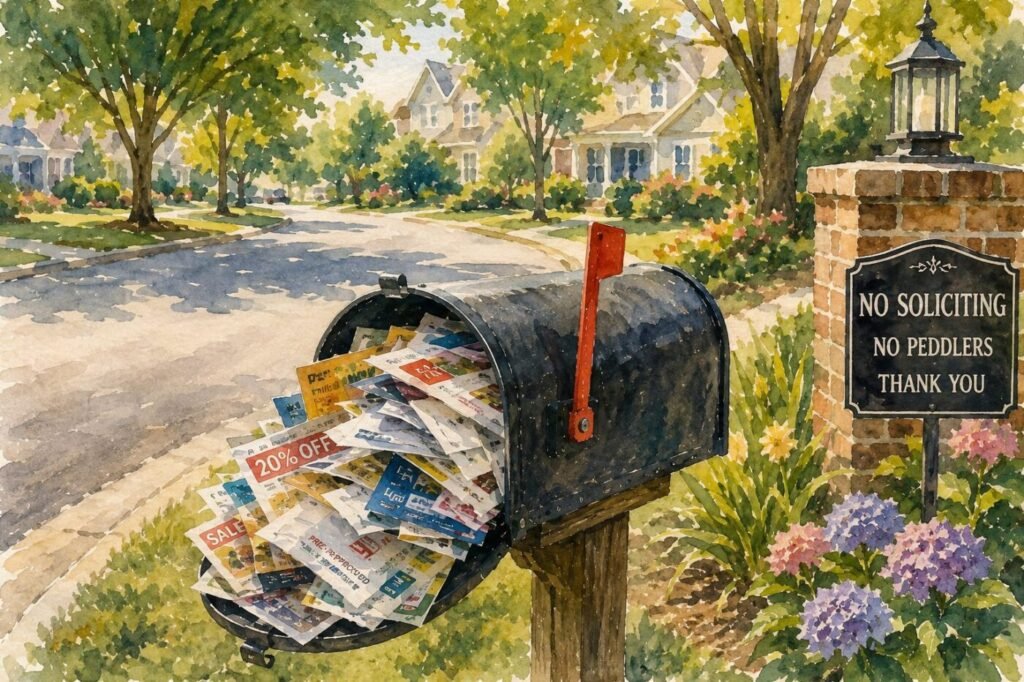
You come home from work in Alpharetta or Johns Creek, open the mailbox, and pull out what feels like half a forest. Credit card offers. Solar flyers. Roofing postcards. Insurance letters stamped “Important Information Enclosed.” Then, just as dinner starts, the doorbell rings and somebody in a polo shirt asks whether you have “a quick minute.”
In neighborhoods stretching from Windermere and Vickery to Suwanee, Milton, and Duluth, the modern suburban home has quietly become one of Georgia’s most aggressively marketed spaces.
The reason is simple: North Fulton and South Forsyth contain exactly the kind of households advertisers chase. Higher incomes. Homeownership. Families. Multiple vehicles. Expanding subdivisions. Renovation spending. Insurance policies. Retirement accounts.
To marketers, the cul-de-sac is not just a neighborhood. It is a database.
But many residents are surprised to learn they actually do have ways to push back.
The funny thing is that most people assume junk mail is just part of modern life — like pollen season or GA-400 traffic. Yet a surprisingly large percentage of unwanted mail can be stopped with a few targeted opt-outs.
One of the biggest sources of mailbox clutter comes from pre-approved financial offers. Credit bureaus legally package consumer information and sell it to lenders and insurance companies unless residents explicitly opt out.
That means the endless stream of “You’re Pre-Selected” envelopes is not random at all. It is highly organized.
Reclaiming the Front Porch
Residents can remove themselves from many of these lists through the federal OptOutPrescreen system, which allows either a five-year or permanent removal from many financial marketing databases. According to the report, this single step often eliminates the largest category of high-volume direct mail.
Then there are the coupon packs.
Anyone living in suburban Georgia knows the blue Valpak envelope. It appears with near clockwork precision, usually filled with pizza coupons, HVAC promotions, carpet cleaning ads, and dental specials.
Those can often be stopped too, although the process is more fragmented. Residents usually must contact companies like Valpak or Save individually, and the suppression periods expire after several years.
The larger surprise may be how much local governments already regulate door-to-door solicitation.
Georgia does not operate a statewide “Do Not Knock” system. But many North Atlanta suburbs have quietly built their own layers of rules, permits, and enforcement.
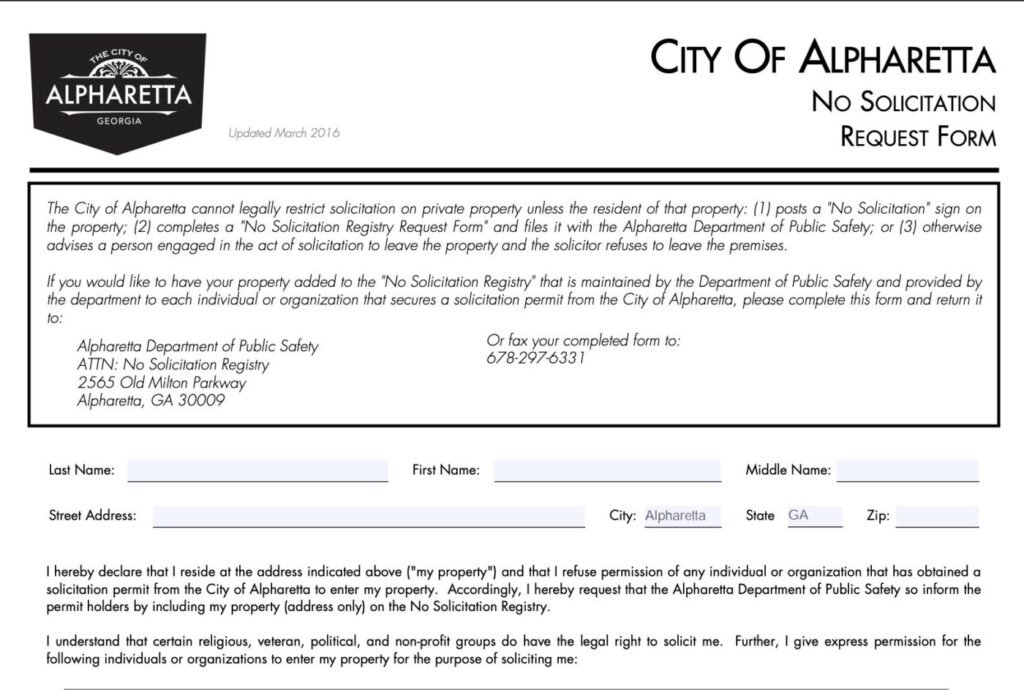
In Alpharetta, residents can place their address on an official municipal No Solicitation Registry managed through public safety officials.
In Johns Creek, commercial solicitors must obtain permits and background screening.
Milton requires criminal background checks for many solicitors.
Suwanee can issue substantial fines for violations tied to peddler ordinances.
And in parts of Forsyth County, solicitors are required to visibly wear identification and carry permits while going door to door.
What still catches many homeowners off guard is this: the humble “No Soliciting” sign actually carries legal weight in many Georgia jurisdictions.
It is not merely decorative suburban passive-aggression.
Across portions of Forsyth County and several North Atlanta municipalities, entering a property clearly marked with a No Solicitation or No Peddlers sign can become a code violation for commercial solicitors.
That partly explains why more North Atlanta homes now display signs that range from elegant brass plaques to increasingly exhausted-looking warnings printed in all caps.
The Endless Suburban Sales Funnel
There is also a newer frustration suburban residents have noticed in recent years: plastic-wrapped flyers tossed onto driveways.
Some are simple advertising packets. Others, according to multiple Georgia incidents cited in the news, have included extremist and antisemitic propaganda distributed across suburban neighborhoods including Dunwoody, Sandy Springs, Roswell, and Marietta.
While the First Amendment protects even deeply offensive speech, municipalities and police departments have increasingly explored littering and dumping laws when materials are thrown onto private property without consent.
Perhaps the most revealing part of the situation is what it says about suburban life itself.
North Atlanta’s growth brought beautiful trails, restaurants, parks, mixed-use developments, and high-performing schools. But prosperity also created an enormous commercial targeting zone. The same demographics that attract new restaurants and investment also attract sales ecosystems designed to reach homeowners at every possible point: mailbox, driveway, inbox, smartphone, and front porch.
In other words, suburban convenience has a shadow economy.
And increasingly, residents are trying to reclaim a little quiet.
Some do it with camera doorbells. Others with HOA gate policies. Others simply stop answering the door, unless they know who is outside.
The modern suburban “Leave Us Alone” movement may not look dramatic. It often begins with something much smaller. A tiny sign beside the doorbell. Or finally unsubscribing from that blue envelope.
The Yard Sign Season That Never Ends
There is another form of suburban clutter that technically is not junk mail at all, yet many North Atlanta residents increasingly experience it the same way: political campaign saturation.
Every election cycle, intersections across Johns Creek, Alpharetta, Roswell, and Suwanee begin to transform into temporary forests of corrugated plastic signs. Utility poles accumulate stapled campaign notices. Road medians become crowded with overlapping candidate branding. Major corridors like Medlock Bridge Road, Old Alabama Road, McGinnis Ferry, and Peachtree Parkway can suddenly resemble outdoor advertising corridors rather than suburban streets.
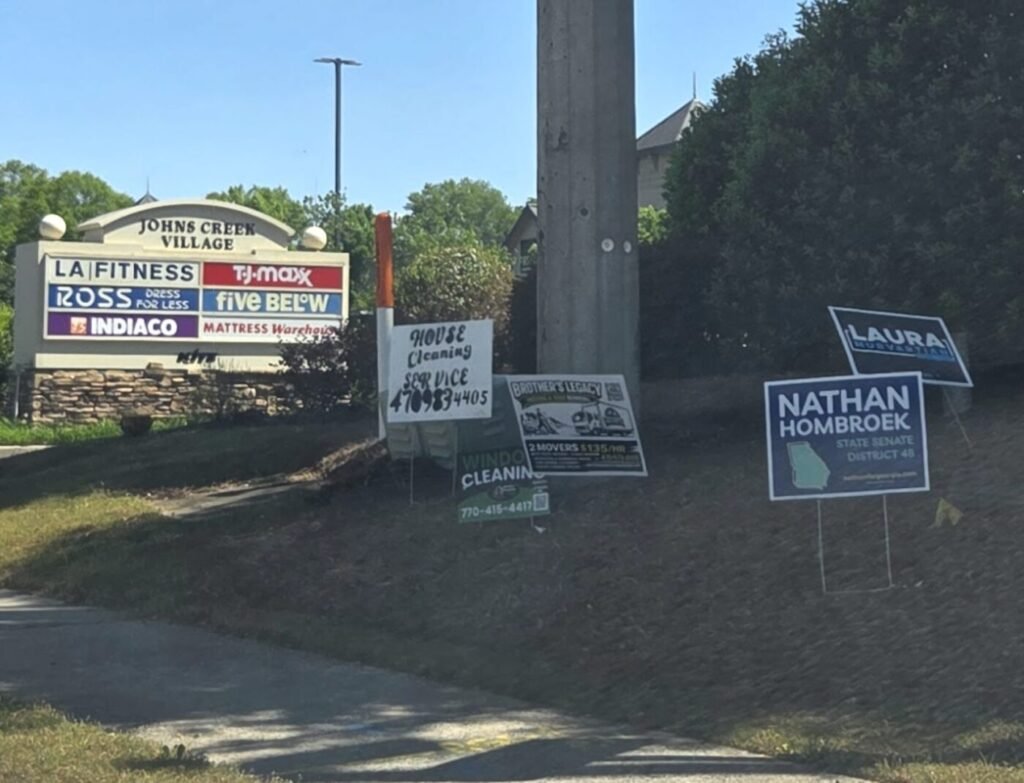
Unlike commercial solicitation, political speech receives some of the strongest constitutional protections in American law. That means local governments often have limited authority to regulate campaign messaging itself, particularly during election periods. Yet many municipalities still struggle with the aftereffects: abandoned signs left weeks after elections, damaged medians, blocked sightlines near intersections, and plastic debris scattered after storms.
Residents frequently complain less about the politics and more about the sheer physical accumulation. During major election years, the suburban landscape can begin to feel temporarily rented out to competing campaigns. And because signs are relatively inexpensive compared to television advertising, suburban intersections with heavy commuter traffic have become especially valuable political territory.
The result is a curious modern reality of suburban life: residents spend considerable money maintaining manicured entrances, HOA landscaping, seasonal flowers, and neighborhood beautification, only to watch many of those same corners become cluttered every election season with temporary signage wars.
The “Lawn Newspaper” That Bypasses the Mailbox
Then there is the suburban publication that never actually enters the mailbox at all.
Across North Atlanta neighborhoods, residents regularly wake up to find free community newspapers or advertising circulars tossed onto driveways and lawns, usually wrapped in plastic bags. Some contain local reporting. Many are dominated by coupon inserts, grocery promotions, chain restaurant ads, mattress sales, and home-service marketing.
In effect, it is a parallel distribution system designed specifically to bypass mailbox opt-outs.
Even households that successfully reduce junk mail through federal suppression systems often continue receiving these driveway deliveries because they operate under entirely different distribution networks.
On rainy mornings across suburban Georgia, the result becomes familiar: soggy blue plastic sleeves sitting near curbs, newspapers flattened into driveways by passing cars, or scattered coupon pages drifting through storm drains after windstorms.
Some residents still genuinely enjoy receiving local print editions, particularly older readers who grew up with community newspapers as part of daily life. But others increasingly view the practice as another form of unsolicited suburban overflow — especially when the publication itself contains relatively little news compared to the volume of advertising inserts packed inside.
The irony is difficult to miss. In an era when much of America worries about the decline of local journalism, many suburban residents simultaneously feel overwhelmed by the physical remnants of advertising-heavy print distribution systems that survive largely because of coupon revenue.
And so the suburban threshold keeps evolving.
First the mailbox filled up. Then the driveway. Then the lawn. Then the phone. Then the inbox.
Modern suburban life increasingly involves not just owning a home, but constantly managing access to it.
If this felt close to home, these stories may be worth your time too.
Community Voice
A snapshot of reader views, not a scientific survey.
Explore Community Voice →About the Author


In North Atlanta
Eggs in North Atlanta: Where They Really Come From — and What “Local” Means in 2026
Is North Atlanta Headed for a Florida-Style Affordability Crunch?
Final Day to Register Sets the Stage for a Competitive Georgia Primary

HOA Fees in North Atlanta: What You’re Really Paying For—and Why It Keeps Going Up

Inside Boehringer’s New Johns Creek Headquarters, Medley Begins to Feel Real
Newsletter, Top Stories, May 19
IN NORTH ATLANTA