Eggs in North Atlanta: Where They Really Come From — and What “Local” Means in 2026
Get major local stories and development updates.
For residents across Johns Creek, Alpharetta, Roswell, Milton, Cumming, Duluth, and Suwanee, eggs are one of the most common items in the refrigerator.
But the question many shoppers assume they know the answer to — where do these eggs actually come from? — turns out to be more complicated than it looks.
Despite the strong “local food” culture in North Atlanta, the reality is that very few eggs are actually produced inside the counties where most people in the region live.
Instead, the egg supply for the area is built around a regional production network across North and Northeast Georgia, combined with national brands and private-label supermarket sourcing.
Here is how that system works.
The surprising reality: very few eggs are produced inside North Atlanta counties
The counties that make up the core North Atlanta suburban belt — Fulton, Forsyth, and Gwinnett — are major consumers of eggs, but not major producers.
According to the 2022 U.S. Agricultural Census, the number of egg-laying hens in these counties is extremely small.
Approximate counts:
| County | Egg-laying hens |
|---|---|
| Forsyth County | ~51,000 |
| Fulton County | ~1,300 |
| Gwinnett County | ~450 |
For comparison, a single industrial egg operation may house hundreds of thousands to several million hens.
This means the egg production inside these counties is mostly:
• small hobby farms
• backyard flocks
• tiny direct-to-consumer operations
In other words, local production exists — but at a very small scale.
Where most eggs actually come from
The real production base for eggs sold in North Atlanta sits just outside the metro area.
Several counties in North and Northeast Georgia contain dramatically larger concentrations of egg farms.
One example:
• Franklin County, Georgia — more than 1 million egg-laying hens
That is roughly 20 times the number in Forsyth County, and hundreds of times more than Fulton or Gwinnett.
These rural counties supply grocery distribution networks that feed the entire Atlanta metro region, including North Atlanta suburbs.
Franklin County, Georgia is located in Northeast Georgia, about 90 miles northeast of Atlanta near the South Carolina border. The county sits in a largely rural part of the state and remains heavily agricultural compared with the suburban counties that make up most of North Atlanta.
A major regional producer: Country Charm Eggs
One of the clearest examples of this regional supply chain is
Country Charm Eggs, LLC.
Located in Gillsville, Georgia, the company reports:
• roughly 1.7 million laying hens
• production of both white and brown eggs
• output ranging from commodity eggs to certified organic
The company produces, packages, and distributes eggs across the entire Southeastern United States.
In 2023, the operation was acquired by MPS Egg Farms, an Indiana-based company.
The acquisition highlights an important reality of the egg market:
Even when eggs are produced regionally, ownership and distribution are often part of national agricultural networks.
What “local eggs” really means
Many shoppers assume the word “local” has a strict definition.
In reality, it doesn’t.
There is no single federal definition of “local food.”
Some USDA programs define local as:
• produced within the same state, or
• produced within 400 miles
Farmers markets often use stricter definitions.
For example, some markets in the North Atlanta area limit vendors to farms within about 100 miles.
So the same carton of eggs might be considered:
• “local” in a supermarket, but
• not local at a farmers market
Both claims can technically be true.
The easiest way to see where eggs come from
Most consumers overlook the small code printed on egg cartons.
Look for a number that begins with “P-”.
Example:
P-1234
This code identifies the processing plant where eggs were washed, graded, and packaged.
It does not always tell you where the hens lived, but it gives a reliable starting point for tracing the supply chain.
| Plant Code | Company | Location | Notes |
|---|---|---|---|
| P-1359 | Country Charm Eggs | Gillsville, Georgia | Large regional egg processor distributing across the Southeast. |
| P-1103 | Cal-Maine Foods | Multiple Southeast facilities | Largest egg producer in the United States supplying grocery private labels. |
| P-1065 | Braswell Family Farms | Nash County, North Carolina | Regional supplier of specialty and pasture-raised eggs. |
| P-1946 | Rose Acre Farms | Indiana (national distribution) | One of the largest egg producers supplying national grocery chains. |
What kinds of eggs are sold in North Atlanta stores
Supermarket egg sections now contain far more variety than they did a decade ago.
Across major grocery chains serving North Atlanta — including Publix, Kroger, Sprouts, Costco, and Whole Foods — several categories dominate.
Conventional eggs
The most affordable category.
These typically come from large industrial operations supplying regional distribution networks.
Cage-free eggs
Increasingly common.
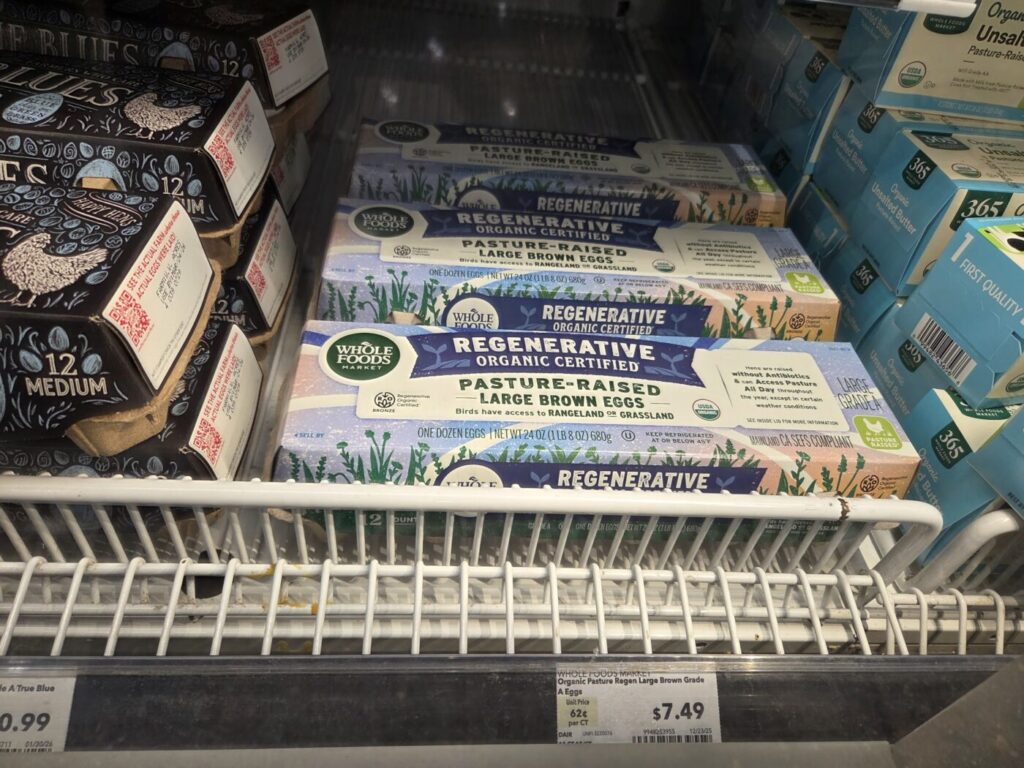
Some grocery chains — particularly Whole Foods — now require all eggs they sell to be cage-free or better.
Free-range eggs
Hens have outdoor access, although the amount of outdoor space can vary widely between producers.
Pasture-raised eggs
Often marketed as the premium tier.
Brands such as Vital Farms emphasize hens raised on open pasture.
Prices in North Atlanta stores often reach $8–$9 per dozen.
Organic eggs
These must meet USDA organic certification standards, including organic feed and restrictions on antibiotics.
Organic eggs are widely available in the area but are usually produced outside the immediate counties around Atlanta.
Regenerative eggs
A newer category.
Some producers now market eggs produced using regenerative agricultural practices, focused on soil health, pasture rotation, and ecosystem management.
These remain a small niche segment of the market.
Why egg production stays outside North Atlanta
Several structural factors limit large-scale egg farming inside North Atlanta’s suburban counties.
Land prices
Agricultural land in North Fulton and South Forsyth has become extremely expensive due to residential development.
Large poultry farms require significant land buffers, making suburban locations impractical.
Zoning and local regulations
Cities and counties across North Atlanta allow backyard chickens, but under strict rules.
Typical regulations include:
• limits on the number of birds
• bans on roosters
• setback requirements from neighboring homes
• HOA restrictions
These rules allow small backyard flocks but make commercial production nearly impossible inside suburban areas.
Shrinking farmland
Agricultural land has declined significantly across the region.
Since 2017:
• farmland in Forsyth County has declined
• farmland in Fulton County has declined
• farmland in Gwinnett County has declined sharply
As land converts to housing and commercial development, egg production moves farther away.
Small local farms still exist
Although the region lacks large commercial egg farms, smaller operations do exist within about 50–100 miles of North Atlanta.
Examples include small pasture-raised egg farms in rural North Georgia that sell through:
• farmers markets
• CSA subscriptions
• farm stores
• regional delivery platforms
These farms typically operate hundreds of hens rather than thousands or millions.
For consumers seeking truly local eggs, these channels are often the best option.
Egg prices: the roller-coaster of 2024–2026
Egg prices in the United States have been unusually volatile in recent years.
A major factor has been avian influenza (bird flu) outbreaks affecting poultry flocks across the country.
During 2025, national egg prices reached historic highs.
By early 2026, prices have cooled significantly.
Average U.S. retail price (January 2026):
• roughly $2.57 per dozen for standard large eggs
But in North Atlanta stores, premium eggs still sell for much more.
Typical retail ranges:
| Egg type | Typical price |
|---|---|
| Basic eggs | $2–$3 |
| Cage-free | $4–$5 |
| Free-range | $5–$6 |
| Organic | $6–$7 |
| Pasture-raised | $8–$9 |
Premium categories have remained far more stable in price than commodity eggs.
What the future likely looks like
Looking ahead to the rest of the decade, the structure of the egg market around North Atlanta is unlikely to change dramatically.
The most probable scenario:
• North Atlanta remains a consumption center rather than a production hub
• eggs continue to arrive from North Georgia and the wider Southeast
• grocery stores expand premium labeling categories
• truly local eggs remain a small niche sold mostly through farmers markets and direct farm sales
For shoppers, the key takeaway is simple:
The word “local” on an egg carton often refers to the region — not necessarily the neighborhood.
And if you want to know where your eggs really come from, the small plant code on the carton is still the best place to start.
Read Also:
About the Author


In North Atlanta

Dervish Plans 200-Seat Turkish Restaurant in Johns Creek

Simple Man Distillery Hiring Ahead of Cumming City Center Opening

Roswell Approves Champions Place Expansion for Adults With Physical Disabilities

Tavern Off the Green Opens at Cumming City Center With Cajun Menu and Late-Night Hours

Johns Creek Native to Lead Medley’s Concierge Team Ahead of October Opening

At Read It Again, the Bookstore Comeback Is About Community
IN NORTH ATLANTA