Texas, Louisiana and Mississippi Are Competing for the Next Generation of Megaprojects
Texas, Louisiana, and Mississippi are competing for huge investments from SpaceX and xAI in semiconductor plants, launch complexes, and AI data centers. These projects could reshape local economies but come with significant infrastructure and environmental demands.
Get the week’s jobs, development, housing and growth stories from across the Sun Belt in one email.
The scale of economic development across the Sun Belt is entering unfamiliar territory.
In Texas, SpaceX is planning the first phase of a semiconductor manufacturing complex valued at more than $16.8 billion. Louisiana has landed a proposed $100 billion SpaceX launch campus along its Gulf Coast. In Mississippi, Elon Musk’s xAI has committed more than $20 billion to a data center in Southaven, just across the state line from its enormous computing operations in Memphis.
These are not conventional factory announcements. They are projects capable of changing the tax base, labor market, infrastructure needs and, in some cases, the physical identity of the communities where they land.
They are also showing how aggressively Southern states are competing for the next generation of American industry.
Texas Lands a $16.8 Billion Chip Project
In August, Texas Gov. Greg Abbott announced that SpaceX would build a vertically integrated semiconductor plant in Grimes County, northwest of Houston.
The first phase of the Terafab project represents more than $16.8 billion in planned investment and 3,000 jobs, according to the governor’s office. Texas offered SpaceX a $30 million Texas Enterprise Fund grant, and the project also qualifies for incentives through the state’s Jobs, Energy, Technology and Innovation program.
At a planned 100 million square feet, the facility is intended to bring multiple parts of semiconductor production under one roof. The project adds another major Musk-linked operation to a state already home to SpaceX headquarters and Starbase, Tesla’s large manufacturing presence near Austin, The Boring Company and Neuralink.
For Grimes County, the significance goes well beyond another employer moving into town. A project of that size brings thousands of workers, contractors and suppliers into an area that has never operated at that industrial scale.
And Texas is no longer competing only for traditional factories. Chips, artificial intelligence infrastructure, rockets and advanced manufacturing increasingly sit on the same economic-development map.
Louisiana Goes Much Bigger
Louisiana’s newest SpaceX announcement makes even Texas’ numbers look modest.
SpaceX announced in August that it intends to invest $100 billion in a launch complex in Vermilion Parish, along the Louisiana coast. The company expects to create 3,000 direct jobs over 10 years with an average annual salary of about $92,600. Louisiana Economic Development estimates another 8,100 indirect jobs could follow.
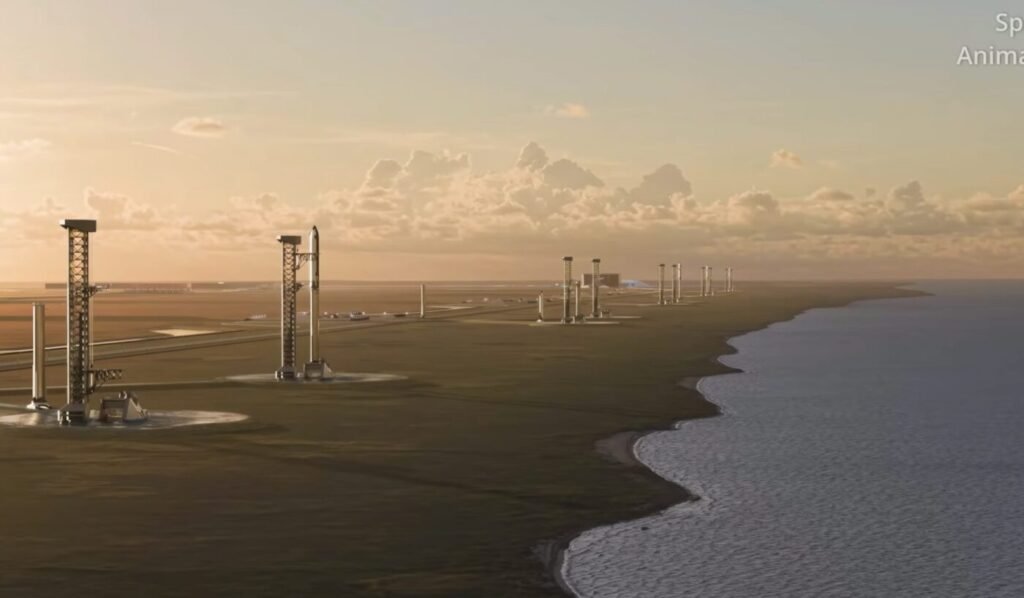
At full buildout, the campus is expected to include five launch complexes with two launch pads each, along with propellant production, power generation, vehicle processing facilities and housing for employees. Construction is expected to begin by the end of 2027, with the first launch targeted as early as 2029.
Louisiana has assembled state incentives, workforce assistance and local agreements around the project. Under a payment-in-lieu-of-taxes agreement, SpaceX is expected to make a $20 million upfront payment and at least $25 million annually to local taxing bodies for 25 years. State officials say those payments should exceed $825 million over the life of the agreement.
The choice of Vermilion Parish also reflects a broader shift in the Southern economy. Louisiana officials are openly trying to transfer the skills and industrial base built around oil, gas and heavy industry into aerospace, advanced manufacturing and technology.
The state is already pursuing similarly enormous investments elsewhere. Meta’s planned Hyperion data center campus in Richland Parish carries an announced investment of about $50 billion.
Mississippi Joins the AI Infrastructure Race
The Memphis region offers another version of the same transformation.
Across the Tennessee-Mississippi line, xAI is developing a new data center in Southaven that Mississippi officials say will involve more than $20 billion in investment, the largest corporate investment announced in the state’s history.
The Southaven operation, known as MACROHARDRR, is being developed near an xAI power-generation site and the company’s existing computing infrastructure in Tennessee. Mississippi says the development will create hundreds of permanent jobs and push xAI’s computing capacity in the area toward 2 gigawatts.
Mississippi approved the company for its Data Center Incentive, which provides qualifying operations with sales- and use-tax exemptions on computing equipment and software. Southaven and DeSoto County are also supporting the development through fee-in-lieu agreements.
The result is effectively a two-state technology corridor. The larger Memphis-area operation already includes multiple major data-center campuses, while the Southaven expansion pushes the footprint deeper into Mississippi. Pasted text
The Competition Comes With Bigger Demands
Projects measured in tens of billions of dollars can bring jobs and tax revenue, but their demands extend well beyond a factory gate.
Data centers require enormous amounts of electricity and cooling. Semiconductor plants need water, power and specialized infrastructure. Rocket facilities can reshape roads, environmental planning and surrounding land use. Thousands of new employees can also put pressure on housing, schools and transportation.
Those effects are already part of the debate around the Memphis-area expansion. The City of Memphis is developing community programs near the Colossus complex and has been considering the operation’s effects on air quality and surrounding neighborhoods. The city has also worked with xAI on a proposed water-recycling facility intended to reduce demand on the region’s aquifer.
Louisiana, meanwhile, says transportation officials are evaluating roads and bridges around the planned SpaceX complex, while environmental and coastal agencies are preparing for the demands of a project unlike anything previously built there.

That is becoming part of the Sun Belt megaproject competition itself. Winning a project is increasingly only the beginning. States and local governments must also show that they can supply the electricity, transportation, workers, housing and regulatory capacity needed to make it function.
A Different Kind of Southern Growth
For decades, Southern economic development was often associated with automobile plants, distribution centers and corporate relocations.
Those projects remain important. But the newest competition is moving into industries that require far more capital and infrastructure: artificial intelligence computing, semiconductors, batteries, aerospace and advanced manufacturing.
Musk’s companies provide an unusually concentrated example. Texas, Louisiana, Tennessee and Mississippi now host or are preparing for some of the largest projects in his business network, while states are using grants, tax programs, workforce assistance and infrastructure commitments to attract them.
The announced investment figures are enormous, but many of these projects remain years from full buildout. The promised jobs, tax revenue and broader economic effects will depend on how much of those plans ultimately gets constructed.
What is already clear is where much of the competition is taking place. Increasingly, some of America’s most ambitious industrial bets are being made not in the traditional technology centers of the West Coast, but across the Sun Belt.
About the Author

 Build a Stronger Plan for the SAT
Edison Prep’s SAT group classes combine experienced instruction, structured preparation and practical testing strategies.
Explore SAT Classes
Build a Stronger Plan for the SAT
Edison Prep’s SAT group classes combine experienced instruction, structured preparation and practical testing strategies.
Explore SAT Classes
Across the Sun Belt
Tesla’s $10.1 Billion Solar Factory Plan Could Bring Nearly 10,000 Jobs to Texas
A Tiny Texas Community Is Becoming a $1.2 Billion Data Center Hub

The Data-Center Boom Needs Factories, Too. This Texas Plant Is Heading Toward 4,000 Workers
The Data-Center Boom Is Building a New Factory Workforce in the Sun Belt

The Sun Belt’s Battery Belt Is Losing Jobs as EV Factory Plans Shrink and Shift