A $1.4 Billion Medical-Isotope Reactor Is Planned for Rural New Mexico
New Mexico supports a $1.4 billion Eden Radioisotopes facility to produce medical isotopes like molybdenum-99, potentially supplying millions of cancer treatment doses and creating 205 jobs statewide. The project awaits federal approval.
Get the week’s jobs, development, housing and growth stories from across the Sun Belt in one email.
A $1.4 billion nuclear facility planned for southeastern New Mexico could eventually produce radioactive materials used every day to diagnose heart disease, detect cancer and deliver increasingly important targeted cancer treatments.
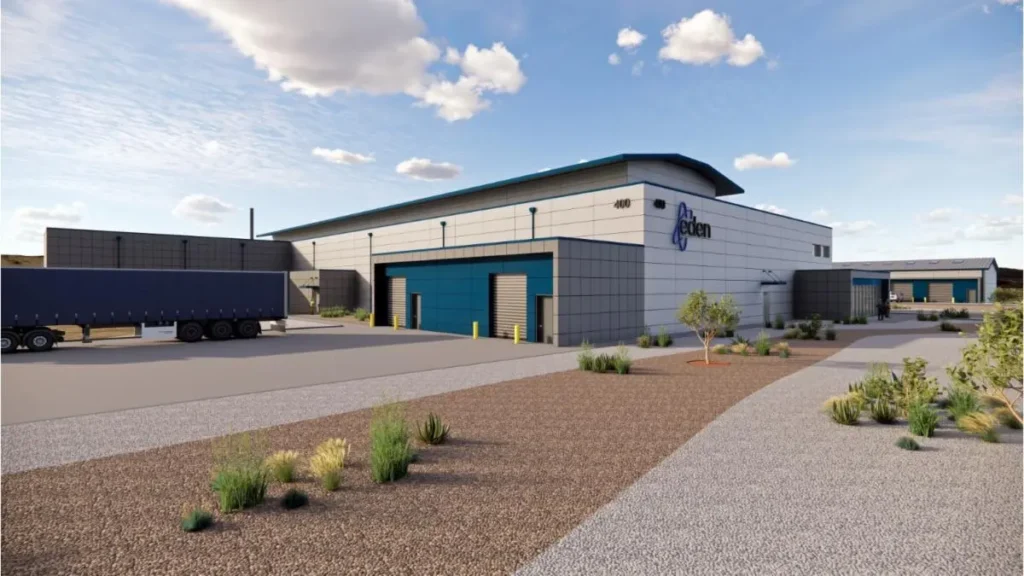
Eden Radioisotopes plans to build the medical-isotope production complex near Eunice in Lea County, close to the Texas state line. New Mexico announced its support for the project Thursday, Sept. 24, describing it as an investment of up to $1.4 billion that could create 205 jobs statewide.
The project is not yet cleared for construction. Eden has applied to the U.S. Nuclear Regulatory Commission for a construction permit, and the federal safety and environmental review is underway. The NRC has scheduled a public hearing in Eunice for Sept. 29.
If the project moves through licensing and construction as planned, initial isotope production could begin in 2030.
What the New Mexico facility would make
The planned Eden Isotope Production Complex is not a commercial nuclear power plant. Its reactor would be built specifically to create medical isotopes, radioactive forms of elements that can be used inside the body for imaging or treatment.
One of the most important is molybdenum-99, or Mo-99. It decays into technetium-99m, a radioisotope widely used for medical imaging, including heart scans and tests that help doctors detect cancer and evaluate how organs are functioning.
More than 40,000 medical procedures in the United States use technetium-99m each day, according to the U.S. Department of Energy.
Eden also plans to make lutetium-177, an isotope used in a growing class of targeted cancer treatments. Those therapies pair a radioactive isotope with a molecule designed to seek out particular cancer cells, allowing radiation to be delivered much more directly to tumors.
Eden says its proposed reactor could produce enough Mo-99 to meet at least half of global demand and as many as 3 million doses of lutetium-177 annually. Those are company projections and will depend on licensing, construction and eventual operating performance.
Why America still depends on overseas reactors
The project addresses a problem largely invisible to patients. The United States performs tens of thousands of procedures with medical isotopes every day, yet its supply chain for Mo-99 remains heavily dependent on production outside the country.
The Department of Energy said this year that the United States still relies on Mo-99 imported from the Netherlands, Belgium, South Africa and Australia. The isotope decays quickly, losing about 1% of its activity every hour, which makes long international supply chains particularly vulnerable to delays and reactor outages.
That vulnerability is not theoretical. A combination of scheduled and unscheduled shutdowns at two overseas reactors in 2024 produced a global Mo-99 shortage that affected medical providers in the United States. The federal government has spent years encouraging domestic alternatives.
Another major domestic project is already under construction in Wisconsin. SHINE Technologies is developing a facility that the Department of Energy says could eventually supply up to three-quarters of U.S. Mo-99 demand.
Eden would add another large source, using a different reactor-based approach in New Mexico.
Federal approval still comes first
Eden submitted its construction-permit application to the Nuclear Regulatory Commission in May. The NRC accepted the application for review in June.
The application covers a non-power reactor and associated facilities for processing and preparing medical isotopes. The complex would also include target-fabrication operations and facilities for handling and storing radioactive waste.
The NRC currently expects to complete a final environmental assessment in June 2027 and a final safety evaluation in October 2027.
Eden’s own schedule calls for construction between 2027 and 2029, followed by commissioning and regulatory verification before initial production in 2030.
The Sept. 29 NRC meeting in Eunice will give residents an opportunity to comment publicly on the application.
205 jobs are planned
New Mexico expects the project to create 205 jobs, including 146 in Lea County. The first phase would account for 125 jobs. Another 80 positions are expected with a future second reactor.
Positions are expected to include nuclear engineers, reactor operators, radiation-safety specialists and skilled technicians. The state says 200 of the 205 jobs are connected to manufacturing.
The project is receiving support through New Mexico’s Job Training Incentive Program, high-wage and rural-job tax credits and a state economic-development tax program. State officials estimate the development could generate more than $1.5 billion in economic impact over 10 years.
The final value of the public support will depend on the project’s investment, hiring and eligibility under the individual programs.
New Mexico already has deep nuclear roots
New Mexico has been connected to nuclear science for generations through Los Alamos National Laboratory, Sandia National Laboratories and other federal and private facilities.
Eden’s reactor technology itself grew from work at Sandia. The company holds an exclusive license to the reactor design and has brought former Sandia researchers involved in its development into the project.
Lea County also provides proximity to other parts of the nuclear fuel and waste-management industry.
What New Mexico has not had is a commercial operation on the scale Eden is proposing, built specifically around producing medical isotopes for hospitals and pharmaceutical companies.
A long path remains before the first patient benefits
The $1.4 billion figure makes the project one of the more unusual industrial developments announced in the Sun Belt this year, but the immediate story is still about licensing rather than construction.
Eden must complete the NRC review, secure a construction permit, finance and build the complex, commission its equipment and later obtain federal permission to operate it.
That process will take years. If it succeeds, however, a facility outside a small New Mexico community could become part of a medical supply chain reaching hospitals across the country.
For patients undergoing a heart scan or a new generation of targeted cancer treatment, the radioactive material involved may last only hours or days.
The effort to make more of it in America is shaping up to last much longer.
About the Desk

 Build a Stronger Plan for the SAT
Edison Prep’s SAT group classes combine experienced instruction, structured preparation and practical testing strategies.
Explore SAT Classes
Build a Stronger Plan for the SAT
Edison Prep’s SAT group classes combine experienced instruction, structured preparation and practical testing strategies.
Explore SAT Classes
Across the Sun Belt
Tesla’s $10.1 Billion Solar Factory Plan Could Bring Nearly 10,000 Jobs to Texas
A $400 Million South Carolina Factory Expansion Will Create 105 Jobs

Food Lion Sets Fall Opening Dates Across the Carolinas and Georgia, Signals More Growth in 2027

Livestock Trade Is Reopening as Texas Continues Fighting Screwworm

Arizona’s $7 Billion Chip Project Just Became a $12 Billion Project