What Dawsonville’s Boom Could Mean for Traffic, Housing, and Prices in North Atlanta
Get major local stories and development updates.
This article is part of our ongoing 2026 Development Update series examining how public projects and private investment are reshaping North Atlanta.
The steady flow of traffic along Georgia 400 no longer ends at Forsyth County. It continues north, carrying with it a pattern that has already reshaped Alpharetta, Johns Creek, and much of South Forsyth: rising home prices, tightening land supply, and a search for the next place to grow.
That next place, increasingly, is Dawsonville.
What is unfolding there is not a small-town growth story but a regional shift with implications that reach directly into North Fulton and South Forsyth. The forces now transforming Dawson County—migration, infrastructure investment, and industrial expansion—mirror the earlier phases of growth seen farther south, offering a preview of where the North Atlanta suburban model is heading next.
A Population Surge Driven by Affordability
Dawson County’s population grew from 26,797 in 2020 to an estimated 35,365 by 2025, a roughly 32 percent increase in just five years.
That pace placed it among the fastest-growing counties in the United States, with growth largely fueled by domestic migration rather than natural population change. Similar patterns are playing out in outer-ring suburbs of cities like Austin, Nashville, and Phoenix, where rising costs in core suburban markets are pushing buyers farther out in search of affordability, space, and newer housing options.
The pattern is familiar. Residents are moving north from more established and more expensive suburban markets—particularly Forsyth and Gwinnett—seeking lower home prices and more space. Median home values in Dawson County hover around $415,000, a meaningful discount compared to Cumming or Alpharetta.
For North Atlanta communities, this shift matters. It suggests that affordability pressures are no longer contained but are actively pushing demand outward, extending the suburban growth corridor beyond its traditional boundaries.
How Home Prices and Lot Sizes Shift Moving North
The differences begin to show quickly once you move up the GA-400 corridor. In Alpharetta, the housing market reflects years of sustained demand, strong schools, and proximity to major employers. Median home prices are commonly in the $700,000 to $900,000 range, with many newer or renovated properties exceeding that. Lot sizes, particularly in newer developments, tend to be tighter—often between 0.15 and 0.3 acres—reflecting both land constraints and a shift toward higher-density suburban living.
A short drive north into Cumming begins to change the equation. Prices generally ease into the $500,000 to $700,000 range, depending on proximity to GA-400 and newer master-planned communities. Lot sizes expand slightly, often landing between 0.2 and 0.5 acres, offering more space while still maintaining a suburban neighborhood feel.
By the time buyers reach Dawsonville, the contrast becomes more pronounced. Median home prices hover closer to the low $400,000s, with many properties offering significantly larger lots—frequently between 0.5 and 1 acre, and sometimes more. The result is a different value proposition: less proximity to job centers, but more space, newer construction options, and a price point that remains accessible compared to North Fulton.
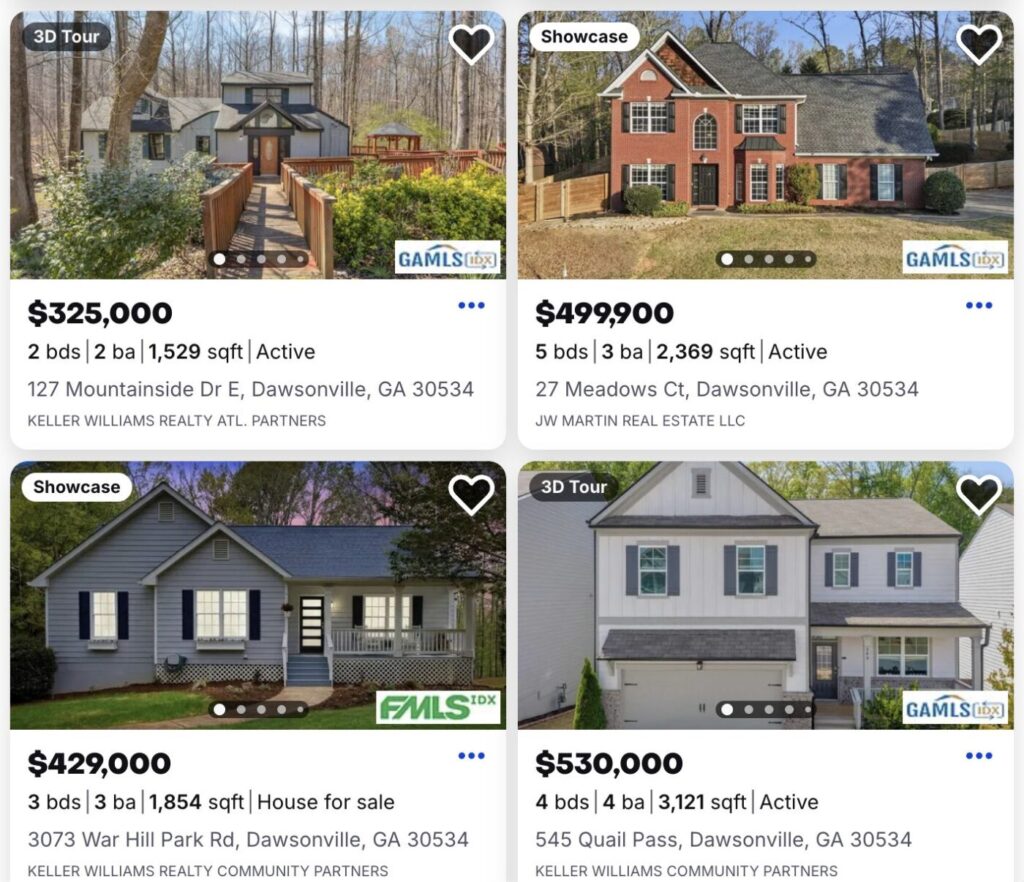
For buyers priced out of Alpharetta or looking for more land without leaving the broader North Atlanta orbit, Dawsonville is increasingly becoming part of the same conversation rather than a separate market altogether.
Infrastructure First: Securing Long-Term Growth
Unlike earlier suburban expansions that often followed development, Dawsonville’s growth is being built on major infrastructure investments.
At the center is the Russell Creek Reservoir, a project estimated between $50 million and $100 million that is designed to produce 17.3 million gallons of water per day.
The reservoir addresses a projected shortfall of 3.8 million gallons per day and is intended to support a future population of up to 126,000 residents by 2057.
For comparison, that kind of forward-looking water planning reflects lessons learned in faster-growing counties to the south, particularly Forsyth County and Gwinnett County, where rapid residential expansion has at times outpaced infrastructure upgrades. The approach in Dawsonville suggests a more deliberate attempt to align growth with capacity from the outset.
A New Kind of Downtown
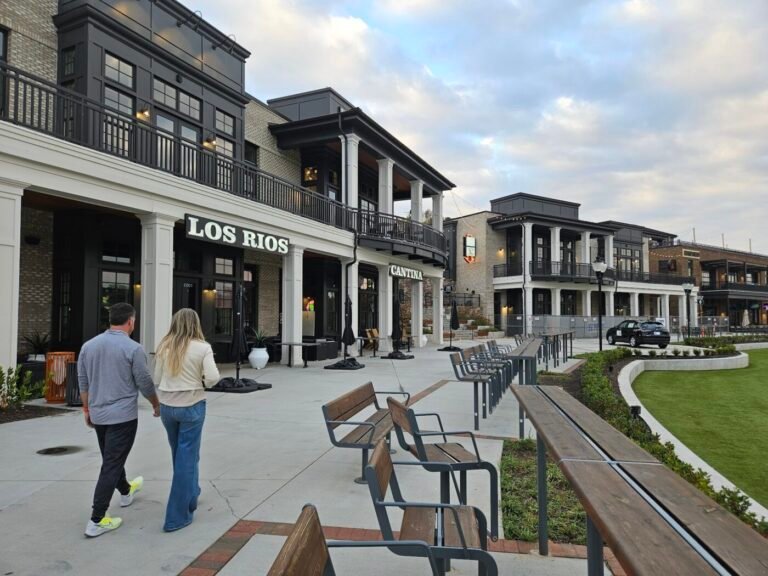
Dawsonville’s leadership is also attempting something that many North Atlanta suburbs have spent years refining: the creation of a true town center.
A 17-acre mixed-use development is planned to connect the city’s historically disconnected core areas, with space for 700 to 800 residential units, retail, dining, and public gathering spaces.
The plan includes features that echo successful suburban models: A walkable central plaza designed for events and concerts, shared commercial kitchens and local food markets, coworking and business incubation spaces, and cultural and conference facilities.
The goal is clear: attract younger residents and remote workers who might otherwise gravitate toward established hubs like Alpharetta’s Avalon or downtown Roswell.
For North Atlanta, the implication is competitive. As newer areas replicate the “live-work-play” formula, the differentiation between suburban centers becomes thinner, and the competition for residents and businesses expands geographically.
Industry Moves In Along GA-400
While residential growth draws attention, Dawsonville’s long-term strategy is rooted in industry.
The opening of a 335,000-square-foot facility by BTD Manufacturing in April 2025 highlights the scale of industrial investment taking place.
At the same time, a 77-acre Business & Innovation Park is planned to attract companies in clean technology, biotechnology, and advanced manufacturing.
This aligns with a broader effort to position the GA-400 corridor not just as a commuter route, but as a continuous economic spine extending north from North Fulton.
For communities like Johns Creek and Alpharetta, which have long anchored the technology and office segments of this corridor, the northward expansion of industrial and innovation space could redistribute job growth and reshape commuting patterns over time.
Retail Follows Rooftops
Retail development is keeping pace. A 102-acre project known as Dawson Marketplace is expected to bring approximately 350,000 square feet of retail space, including national tenants such as Sierra and Crumbl, alongside a major grocery anchor.
The project alone is expected to create around 450 jobs while expanding the county’s commercial tax base.
This reflects a familiar sequence seen across North Atlanta: residential growth first, followed by retail consolidation into “power centers” that reduce the need for residents to travel south for everyday services.
The Regional Link: Logistics and Connectivity
Perhaps the most significant long-term development lies just outside Dawson County. The Blue Ridge Connector inland port in Gainesville, a $134 million facility scheduled to open in 2026, will provide direct rail access to the Port of Savannah.
For manufacturers, this reduces a 600-mile roundtrip truck journey and connects the region to global shipping routes more efficiently.
The effect is not limited to Dawsonville. Improved logistics infrastructure strengthens the entire North Georgia economic corridor, making the region more competitive for industrial investment—and potentially accelerating growth pressures further south.
What It Means for North Atlanta
Dawsonville’s rise is part of a broader rebalancing of growth across the northern arc of metro Atlanta. For North Fulton and South Forsyth, several implications are already becoming visible:
Housing pressure may ease slightly at the margin as buyers look farther north, but demand is not disappearing—it is expanding geographically.
Traffic patterns along GA-400 are likely to intensify as commuting distances lengthen.
Retail and service competition will broaden, as newer developments replicate established suburban models.
Industrial growth north of Forsyth could gradually shift where jobs are located, not just where people live.
In many ways, Dawsonville today resembles North Fulton a decade or two ago: a place where land, infrastructure, and timing align to create rapid transformation.
The difference is that this time, the expansion is happening in a more connected, more competitive, and more closely watched regional landscape.
If you’ve been following growth and change around here, these stories are worth a look too.
About the Author


In North Atlanta

5 Coffee Trucks and Mobile Cafés Worth Finding Around North Atlanta
Simple Man Distillery Hiring Ahead of Cumming City Center Opening
Medley Opens First Access to 133 Townhomes in Johns Creek
North Atlanta Added 11,000 Residents, but the Growth Is Concentrated in Three Cities
North Atlanta’s Job Market Splits as Health Care Grows and Office Work Shrinks
What North Atlanta Should Know Today. Friday, Sept. 11, 2026
IN NORTH ATLANTA