 Exclusive sponsor
Why Many North Atlanta Residents Still Won’t Use MARTA — Even After the April 18 Redesign

Major local stories and useful updates, once a week.
On paper, the new MARTA bus network sounds like the kind of fix riders have been asking for. Starting April 18, buses are expected to come more often, transfers are supposed to be easier, and the system is being simplified after decades of incremental changes.
But frequency is only one part of the equation. And for many residents across Alpharetta, Johns Creek, Milton, and South Forsyth, the bigger question isn’t how often the bus comes. It’s whether it comes at all.
A System Built Around a Different Geography
The redesign shifts MARTA away from wide geographic coverage toward higher-frequency routes. The number of routes drops significantly, but the promise is that the remaining ones will run more often and more consistently.
That tradeoff makes sense in dense urban areas.
It’s a harder sell in suburban North Atlanta, where daily life is built around distance. Homes, schools, offices, and shopping centers are spread out by design. Cul-de-sacs feed into arterial roads. Office parks sit far from residential clusters. Even a short trip often requires a car.
In that environment, losing coverage in exchange for frequency can feel like losing access altogether.
The Reliability Problem That Hasn’t Gone Away
Even before the redesign, reliability—not frequency—was the biggest issue for riders.
Wait times on many routes have stretched to 40 minutes or more, especially outside peak hours . And that assumes the bus arrives. In recent years, cancellations have been frequent enough that some commuters effectively plan for missed trips as part of their routine.
In 2025, roughly 3% of scheduled bus trips were canceled . On some routes, that translated into a missed bus every couple of weeks for regular riders. During worse periods, the rate was significantly higher.
For someone commuting from a North Fulton suburb into a job center, that level of uncertainty is difficult to absorb. Being late once in a while is manageable. Being unpredictably late is not.
The redesign promises shorter wait times. But if reliability doesn’t improve alongside frequency, shorter intervals between scheduled buses won’t matter. Riders will still be waiting.
The Labor Constraint Behind the System
One of the most important details in the data is also the least visible: most cancellations are not caused by traffic or planning mistakes, but by missing operators.
Staffing shortages account for the majority of canceled trips—close to 60% in recent years . The job itself is difficult, the pay competes with other CDL-required roles, and retention has been a persistent challenge.
The new network is designed to require fewer drivers, which should ease some of that pressure. In theory, that makes the system easier to run.
But it doesn’t eliminate the underlying issue. If hiring and retention remain unstable, the system may continue to struggle to deliver the service it schedules.
The Gap Between Promise and Behavior
MARTA’s goal is clear: attract more “choice riders”—people who have access to a car but might choose transit if it’s convenient enough.
That’s where the redesign faces its biggest test. In North Atlanta, driving offers something transit still doesn’t: control. You leave when you want. You take a direct route. You adjust in real time. Even in traffic, the system is predictable in a way transit often isn’t.
For a commuter in Alpharetta or Johns Creek, switching to a bus requires more than improved frequency. It requires confidence that the trip will work every time. Right now, that confidence isn’t fully there.
What Would Actually Need to Change
If the April 18 redesign succeeds, it won’t be because buses come more often on paper. It will be because riders begin to trust that the system works in practice.
That means:
- Consistent, reliable arrivals—not just scheduled frequency
- Stable staffing and fewer last-minute cancellations
- Better alignment between where people live and where routes run
- Realistic travel times compared to driving
Without those, the gap between promise and reality will remain.
A System at a Turning Point
The redesign is being described as a generational change, and in many ways, it is. It simplifies the network, prioritizes high-demand corridors, and attempts to address one of the system’s longest-standing complaints.
But it also exposes the deeper structural challenge.
Transit systems work best where density supports them. Much of North Atlanta was built without that assumption. Changing routes is one step. Changing how people move—and where they choose to live and work—is a much longer process.
April 18 will mark the beginning of a new network. Whether it marks a shift in behavior is something that will take longer to answer.
Which MARTA Options Are Actually Usable for North Fulton Commuters
For most North Fulton residents, MARTA bus routes themselves are not the primary entry point into the system. Even after the redesign, direct bus coverage in places like Alpharetta, Johns Creek, and Milton remains limited. What exists instead is a hybrid pattern—drive first, then transit.
The most realistic options tend to center around MARTA rail stations at the southern edge of North Fulton. North Springs remains the key anchor, with some commuters also using Sandy Springs or Dunwoody depending on their route. In practice, that means driving 15 to 25 minutes just to begin the transit portion of the trip.
From there, MARTA becomes more viable—especially for destinations in Midtown, Buckhead, or Downtown Atlanta. The redesigned bus network may improve connections once riders are inside the system, particularly along higher-frequency corridors and timed transfer points.
There are also a handful of regional and employer-supported options that some commuters rely on, including park-and-ride express services and private shuttle connections tied to major office hubs. These are limited in scope and schedule, but for certain commute patterns, they can work.
What remains largely out of reach is a true “walk to transit” or even “short local bus to transit” model. The suburban layout—low density, spread-out destinations, and limited feeder routes—makes that difficult to deliver at scale.
In other words, MARTA can work for North Fulton commuters, but rarely as a door-to-door solution. It functions best as the second half of a commute, not the first.
Driving vs. MARTA Commute Times From Alpharetta, Johns Creek, and South Forsyth
From Alpharetta, a typical drive to Midtown or Buckhead during peak hours can take anywhere from 35 to 60 minutes, depending on traffic along GA-400. The MARTA alternative usually begins with a 15 to 20-minute drive to North Springs Station, followed by a 20 to 30-minute train ride. On paper, that puts total transit time in a similar range. In practice, small delays—parking, waiting for a train, or missed connections—can quickly push the total closer to 70 or 80 minutes.
From Johns Creek, the gap widens slightly. Driving often takes 40 to 70 minutes depending on route choice and congestion. Using MARTA typically requires a longer first leg—20 to 30 minutes by car to reach a station—before even beginning the rail portion. That added step introduces more variability, especially during peak periods when station parking fills up or traffic slows access roads.
South Forsyth commuters face the longest transit ramp-up. A drive to North Springs can take 25 to 35 minutes on its own, before transferring to rail. Total MARTA commute times can easily exceed 75 to 90 minutes when all segments are included, compared to a 45 to 70-minute drive in typical conditions.
The key difference is not always speed, but certainty. Driving times fluctuate with traffic, but they remain continuous—you are always moving, even if slowly. MARTA trips, by contrast, are segmented. Each segment—drive, park, wait, transfer—introduces the possibility of delay.
For many commuters, that layered uncertainty is what ultimately tips the balance toward staying in the car.
Keep reading with a few more stories from around North Atlanta.
Community Voice
A snapshot of reader views, not a scientific survey.
Explore Community Voice →About the Author


In North Atlanta
At Medley, Johns Creek’s Town Center Vision Starts to Look Real
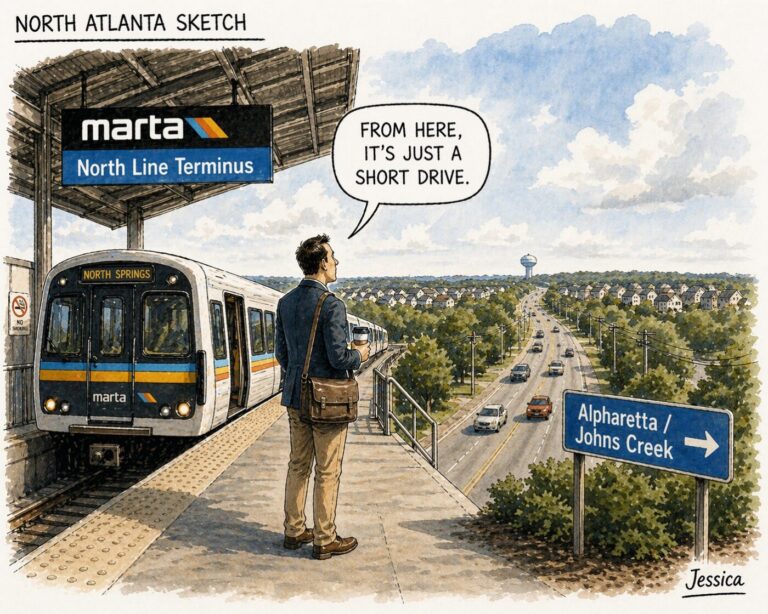
North Atlanta Sketch: The Last Stop
The Long Return of the Train: Atlanta’s Next Transportation Shift

North Atlanta Sketch: Citizen of the Year

North Atlanta Sketch: The Long View
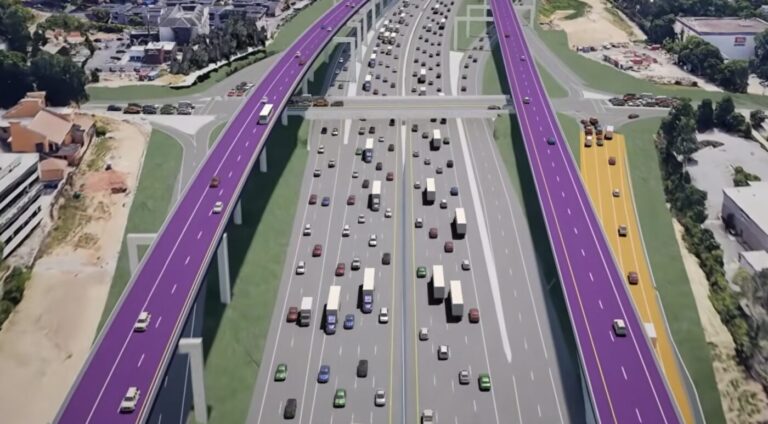
Toll lanes move forward on northern I-285, with first opening planned for 2034
IN NORTH ATLANTA