North Atlanta Homes Go to Auction Sight Unseen. The Bargain May End at the Front Door.
Homes in North Atlanta and nearby suburbs are being auctioned off without interior walkthroughs. Buyers must pay in full at sale and accept the risk of hidden issues in these properties, many located in otherwise desirable neighborhoods.
Get major local stories and development updates.
A Connecticut real-estate buyer recently paid $525,000 for a four-bedroom house he had never entered. The home appeared to be a bargain in a community where the property had been valued at roughly $650,000.
Then he opened the door.
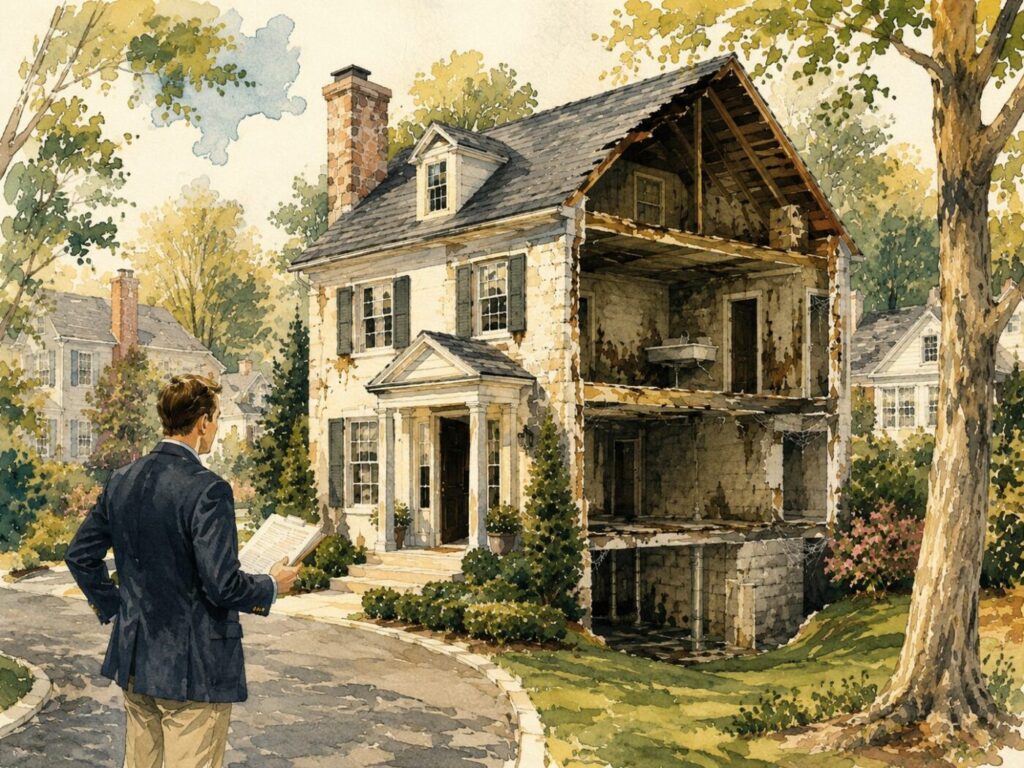
Inside were the skeletal remains of three people, including a former owner and her son. The discovery, reported Monday by The Wall Street Journal, is an almost unimaginably grim example of the risk built into foreclosure auctions: A buyer can study tax records, aerial photographs and comparable sales, yet still know remarkably little about the property being purchased.
Nothing suggests a comparable discovery awaits a buyer in North Atlanta. The more ordinary possibilities are costly enough: water damage hidden behind a front door, a failed air-conditioning system during a Georgia summer, missing appliances, mold, damaged plumbing, an unresolved lien or an occupant who has not moved out.
And homes are being offered under those conditions across some of the region’s most desirable suburbs.
A Johns Creek Home With No Tour and No Mortgage
A three-bedroom home on South River Farm Drive, inside Johns Creek but carrying an Alpharetta mailing address, is scheduled for foreclosure auction Aug. 4 at the Fulton County Courthouse in downtown Atlanta. The 2,232-square-foot home was built in 1986, and the auction platform places its estimated market value at approximately $475,000.
A prospective buyer cannot schedule a showing or send an inspector inside. The property is being offered “as is, where is,” and the auction instructions say it should be treated as occupied even if it appears vacant. Entering the property before the sale would be trespassing.
Nor can a bidder make the winning offer and spend the next month arranging a conventional mortgage. The listing says traditional financing cannot be used and that the entire purchase amount is due at the sale in cashier’s checks. The buyer is expected to investigate the title and possible liens before bidding, despite having no guaranteed interior access.
Nearby listings scheduled for the same auction cycle include another Alpharetta-area house with an estimated value above $1 million and a two-bedroom property estimated at slightly more than $314,000. This is not a market confined to abandoned cottages or visibly distressed blocks. Foreclosure auctions can reach into established subdivisions where the house next door may have recently sold through a conventional transaction with an inspection, appraisal and weeks of due diligence.
The Same Bet Is Available in Cumming and Suwanee
In Forsyth County, a three-bedroom home on Park Forest Court in Cumming is scheduled to be offered at the courthouse on Aug. 4. The house was built in 1997, contains about 1,895 square feet and sits on nearly half an acre. Its platform-generated market estimate is approximately $461,000.
Another Cumming property, a four-bedroom house on Hidden Creek Point, is estimated at approximately $585,000. It was built in 2005 and has nearly 3,000 square feet, the profile of an ordinary family home rather than the deteriorating foreclosure property many buyers might imagine. Yet the same restrictions apply: no interior access, no conventional financing and full payment expected at the sale.
The numbers rise further in Suwanee. A four-bedroom house on Magnolia Leaf Lane, built in 2000 and measuring more than 4,300 square feet, is scheduled for a Gwinnett County foreclosure sale with an estimated market value of approximately $706,000. Other Suwanee properties displayed alongside it carry estimates of roughly $572,000 and $760,000.
The Magnolia Leaf Lane buyer would be required to arrive with the full purchase amount available in cashier’s checks. The listing provides no interior inspection and tells bidders to evaluate property condition, title and liens before placing an offer.
In Duluth, a three-bedroom house on Bristol Lane is also scheduled for auction. In Buford, current offerings include a 1941 home near downtown and more conventional suburban houses in the $300,000-to-$425,000 estimated-value range. The Duluth listing similarly requires full payment at the sale and warns that an interior visit is not available before the ownership transfer.
Any of these sales could be postponed or canceled before auction day. A borrower might resolve the default, seek bankruptcy protection or reach another agreement with the lender. A listing on an auction calendar is not a guarantee that a property will actually be sold.
Why the Buyer Cannot Simply Ask to Look Inside
Georgia is a nonjudicial foreclosure state. A lender generally does not need to file a lawsuit and obtain a judge’s approval before selling a property secured by a mortgage, provided the state’s notice and advertising requirements are followed.
Foreclosure notices must generally be sent at least 30 days before the proposed sale and published for four consecutive weeks in the county’s official newspaper. Sales take place on the first Tuesday of the month, between 10 a.m. and 4 p.m., at the courthouse in the county where the property is located.
Until the sale occurs, however, the house still belongs to the borrower. The resident may be living inside, and the property has not yet transferred to the potential bidder standing at the curb. That leaves investors trying to read the condition of a home from clues visible outside: an aging roof, stained siding, overgrown grass, covered windows or a relatively well-maintained yard that reveals almost nothing.
The restriction also protects homeowners from strangers wandering around a property while they are still facing foreclosure. For bidders, it creates the defining contradiction of the sale: The greatest financial risk may be contained in the part of the property they are legally prohibited from seeing.
What Might Actually Be Behind the Door
The likely surprise in North Atlanta is not a crime scene. It is deferred maintenance.
A house that has been under financial strain may also have gone months without preventive work. A small roof leak can spread into insulation and drywall. An empty house can develop plumbing damage without anyone noticing. A broken air conditioner can create moisture problems. Appliances, copper wiring or fixtures may disappear before possession changes hands.
Even a tidy interior can leave the buyer with expenses that were not reflected in the winning bid. The septic system may need work. The retaining wall may be failing. The deck may require replacement. A large house purchased at an apparent $75,000 discount can stop looking inexpensive after a new roof, two heating and cooling systems, flooring, paint and legal fees are added.
Then there is possession. Once a valid foreclosure is completed, the former borrower loses the right to remain in the home, but the new owner may still need to file a dispossessory action if the occupant does not leave voluntarily. Ownership can change at the courthouse before the buyer receives an empty house and a working set of keys.
The title requires its own examination. Auction listings specifically direct buyers to investigate possible liens and obtain a professional opinion rather than treating a preliminary report as a guarantee. The conventional home-buying process distributes risk among inspectors, appraisers, lenders, attorneys, insurers and negotiated contract provisions. At a foreclosure auction, much more of that risk lands directly on the bidder.
Why Anyone Still Bids
The answer is the possibility of buying below market value.
In an expensive housing corridor, even a modest discount can create room for repairs, resale profit or rental income. Experienced investors develop formulas that assume a substantial renovation budget before they ever see the interior. They research ownership records, prior listings, permits, neighborhood sales and outstanding claims, then reduce their maximum bid to account for everything they cannot confirm.
That discipline matters because an auction estimate is not the sales price. The winning bid may rise sharply once several investors compete, and the supposed bargain can disappear before anyone reaches the courthouse door.
Foreclosure activity is also becoming more visible. Georgia recorded 4,356 foreclosure starts during the first quarter of 2026, the fourth-highest total among the states. The Atlanta metropolitan area recorded 2,520 starts, one of the largest metropolitan totals in the country. Nationwide foreclosure starts increased 20 percent from a year earlier, although volumes remained far below the historic peaks associated with the housing crash.
Those figures do not establish a foreclosure crisis in North Fulton, Forsyth or Gwinnett. The local listings remain a small part of a large suburban housing market. They do show that foreclosure is not absent from prosperous communities—and that the auction system operates quietly alongside the familiar market of open houses, polished listing photographs and carefully staged kitchens.
For a typical buyer, a home is the place where uncertainty is supposed to end. At a foreclosure auction, uncertainty is part of the property being sold.
The house may be a bargain. The buyer usually learns why only after opening the door.
About the Author


In North Atlanta
Medley Opens First Access to 133 Townhomes in Johns Creek

North Atlanta Added 11,000 Residents, but the Growth Is Concentrated in Three Cities
New Model Home Opens as Coal Mountain’s Mixed-Use Community Takes Shape
What North Atlanta Should Know Today. Friday, Sept. 11, 2026

North Atlanta Courthouse Wedding Price Check: A Legal Marriage Can Start at $16
North Point Redevelopment Will Not Move Forward Without NHL Team, Jamestown Says
IN NORTH ATLANTA