Sandy Springs Development Update 2026: Infrastructure, Downtown Growth & What’s Changing
Sandy Springs is advancing major infrastructure and redevelopment projects in 2026, improving traffic flow, pedestrian safety, and transit options while fostering downtown growth and neighborhood connectivity.
Get major local stories and development updates.
This article is part of our ongoing 2026 Development Update series examining how public projects and private investment are reshaping North Atlanta.
Sandy Springs sits at the center of several forces shaping North Atlanta in 2026: regional commuting on GA‑400 and I‑285, a growing network of trail and sidewalk projects, and a multi-year shift in how older office districts are being reused.
For homeowners in Sandy Springs and nearby suburbs, “development” tends to show up in three everyday ways: how long it takes to get to work or school, whether local roads feel safer to walk and bike, and what kinds of housing and commercial spaces are being added (or replaced) around established neighborhoods.
This update focuses on projects and decisions that are either underway now, were approved in 2024–2026, or are positioned to affect traffic, housing options, and retail patterns in 2026–2027—without guessing beyond what public documents and reporting support.
Why Sandy Springs Matters to North Atlanta Residents
Sandy Springs functions as a “hinge point” between North Fulton suburbs and Core/Perimeter employment hubs. For residents of Roswell, Alpharetta, Milton, Johns Creek, Cumming, Duluth, and Suwanee, major construction decisions inside Sandy Springs quickly ripple outward—especially when they touch GA‑400 travel lanes, I‑285 connections, and the MARTA station areas that anchor Park‑and‑Ride and transit transfers.
A few indicators show why Sandy Springs remains an “outsized” player in regional patterns:
Population change has not been linear. The city grew substantially from 2010 (93,853) to the 2020 Census count (108,080), but the Census Bureau’s estimate shows a −2.4% change from April 2020 to July 2024. That matters because it suggests current growth pressure is coming more from job concentration, traffic patterns, and reinvestment—rather than simple population increases alone.
Sandy Springs reflects high housing costs and high incomes, which tends to concentrate redevelopment interest along its commercial corridors. The Census Bureau reports median household income of $104,340 (2020–2024), a median owner‑occupied home value of $619,800 (2020–2024), and a mean travel time to work of 25.8 minutes (2020–2024).
Even if a household doesn’t shop “in Sandy Springs,” the city’s retail and service economy affects how businesses decide where to open in North Atlanta. Census Bureau QuickFacts reports total retail sales of $2,135,975,000 (2022) and retail sales per capita of $19,845 (2022) for Sandy Springs.
Major Infrastructure Projects Underway
A key point for homeowners: Sandy Springs’ 2026 infrastructure work is not being driven by one single mega‑project. It’s a layered program—city corridor rebuilds, trail extensions, targeted sidewalk gaps, drainage fixes—stacked on top of state-led highway construction.
Funding and the “how is this paid for” question
A large share of transportation work is tied to the voter-approved Fulton County Transportation Special Purpose Local Option Sales Tax (TSPLOST). The city notes that Sandy Springs voters approved the 2021 five‑year TSPLOST extension, continuing the 0.75% sales tax first approved in 2016, with collection running April 1, 2022 through March 31, 2027.
That matters because it clarifies why some expensive projects proceed even amid controversy: the Hammond Drive corridor page bluntly states that these projects “were approved and funded by the voters,” and therefore the city has “little flexibility” on execution once they advance into right‑of‑way and construction stages.
Separately, the city’s FY2026 budget documents show capital spending in Public Works, Stormwater, and Parks continuing at meaningful levels (for example: stormwater capital improvements design/construction budgeted at $3,000,000; traffic management program budgeted at $500,000; traffic management center fiber program at $530,000).
Mount Vernon Highway corridor work nearing the “wrap-up” phase
Two Mount Vernon corridor projects—TS191 (Johnson Ferry/Mt. Vernon) and TS192 (Mt. Vernon corridor improvements)—have dominated localized traffic and neighborhood frustration east of the Roswell Road “downtown core” area because they combine roadway configuration changes with sidewalks, sidepaths, utility work, and intersection rework.
The city’s TS191 project page lists a construction start date of Feb. 26, 2024 and describes a roughly two‑year construction duration, with intermittent lane closures and flagging operations expected during the project.
A major near-term change already implemented is the opening of Spruill Lane in December 2024 as a connector between Mt. Vernon Highway and Johnson Ferry Road, tied to removing an older intersection just west of the Sandy Springs Library area as the final road configuration separates the corridors more cleanly.
For residents trying to understand “when does this end,” a February 2026 local report stated that roughly $27 million in active construction along Mount Vernon Highway and at the corridor’s intersection with Johnson Ferry and Roswell Road is expected to wrap up before the end of May 2026, with inspection services extended to match delays from additional utility work.
TS192, which runs from the Sandy Springs Library area to the Sandy Springs MARTA station area, is explicitly framed as a multimodal connection: the city describes a multi‑use path on the south side, 6‑foot sidewalks on the north, new turn lanes at multiple intersections, and traffic signal upgrades. Funding sources listed include TSPLOST and support from the Perimeter CID.
Hammond Drive is positioned as the next “big construction footprint”
If there is one project most likely to produce new traffic patterns (and detours) for 2026–2027, it’s Hammond Drive.
The city’s Hammond Drive Improvements page calls out 17,500 daily vehicles (based on traffic data collected in 2019) on the Roswell Road–Glenridge Drive segment—above the practical capacity of a two‑lane roadway—along with congestion, queueing, lack of sidewalks, and poor pedestrian crossing provisions.
The project description emphasizes not only widening/capacity, but also walking and biking connectivity: multi‑use paths on both sides of Hammond Drive, dedicated pedestrian crossings at four locations, and an underpass at Kayron Drive intended to knit together both sides of the Glenridge‑Hammond neighborhood with safer non‑car access.
As of the city’s project page, Hammond is in the “right of way/final design stage,” with 34 properties acquired through voluntary sales and 3 remaining parcels to acquire; it also documents an older estimate that placed overall cost between $59.6 million and $64.6 million (as presented in a 2020 open house).
On timing, a February 2026 report describes Hammond widening as an “extensive” project that is set to begin by the end of 2026, after the city acquired nearly all of the 37 residential parcels needed for the roadway expansion and continued demolition work along the corridor.
GA‑400 corridor: trails, express lanes, and the long tail of interchange work
The state-led highway program and the city-led trail program are increasingly intertwined along GA‑400.
On the trail side, the city’s PATH400 Multiuse Trail Extension page provides a detailed status snapshot: as of “Winter 2026,” the project is split into three segments; construction is underway on Segments 1 and 3, expected to complete in three years; Segment 2 received an $18 million investment from the Atlanta Regional Commission in 2025, enabling construction bidding; and Segment 2 construction is expected to begin in Summer 2026 and take around three years.
The same page records large contract awards and funding mixes (including federal funds administered through GDOT for portions): a $15,758,413 contract award to F.S. Scarbrough for Segment 2 (described as funded through local funds and federal funds through GDOT), and a prior $20,150,923.94 contract award to F.S. Scarbrough for segments tied to a local/federal combination.
Separate City Council documentation shows the city authorized $1,489,000 for construction engineering and inspection services for the Sandy Springs portion of the PATH400 multiuse trail extension project, approved Feb. 4, 2025.
On the highway side, the biggest “new” disruption risk is the SR 400 Express Lanes project. A February 2026 report on a Sandy Springs City Council retreat described:
Tree clearing scheduled to resume in March 2026, before heavier construction begins in summer 2026 between the North Springs MARTA station and Woodland Elementary School.
Heavy construction expected to begin in July 2026, adding two ground-level lanes in each direction through the central portion of the highway.
A projected opening for the Sandy Springs subsegment in February 2031.
MARTA bus rapid transit planned to operate in the barrier-separated express lanes.
A long-term P3 contract described as 56 years and $4.6 billion to design, build, operate, and maintain 16 miles of highway from the North Springs station area to southern Forsyth.
The same reporting documents neighborhood-level issues that can matter later for zoning and redevelopment: residents and city officials raised concerns about final wall locations, noise mitigation studies, construction laydown yards, and the need for consistent communication and final design sharing.
Finally, the legacy issue: the Transform 285/400 interchange work. A GDOT fact sheet dated Jan. 10, 2024 states that all lanes were in final alignment on I‑285 and SR 400 (and on key surface roads like Glenridge Drive, Peachtree Dunwoody Road, and Abernathy Road), with new ramps open to traffic; it also states that final work items (paving, striping, ITS connections) would continue throughout 2024. For 2026 readers, that suggests the largest geometry changes are already “baked in,” even if limited finishing work and related corridor projects can still affect travel patterns.
Sidewalks, local safety projects, and “small” work that’s visible to residents
Not all mobility projects are multi‑year corridor rebuilds. Sandy Springs’ Featured Projects list and resolutions show a steady pipeline of sidewalk and safety work that often matters most to individual neighborhoods.
Examples include the Lake Forrest Sidewalk Phase 1 project, approved via a City Council resolution that describes 1,240 linear feet of 6‑foot sidewalk on the west side of Lake Forrest Drive (in two segments), with a contract award of $272,700.
The city also maintains a structured approach for prioritizing CIP sidewalk work via a Sidewalk Improvement Policy and a Sidewalk Network Master Plan, while still requiring sidewalks (or funding) from developers through development regulations and an impact fee ordinance.
Drainage and stormwater resilience remains an active “quiet” program
While less visible than highway construction, stormwater projects show up quickly in neighborhood quality of life (ponding, road edge failures, repeated sinkholes, and creekbank/culvert issues).
A January 2025 resolution documents the city’s stormwater system improvements at 5055 High Point Road, including the need for permanent and temporary construction easements to facilitate construction.
A September 2024 resolution documents a 4787 Riverview Road drainage improvement project intended to replace a deficient drainage system and bring drainage infrastructure to city standards, with a contract award of $301,751.06 and references to deficiencies identified in a 2022 study.
Budget documents for FY2026 also show planned stormwater capital improvement spending (design and construction) at $3,000,000, reinforcing that drainage work is being treated as an ongoing capital program rather than a one‑off response.
Downtown & City Springs Activity
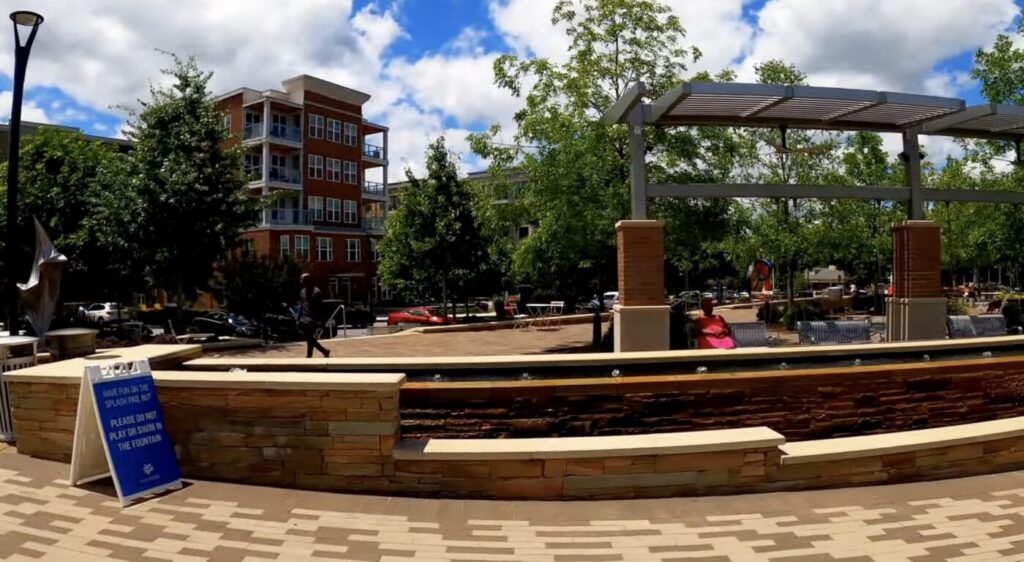
Sandy Springs’ “downtown” is not a historic main street—it is a planned civic and mixed-use district assembled around what had been an empty parking lot beside Roswell Road. In a December 2025 retrospective, a local account notes the City Council adopted a master plan in 2012, and the first phase of City Springs opened with the new City Hall and Performing Arts Center in May 2018; the retail and restaurant spaces followed, with City Springs considered fully open by September 2018.
That timeline is relevant in 2026 because City Springs is now old enough to be operating like a mature district: managing event crowds, adjusting parking policy, and supporting incremental private development nearby rather than “opening day” buildout.
The same account describes City Springs as a 14‑acre mixed-use development that includes a four‑acre City Green and includes restaurants, exercise boutiques, and apartments—along with event attendance that reaches into the thousands for marquee dates (5,000–6,000 for the Sparkle Sandy Springs parade; 8,000–12,000 for Fourth of July).
Parking policy changes are a concrete sign of a district moving from buildout to operations. In August 2025, the city adopted an ordinance expanding the City Springs boundary definition to include additional on‑street parking and a city‑owned public parking facility that had been constructed or striped—so those areas would be covered by existing enforcement regulations.
In a companion August 2025 ordinance, the city reduced parking enforcement civil fines within City Springs boundaries, describing the change as responsive to community feedback and regional benchmarks. The ordinance references a prior $45 first‑time penalty (escalating to $75 if unpaid within 15 days) and sets a $25 civil fine per infraction, with escalation if unpaid.
For residents of nearby suburbs, City Springs’ practical effect is often weekend travel and evening traffic: it’s a regional destination for events, and it sits close enough to major commuter corridors that parking overflow and peak‑event traffic can push onto Roswell Road, Mt. Vernon Highway, and nearby neighborhood cut‑through routes.
Mixed-Use and Redevelopment Projects
Sandy Springs’ development pattern in 2026 is best described as “intensification in nodes”: most large projects are clustered near City Springs and Central Perimeter/MARTA station areas, while many residential neighborhoods remain stable and low-density.
Hillcrest near City Springs
One of the most consequential new projects adjacent to City Springs is Hillcrest, an 8.1‑acre mixed-use development on land formerly owned by Sandy Springs United Methodist Church.
According to an October 2025 announcement from High Street Residential (a subsidiary of Trammell Crow Company) and development partner Third & Urban, Hillcrest includes 362 apartment units, 30 for‑rent townhomes, and more than 19,000 square feet of retail, with delivery expected by the end of 2027.
In practical terms for residents, the “Hillcrest effect” is less about skyline change and more about: additional day‑to‑day trips around the City Springs street grid, more retail demand within walking distance, and greater pressure to make full sidewalk connections (which the city is already pursuing through the Mount Vernon corridor projects).
Solis Sandy Springs near MARTA and GA‑400
A second major redevelopment is Solis Sandy Springs (formerly Solis Embassy Row), a partial office park redevelopment at 6660 Peachtree Dunwoody Road near MARTA’s Sandy Springs station. The developer is Terwilliger Pappas.
Urbanize Atlanta reports the project broke ground in April 2025 on a 6‑acre site and is under construction, with 341 market‑rate apartments planned plus retail space; it also reports a completion target of spring 2027 and notes that an existing parking deck is planned to be retained and enhanced for residential use.
For neighboring North Atlanta residents, projects like Solis matter because they illustrate a broader pattern: converting or partially redeveloping older office parks into housing close to transit—an approach that can change peak-hour traffic volumes (not always down, sometimes redistributed) and shift weekday retail demand closer to employment centers.
High Street at Central Perimeter as a long-horizon reshaper
The largest “on-paper” project in the broader Sandy Springs/Perimeter orbit remains High Street, attributed to GID. GID describes High Street (dated March 2022) as a 36‑acre mixed‑use development with approximately 7 million gross square feet, 3,000 residential units, 600,000 square feet of office, 400,000 square feet of retail, 400 hotel rooms, and 8,000 parking spaces, plus new streets, parks, and infrastructure.
However, GID’s same project page also contains a “groundbreaking targeted for 2021” note, which is clearly out of step with the 2026 calendar. For residents, the responsible takeaway is that High Street remains a fully entitled, high-impact plan whose exact near-term delivery timeline is not confirmed by the public sources reviewed here—so its traffic and retail effects should be treated as longer-horizon rather than a 2026 certainty.
Hospitality & Hotel Demand in Central Perimeter
While much of Sandy Springs’ development discussion centers on housing and infrastructure, hospitality remains an important piece of the long-term mix.
High Street’s approved plan includes approximately 400 hotel rooms as part of its broader 7-million-square-foot vision. Although construction timing for the hotel component has not been confirmed in the public sources reviewed, its inclusion reflects the continued role of Central Perimeter as a business-travel and event-driven market.
City Springs’ growing event calendar, corporate expansions near GA-400 and I-285, and proximity to MARTA all contribute to steady overnight demand in the area.
For now, most hotel inventory is concentrated near:
• Abernathy Road
• Glenridge Drive
• Peachtree Dunwoody Road
• The Perimeter business district
As redevelopment continues, hospitality capacity is likely to expand in parallel with residential and office growth.
Residential Growth and Housing Trends
Residential growth in Sandy Springs in 2026 is less about new master‑planned subdivisions and more about three parallel tracks: multifamily development near MARTA/Perimeter nodes, incremental infill in established neighborhoods, and policy work aimed at managing the transition between protected neighborhoods and denser district corridors.
The market context: high values, flat-to-slightly-down population estimates
The Census Bureau reports a median owner‑occupied home value of $619,800 (2020–2024), with an owner‑occupied share just over half (50.2%).
On “median price” trends, private indices differ from government “median value” measures, but they can help residents understand directionality. Zillow reports an average Sandy Springs home value around $672,238, up 2.4% over the past year (as shown on its Sandy Springs market page accessed during this research).
At the same time, the Census estimate showing −2.4% population change from 2020 to 2024 suggests housing demand pressure may be driven more by household composition, job concentration, and redevelopment patterns—rather than simple population growth.
What’s actually being approved in “single-family” land
Two 2025 rezonings illustrate the kind of incremental change that often matters to homeowners: moving from 1‑acre minimum lot zoning to smaller-lot “residential detached” standards, but with strict conditions limiting the number of buildable lots.
At 9755 Roberts Drive, the city rezoned a parcel from RE‑1 (residential detached—1 acre minimum lot size) to RD‑7.5 (residential detached—7,500 square foot minimum lot size), but capped the subdivision at a maximum of three residential lots and required a single access point from Roberts Drive. The ordinance also ties future development to “planned City projects” by requiring dedication of rights‑of‑way or easements if needed.
A similar rezoning at 5375 Northland Drive moved from RE‑1 to RD‑7.5, again capped at three lots, with additional site conditions including maximum lot coverage limits.
The practical implication is that Sandy Springs’ “estate lot” character (in many neighborhoods) is not being wholesale replaced by dense subdivisions—but the city is permitting selective lot‑size flexibility in certain cases, often paired with access management and stormwater/open‑space constraints (including MRPA-related limits along the river corridor).
How many new units are likely to come online in 2026–2027?
Based on major projects with documented unit counts and in-construction status:
Hillcrest: 362 apartments + 30 townhomes, with delivery expected by end of 2027.
Solis Sandy Springs: 341 apartments, with completion targeted spring 2027.
Those two projects alone imply roughly 733 new market-rate rental units (plus townhomes) added near City Springs and transit‑adjacent corridors by 2027, not counting smaller infill, redevelopment, or projects outside the sources reviewed.
Whether that level of unit delivery “reduces traffic” is not automatic; it depends on commuting patterns and whether new residents work locally (Perimeter/healthcare nodes) or commute elsewhere. That’s one reason station-area planning and active transportation connections are being emphasized in parallel.
Commercial Openings and Market Shifts
Sandy Springs’ commercial story in 2026 is shaped by two simultaneous realities: steady consumer demand (supported by strong retail sales totals) and active churn in dining/fitness/retail driven by leasing turnover and changing workplace patterns.
Confirmed openings and expansions
A major “new-to-many-residents” opening in the Perimeter area is Life Time Perimeter, which opened at 8 Concourse Parkway after transforming the former Concourse Athletic Club site. Reporting and company announcements place the opening in August 2025, positioning it as a workplace-adjacent fitness and wellness hub in Sandy Springs.
In the City Springs orbit, Mister O1 Extraordinary Pizza – Sandy Springs opened a Sandy Springs location in Spring 2025, according to a local profile describing the restaurant’s strong early demand and its placement near City Springs.
For existing Sandy Springs “legacy” dining, the Rumi’s Kitchen – Sandy Springs location underwent renovation and was reported to be reopening in October 2025, reflecting a pattern of reinvestment rather than pure net-new expansion.
Closures and signals of churn
Not every change is an opening. Pig-N-Chik BBQ – Sandy Springs closed its Sandy Springs flagship location in 2025 after 24 years, with reporting attributing the closure to a lease non‑renewal by the landlord while other metro locations remained open.
Axios also reported that SocialBites Food Hub closed its Sandy Springs venue, another data point suggesting that “shared food hall” concepts are not automatically stable in every metro submarket, particularly when leasing and consumer patterns shift.
Corporate and employment shifts that influence commercial demand
Retail and restaurant performance in Sandy Springs is closely tied to office and campus occupancy in the Perimeter area.
A 2025 update from Perimeter Community Improvement Districts states that Mercedes‑Benz (located in Sandy Springs since 2018) announced that its local “1MB” campus would serve as its North American headquarters, with up to 500 jobs expected to come to the Perimeter market by August 2026; it also references an accompanying R&D hub moving technical teams into the area.
If those job additions materialize as described, the likely local effect is not just employment—it’s lunchtime traffic, after‑work demand for fitness and dining, and renewed pressure on peak-hour travel near GA‑400/I‑285 and Peachtree Dunwoody/Roswell Road connectors.
Zoning Decisions Shaping the Future
Zoning and planning actions from 2024–2026 show Sandy Springs working on two fronts: (1) upgrading development rules to manage transitions between protected neighborhoods and higher-intensity districts, and (2) lining up long-range transportation and station-area plans that make future redevelopment more predictable.
The North Springs MARTA corridor plan sets up a “next decade” framework
A February 2025 City Council resolution approved the North Springs MARTA Corridor Livable Centers Initiative (LCI) study, noting the city received an ARC LCI grant to conduct a transportation planning study along part of the Peachtree Dunwoody Road corridor and a transit‑oriented development study for the North Springs MARTA station site.
The resolution documents a lengthy public process (focus groups, open houses, a design charrette, pop‑up events at the MARTA station, and surveys) and identifies the consultant team, with work initiated in February 2024 and drafts presented in December 2024 before final approval.
For homeowners, the key is not a single new building. It is that the city is formalizing a station-area vision that can later support rezoning requests, street grid changes, walkability improvements, and redevelopment of older office/parking sites—often with less case-by-case uncertainty once an adopted plan exists.
Development code changes and the “rules of the game”
In September 2025, the city adopted a Development Code text amendment (TA‑25‑2). The ordinance text shows how updates can affect whether old rezoning conditions remain in force, and it includes revisions touching building height/massing standards in certain districts as well as outdoor amenity space improvement standards (OASIS) that set requirements for usable, publicly accessible outdoor space and landscape design.
For long‑term residents, these details matter because they shape what redevelopment looks like even when no single project is in the news: how buildings transition near protected neighborhoods, how streetscapes must be activated, and how much site design is required beyond pure floor area.
Corridor casework: small rezonings and conditional uses
Some zoning decisions in the last 12–18 months are highly localized but still instructive:
The RD‑7.5 rezonings at 9755 Roberts Drive and 5375 Northland Drive show the city allowing smaller-than-1‑acre minimum lots in specific cases while limiting the number of resulting lots and controlling access and lot coverage.
A December 2025 conditional use permit (CUP) ordinance allowed a drive‑through facility at 6344 Roswell Road in the CX‑3 zoning district, with the ordinance specifying the drive‑through is for bank use and requiring site upgrades consistent with submitted plans.
Taken together, these decisions suggest continued commercial corridor adaptation on Roswell Road alongside careful, case‑specific adjustments to single‑family land—rather than broad rezoning waves across established neighborhoods.
What to Watch in 2026–2027
The next two years are likely to be defined by construction sequencing and “overlap risk”: multiple corridor projects finishing or starting in tight windows, while the SR 400 Express Lanes program begins its most disruptive phase.
| Timeframe | Project | What residents are likely to notice | Funding / approvals snapshot |
|---|---|---|---|
| Spring 2026 | Mount Vernon corridor projects TS191 & TS192 | Final construction push, with completion expected by end of May 2026; shifting traffic patterns near Mt. Vernon/Johnson Ferry/Roswell Road and along the corridor to the MARTA station area. | City contracts and inspection extensions; TS192 funding includes TSPLOST and Perimeter CID support. |
| Spring–Summer 2026 | SR 400 Express Lanes early construction in Sandy Springs segment | Tree clearing resuming in March; heavier construction beginning summer (reported as July), with sustained lane closures and neighborhood impacts through multiple-year phases. | Project described as a 56‑year, $4.6B design-build-operate-maintain P3; BRT planned in express lanes; Sandy Springs segment projected open 2031. |
| Summer 2026 | PATH400 Segment 2 starts construction | Construction bidding and ramp-up for Segment 2; long-duration construction (around 3 years) alongside ongoing work on Segments 1 & 3. | Segment 2 enabled by $18M ARC investment plus city match; GDOT/federal involvement cited; CEI services authorized in 2025. |
| Late 2026 | Hammond Drive widening construction begins (target) | Start of multi-year neighborhood-scale disruption: ROW integration, traffic shifts, and construction staging intended to maintain access while rebuilding the corridor. | Funded through voter-approved TSPLOST collections; city reports ROW/final design stage with most parcels acquired. |
| 2026–2027 | Solis Sandy Springs (Embassy Row office park redevelopment) | Active construction near MARTA Sandy Springs station area; new apartments near transit and GA‑400 likely to add local trips and retail demand. | 341 apartments; completion reported as spring 2027; developed by Terwilliger Pappas. |
| 2026–2027 | Hillcrest mixed-use near City Springs | Continued construction near City Springs with eventual new retail and hundreds of rental units, culminating in end‑2027 delivery expectations. | 362 apartments + 30 townhomes + ~19K sf retail; delivery expected by end of 2027. |
Two policy items are also worth following because they shape what comes after these construction cycles:
The city’s Transportation Master Plan update process began in Fall 2025 and is expected to be adopted by Summer 2026—meaning 2026 is a decision year for what projects move forward next and how they are prioritized.
On Roswell Road “north end” planning (near the river crossing), a January 2026 report describes nearly $5 million in federal funds supporting design progression for the North End Boulevard project, with additional grant applications pending and construction not expected until mid‑2029. Residents should treat 2026–2027 as a design-and-funding phase where the most meaningful near-term input is at public meetings and during planning decisions—not during construction.
Taken together, Sandy Springs in 2026–2027 looks less like a single “boom” and more like a managed transition: finishing one set of corridor projects, starting another, and laying policy groundwork for station‑area redevelopment. For North Atlanta residents, the most practical approach is to track construction phasing (especially around GA‑400 and Hammond Drive), watch how City Springs’ parking and event management evolves, and pay attention to adopted plans (Transportation Master Plan and the North Springs MARTA corridor plan) that will quietly steer what gets built next.
About the Author


In North Atlanta
5 Coffee Trucks and Mobile Cafés Worth Finding Around North Atlanta
North Atlanta Added 11,000 Residents, but the Growth Is Concentrated in Three Cities
North Atlanta’s Job Market Splits as Health Care Grows and Office Work Shrinks
What North Atlanta Should Know Today. Friday, Sept. 11, 2026

What North Atlanta’s No-Degree Jobs Actually Pay
North Atlanta Courthouse Wedding Price Check: A Legal Marriage Can Start at $16
IN NORTH ATLANTA