 Exclusive sponsor
Before Jon Ossoff Became a National Democratic Star, North Atlanta Voters Told Him No
Jon Ossoff’s first major political campaign was in North Atlanta’s 6th Congressional District in 2017, where he lost narrowly. That race revealed growing competitiveness in the suburbs, which eventually helped shape Georgia’s political landscape and Ossoff’s rise to the Senate.
Major local stories and useful updates, once a week.
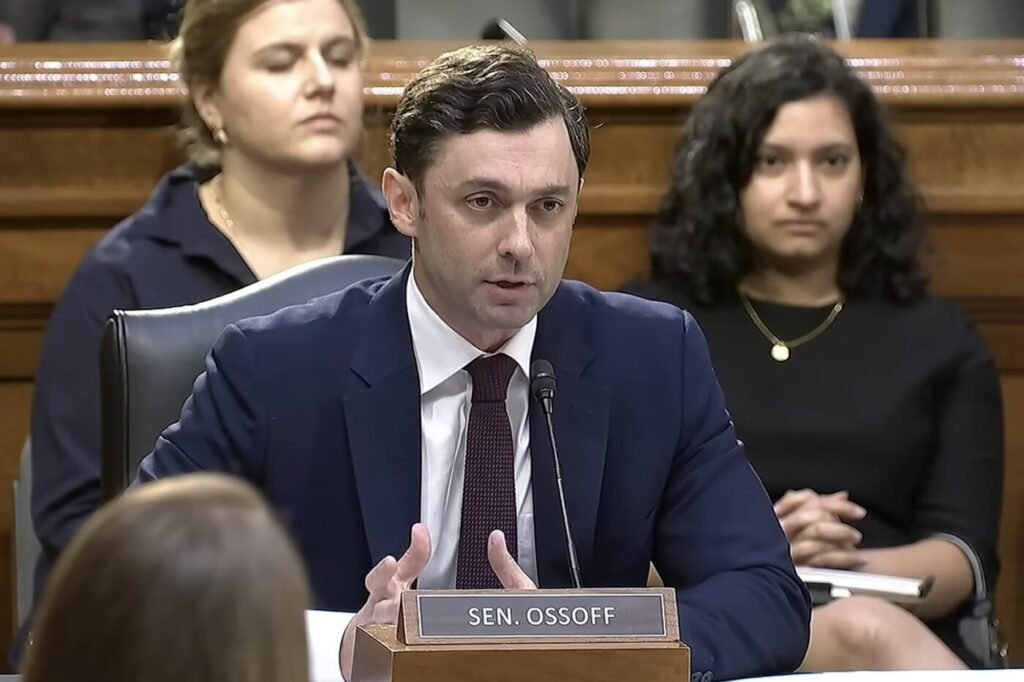
Nine years before Democrats began talking about Jon Ossoff as a possible presidential candidate, voters in North Atlanta had a rather different message for him.
They sent him home.
It was June 2017, and Ossoff was a 30-year-old documentary filmmaker who had suddenly become one of the best-known congressional candidates in America. His special-election campaign for Georgia’s 6th Congressional District drew national money, national television coverage and an extraordinary amount of attention to a collection of suburbs that included Roswell, Alpharetta, Johns Creek, Milton, Sandy Springs and neighboring communities in Cobb and DeKalb counties.
Ossoff lost to Republican Karen Handel by about four percentage points. And North Fulton played an important role in stopping him.
Today, the political picture looks very different. Ossoff is a U.S. senator seeking a second term, early polls have shown him ahead of Republican challenger Mike Collins, and his increasingly aggressive attacks on President Donald Trump are attracting attention well beyond Georgia.
A Wall Street Journal profile published Thursday described the viral speeches, enormous fundraising operation and speculation among some Democrats that Ossoff could eventually become a presidential candidate in 2028. Ossoff has said he is not interested in running for president.
For residents of North Atlanta, however, the more interesting story may be where all of this began.
North Fulton was where Ossoff hit the wall
The 2017 race is easy to remember now as the election that introduced Ossoff to the country. Locally, it looked considerably more complicated.
Handel’s strongest territory ran directly through communities North Atlanta Star covers today. An Atlanta Journal-Constitution analysis after the runoff found that Ossoff won the majority of precincts in only one of North Fulton’s five cities in the district.
Milton was particularly difficult terrain. Handel carried 16 of its 18 precincts. In Roswell, she won 12 of 20. Johns Creek was almost evenly divided, with Ossoff carrying 10 precincts and Handel 11. Ossoff did perform strongly in some larger Johns Creek precincts, including one voting at Shakerag Elementary School where he received 60% of the vote.
Those numbers offer a snapshot of a North Fulton that still leaned substantially more Republican than many of the same communities would only a few years later.
Handel’s path to victory ran through what the AJC at the time described as the Republican strongholds of Milton and portions of Johns Creek and Roswell. Ossoff had generated extraordinary enthusiasm among Democrats and nearly pulled off what would have been a remarkable upset. But the suburban realignment that eventually changed Georgia politics had not quite arrived.
Or, perhaps more accurately, it had started but was not finished.
The loss that changed the suburbs anyway
Ossoff did not win that congressional seat, but the race revealed something that would become increasingly difficult for Republicans to ignore.
Georgia’s northern suburbs were becoming competitive.

The 6th District had been reliably Republican territory for decades. Tom Price, Newt Gingrich and Johnny Isakson had all represented versions of it. Yet by 2017, a previously little-known Democrat had come within roughly 10,000 votes of winning it in what became, at the time, the most expensive U.S. House race in history. Ossoff alone eventually raised nearly $30 million.
A year later, Democrat Lucy McBath defeated Handel.
The political change was not simply about one candidate. North Atlanta was growing, becoming more diverse and attracting more college-educated professionals, while some voters who had reliably supported Republican candidates became less predictable in the Trump era. The old assumption that affluent suburbs north of Atlanta would automatically remain Republican territory was beginning to fail.
By the 2020 presidential election, the change was visible even in the collection of North Fulton cities that roughly correspond to old Milton County — Alpharetta, Johns Creek, Roswell and Milton. Joe Biden carried that area by about five percentage points.
But there was an important complication: those same voters narrowly preferred Republican Sen. David Perdue over Ossoff in the November Senate election.
North Fulton did not simply turn from red to blue. It became competitive, independent and increasingly willing to split tickets. A voter could reject Trump and still vote Republican for Senate. Another could support a Republican locally while choosing a Democrat statewide.
That political independence remains one of the most important characteristics of the northern Atlanta suburbs heading into 2026.
The candidate changed, too
Ossoff has changed alongside the electorate that first made him famous.
The cautious congressional candidate of 2017 spent much of that campaign trying not to make the race entirely about Trump. As a senator, he spent several years cultivating a comparatively restrained image, emphasizing constituent services, bipartisan legislation and government oversight.
The Ossoff campaigning for reelection in 2026 is considerably more combative.
His speeches attacking Trump have generated millions of online views and helped fuel a fundraising operation of a scale rarely seen in a Senate contest. Federal Election Commission records show his campaign collected more than $77 million from the beginning of 2025 through June 30, with approximately $42.6 million still in cash at the end of that period. Across his current Senate term, the campaign has reported nearly $98 million in receipts.
The strategy has also brought risk. His recent remark involving Trump aide Natalie Harp triggered fierce criticism from the White House and Republicans, who portrayed it as personal and inappropriate. Ossoff did not apologize, while Republican strategists argued that his increasingly national posture looked less like a Senate campaign and more like positioning for 2028.
Whether voters see the new tone as forceful or excessive will become clearer this fall.
A very different race nine years later
Republicans once expected Ossoff’s 2026 Senate seat to be one of their best opportunities in the country.
The landscape has become less comfortable for them.
Collins emerged from the Republican primary and runoff carrying strong support among the party’s base, but Ossoff enters the general-election campaign with an enormous financial advantage and leads in the major public polls published so far.
An AARP-sponsored bipartisan poll released in July put Ossoff ahead 52% to 43% and showed him leading Collins by 20 points among independents. Another survey put the race closer, at 47% to 43%, while a Fox News poll showed a wider Ossoff advantage. Polls this far from Election Day are snapshots rather than predictions, but taken together they show an incumbent beginning the fall campaign from a stronger position than Republicans once expected.
The suburban vote will again matter enormously.
Georgia remains competitive enough that statewide candidates cannot easily surrender communities containing large concentrations of affluent, highly educated and politically independent voters. Johns Creek, Alpharetta, Roswell and Milton sit squarely inside that battlefield, while the continued growth of South Forsyth and Gwinnett adds another layer to the northern suburban electorate.
That makes Ossoff’s political history here unusually revealing.
The first audition happened here
Calling Ossoff a presidential contender may be premature. He has a Senate election to win first, and American politics offers plenty of examples of politicians whose presidential speculation lasted much longer than their presidential prospects.
But there is something remarkable about watching his trajectory from North Atlanta.
In 2017, national reporters descended on Roswell, Sandy Springs and surrounding suburbs because a congressional district that was supposed to be safely Republican had suddenly become competitive. The young Democrat at the center of it lost.
Yet the political warning contained in that race proved more enduring than the result.
One year later, the district elected a Democrat. Three years later, a Democratic presidential candidate carried Georgia. A few months after that, Ossoff himself won a Senate seat.
Now the candidate who could not quite get past North Fulton in his first campaign is seeking another six years in Washington while his party discusses whether his ambitions could eventually extend even farther.
For North Atlanta, that makes the story more than a profile of a senator sparring with a president.
It is also a reminder of how dramatically the political ground beneath these suburbs has moved — and how one of the first places America noticed that movement was right here.
More worth reading from around here.
Community Voice
A snapshot of reader views, not a scientific survey.
Explore Community Voice →About the Author


In North Atlanta
Supreme Court Lets Expanded Citizenship Checks Move Forward as Georgia Details Its Voter Review Process

The Tech Diaspora and Suburban Political Realignment
Is Socialism Coming to North Atlanta? The Answer Is More Complicated

Your Mailing Address May Not Be Your City
Final Day to Register Sets the Stage for a Competitive Georgia Primary

Au and Thorne discuss lawsuit reform, jail spending and political compromise in Johns Creek
IN NORTH ATLANTA