 Exclusive sponsor
Georgia’s $110 Million Governor Primary Moves Into Overtime
Key Republican primaries in Georgia for governor and U.S. Senate ended without clear winners, leading to runoffs on June 16. Democrat Keisha Lance Bottoms won her nomination outright. The races have attracted over $110 million in spending and highlight a split in Republican voter preferences.
Major local stories and useful updates, once a week.
Georgia’s 2026 election season moved into a new phase Tuesday night as several of the state’s biggest Republican primaries failed to produce outright winners, setting up a series of June runoff elections that could shape both the governor’s race and control of a closely watched U.S. Senate seat this fall.
The most closely watched contests — the Republican races for governor and U.S. Senate — will now continue through another intense four weeks of campaigning before runoff voters return to the polls on June 16.
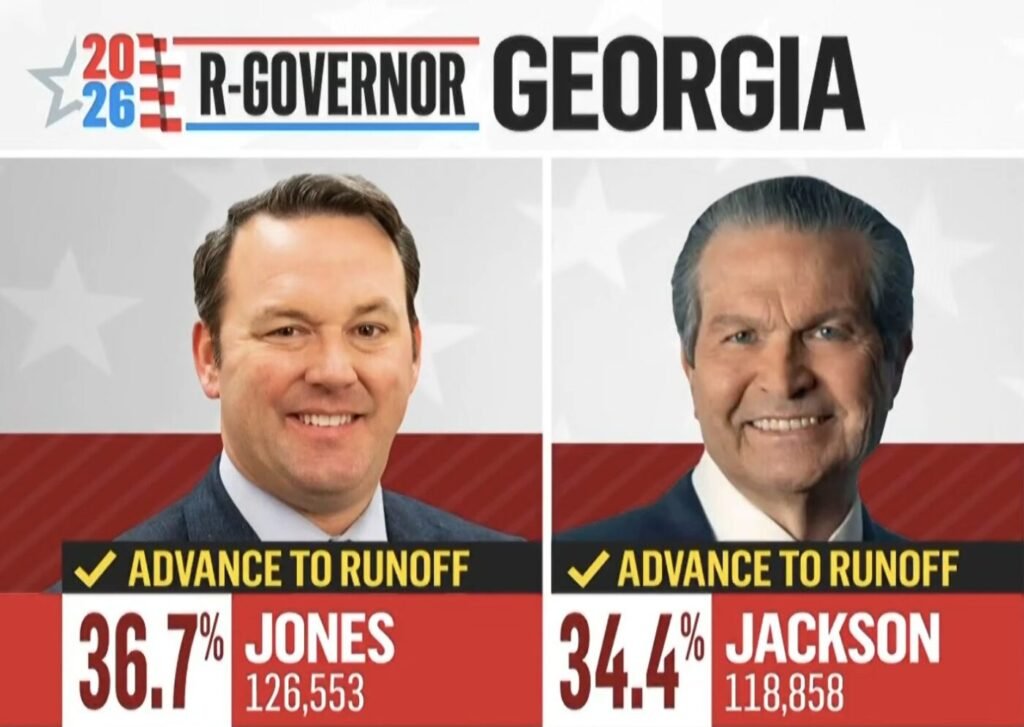
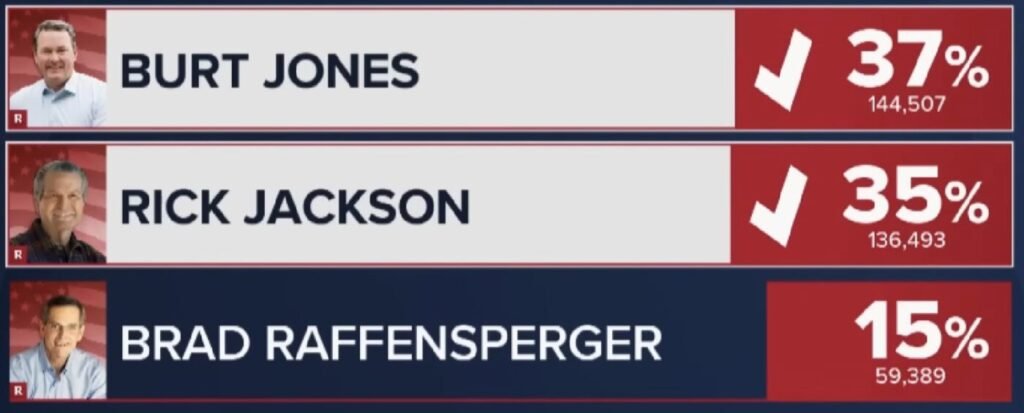
In the Republican gubernatorial primary, Lt. Gov. Burt Jones and healthcare executive Rick Jackson advanced after neither candidate secured more than 50% of the vote. Georgia Secretary of State Brad Raffensperger and Attorney General Chris Carr fell short of reaching the runoff.
Jones, who carried President Donald Trump’s endorsement during the primary campaign, framed the next stage of the race as a direct contest between two sharply different Republican visions for the state.
Speaking to supporters Tuesday night, Jones signaled an aggressive runoff campaign ahead.
“I love giving this guy a one-on-one,” Jones said. “I’ve been looking for that.”
Jackson, a wealthy healthcare executive who poured significant personal money into the campaign, also projected confidence after outperforming expectations in a crowded field.
“We beat the odds tonight, and we’re going to win on June 16,” Jackson told supporters gathered at The Battery Atlanta.
On the Democratic side, former Atlanta mayor Keisha Lance Bottoms avoided a runoff entirely, winning her party’s nomination outright after defeating several challengers.
Bottoms framed her campaign as focused on affordability and statewide economic concerns that have increasingly become central issues for suburban voters across metro Atlanta.
“We are going to build a Georgia that works for all of us,” Bottoms said Tuesday night.
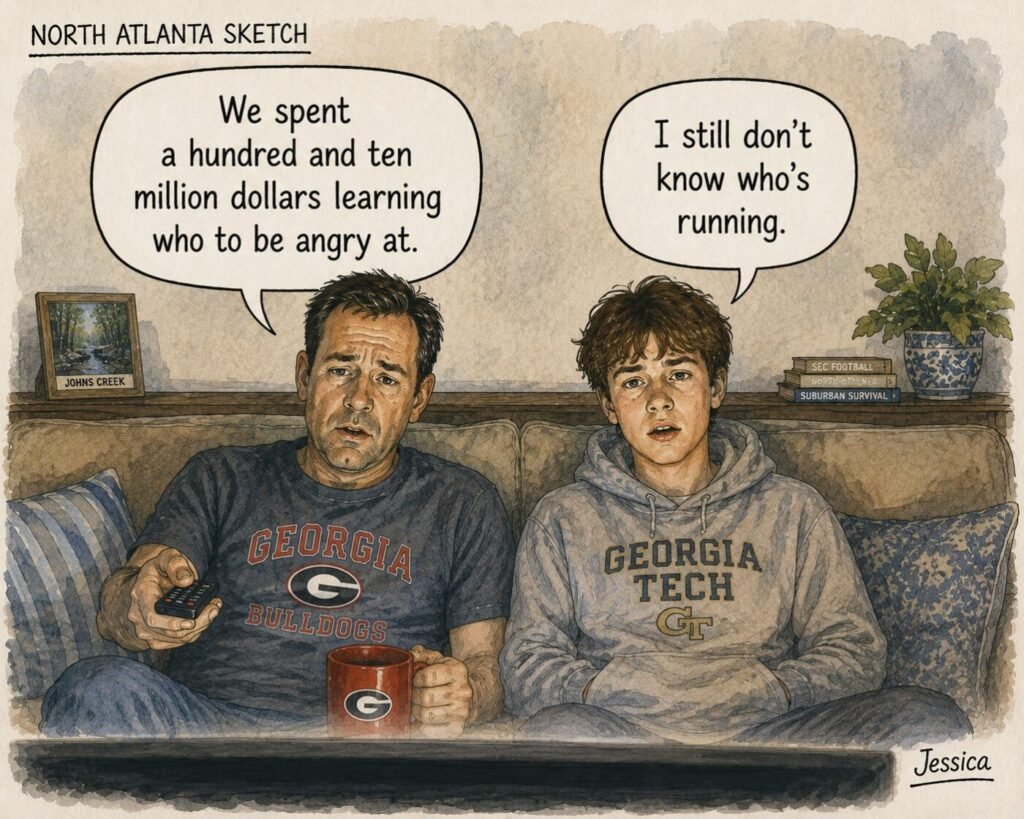
The governor’s race is already becoming one of the most expensive political battles in Georgia history. More than $110 million was spent during the Republican primary campaign alone, according to multiple election reports. Democrats spent significantly less during the primary phase, though general election fundraising is expected to accelerate rapidly over the summer.
The Republican primary for Georgia’s U.S. Senate seat is also headed to a runoff after U.S. Rep. Mike Collins and former football coach Derek Dooley emerged as the top two finishers.
The winner will face Democratic incumbent Jon Ossoff in November.
Collins, a congressman from Jackson and lead sponsor of the federal Laken Riley Act, emphasized his legislative record while addressing supporters after advancing to the runoff.
“The suburban and independent voters, they just want results,” Collins said. “They want somebody to go to Washington to deliver for them.”
Dooley, meanwhile, argued that Republican voters are looking for a different kind of candidate — one less tied to Washington politics and better positioned for a statewide general election campaign.
“A vote for me is new leadership in the U.S. Senate,” Dooley told supporters at his election night gathering near The Battery Atlanta.
The Senate runoff also highlighted an ongoing divide inside Georgia Republican politics between candidates closely aligned with Trump-era conservatism and those attempting to appeal more broadly to suburban swing voters.
Dooley benefited from strong backing by Gov. Brian Kemp and First Lady Marty Kemp during the primary campaign, while Collins built support through his congressional record and strong visibility among conservative grassroots voters.
Political attention across North Fulton, Gwinnett, and suburban metro Atlanta is expected to intensify ahead of the June runoff elections, especially as campaigns begin targeting high-turnout suburban areas including Alpharetta, Johns Creek, Roswell, Milton, Duluth, and parts of Gwinnett County that continue to play an increasingly important role in statewide elections.
Tuesday’s primary also featured several down-ballot races likely to draw continued regional attention in the months ahead.
Republican candidates John F. Kennedy and Greg Dolezal advanced to a runoff in the lieutenant governor’s race, while Democrats Josh McLaurin and Nabilah Islam Parkes will also face each other in a Democratic runoff contest.
Across metro Atlanta, election officials reported mostly smooth voting conditions despite scattered disruptions, including temporary polling interruptions in Sandy Springs tied to a police investigation near Morgan Falls Park and several relocated polling sites in DeKalb County. Voter turnout remained strong throughout the day, continuing a trend that began during Georgia’s record-setting early voting period.
The June 16 runoff elections will determine the final Republican nominees for governor and U.S. Senate before campaigns pivot toward what is expected to become one of the country’s most closely watched statewide election seasons this fall.
Reporting for the section above was aggregated and adapted from coverage by by WSB Radio, The Atlanta Journal-Constitution, Georgia Recorder, 11Alive, NBC News, and Rough Draft Atlanta.
Where Did the Money Come From — and Where Was It Spent?
One reason Georgia’s 2026 governor’s race has drawn national attention is the sheer amount of money flowing into it.
More than $110 million was spent during the Republican gubernatorial primary alone, according to multiple statewide election analyses, making it one of the most expensive primary contests in Georgia history.
Much of that spending came from a mix of billionaire self-funding, national political donors, corporate-backed political action committees, and independent advertising groups that increasingly view Georgia as one of the country’s most important battleground states.
Healthcare executive Rick Jackson heavily financed his own campaign, allowing him to flood television, streaming, and digital platforms with advertising across metro Atlanta and statewide media markets. Lt. Gov. Burt Jones, meanwhile, benefited from strong support among traditional Republican donor networks, business-aligned PACs, and conservative political organizations tied to national GOP infrastructure.
The spending was especially visible across suburban metro Atlanta.
Voters in North Fulton, Gwinnett, Cobb, and Forsyth counties were inundated for months with nonstop political advertising on local television, YouTube, streaming services, social media feeds, sports broadcasts, and radio. Campaign mailers also arrived heavily in suburban neighborhoods viewed as politically competitive.
A large share of the money went toward television advertising in the expensive Atlanta media market, which remains one of the country’s largest and most influential regional political advertising markets. Campaigns also spent aggressively on digital targeting aimed at suburban swing voters, especially college-educated voters around Alpharetta, Johns Creek, Roswell, East Cobb, Brookhaven, and parts of Gwinnett County.
Outside groups played a major role as well.
Political action committees and issue-based organizations spent millions on attack ads, opposition research, polling, and turnout operations. Several campaigns also invested heavily in voter data operations and microtargeted advertising designed to identify persuadable suburban Republicans ahead of the runoff.
The scale of spending reflects how Georgia’s statewide elections have transformed over the past decade from relatively predictable Southern races into nationally watched political contests capable of attracting enormous amounts of outside money.
And with another month now remaining before the June 16 runoff elections, political advertising across metro Atlanta is unlikely to slow down anytime soon.
More worth reading from around here.
Community Voice
A snapshot of reader views, not a scientific survey.
Explore Community Voice →About the Author


In North Atlanta

Mike Collins Won the GOP Race. Now Comes the North Atlanta Test.

Georgia Social Media Law for Minors Cleared to Move Forward
North Atlanta Early Voting Starts Oct. 13. Registration Closes Monday.
Before Jon Ossoff Became a National Democratic Star, North Atlanta Voters Told Him No
North Fulton Voters Will Decide the Future of $300 Million in Transportation Projects

Georgia’s 2026 Tax Rebates Are Rolling Out. What It Means in North Fulton and South Forsyth
IN NORTH ATLANTA