What $22 Billion Built in Midtown Atlanta Since 2000
Get major local stories and development updates.
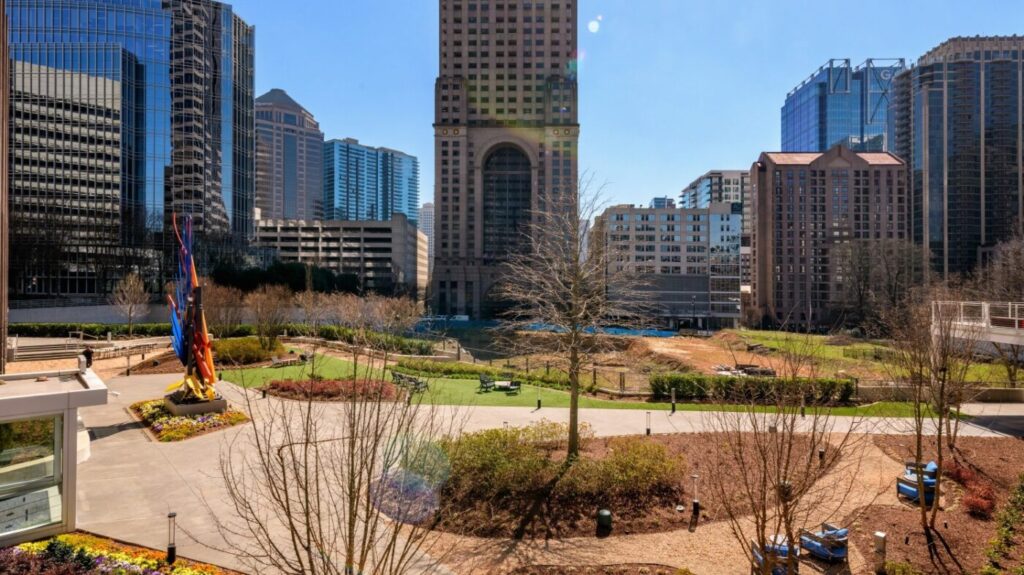
It doesn’t take long in Midtown for the pattern to come into focus. The density, the walkability, the steady flow of people — all carefully built over time.
A 25-Year Experiment That Actually Worked
Midtown’s transformation didn’t happen organically. It has been driven in large part by the Midtown Improvement District (MID), a model funded by commercial property owners who agree to pay additional assessments to improve the area. Over 25 years, that structure has generated more than $170 million for public improvements — streets, safety programs, landscaping, and infrastructure that the city alone might not have delivered at the same pace.
The result is striking: more than $22 billion in private development has followed inside just a 1.2-square-mile district since 2000.
For readers in places like Johns Creek, Alpharetta, or Suwanee, that number should stand out. It shows what happens when public coordination and private capital align tightly — something suburban corridors increasingly try to replicate, often with mixed results.
The “Now or Never” Land Grab
One of the most consequential moves in 2025 was the acquisition of a four-acre site at 98 14th Street for $46 million — about 40% below recent land pricing averages in Midtown.
That decision was driven by a simple reality: there was almost no protected open space left. Before the purchase, the entire 770-acre district had just 1.1 acres of permanently protected green space.
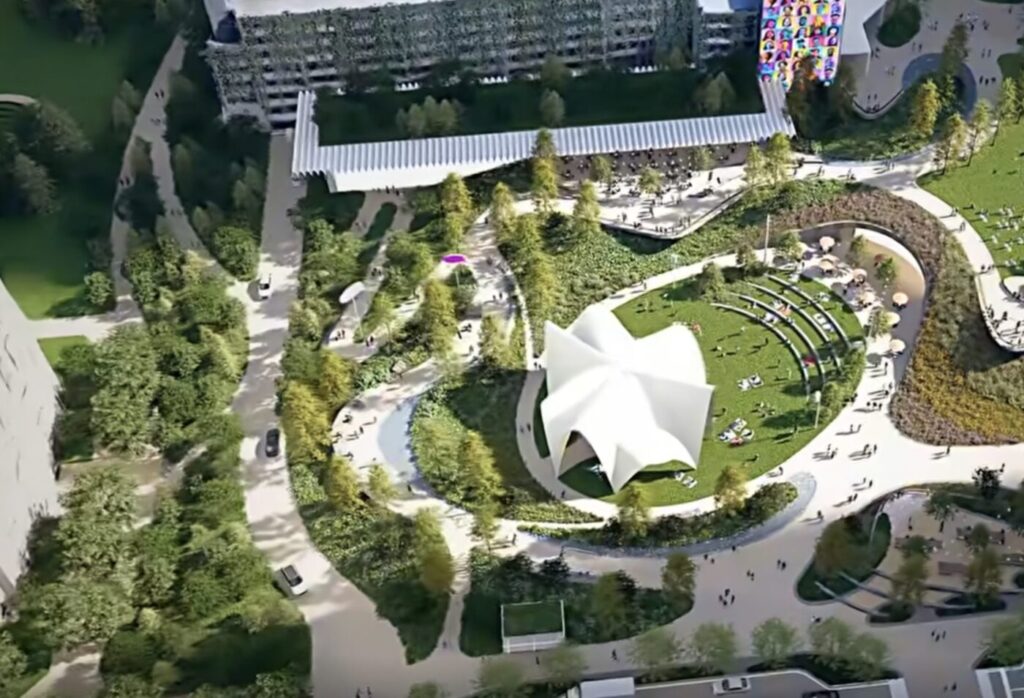
Plans now call for a signature public park, designed by Field Operations — the same firm behind New York’s High Line — with interim green space expected as early as 2026.
There’s a lesson here for fast-growing suburban areas. As development accelerates, land rarely becomes easier to acquire. Decisions about parks and public space tend to be either early and intentional — or late and expensive.
Infrastructure at a Different Scale
In 2025 alone, Midtown advanced roughly $16 million in public improvement projects, with 83% of that funding leveraged from external partners such as federal, state, and regional agencies.
The projects are practical but transformative:
- Nearly two miles of protected bike lanes
- New traffic signals and safer intersections
- Hundreds of sidewalk repairs
- Expanded tree canopy and streetscape work
For suburban readers, this kind of investment often shows up differently — road widenings, new interchanges, or trail systems. But the underlying principle is the same: mobility shapes everything, from property values to daily quality of life.
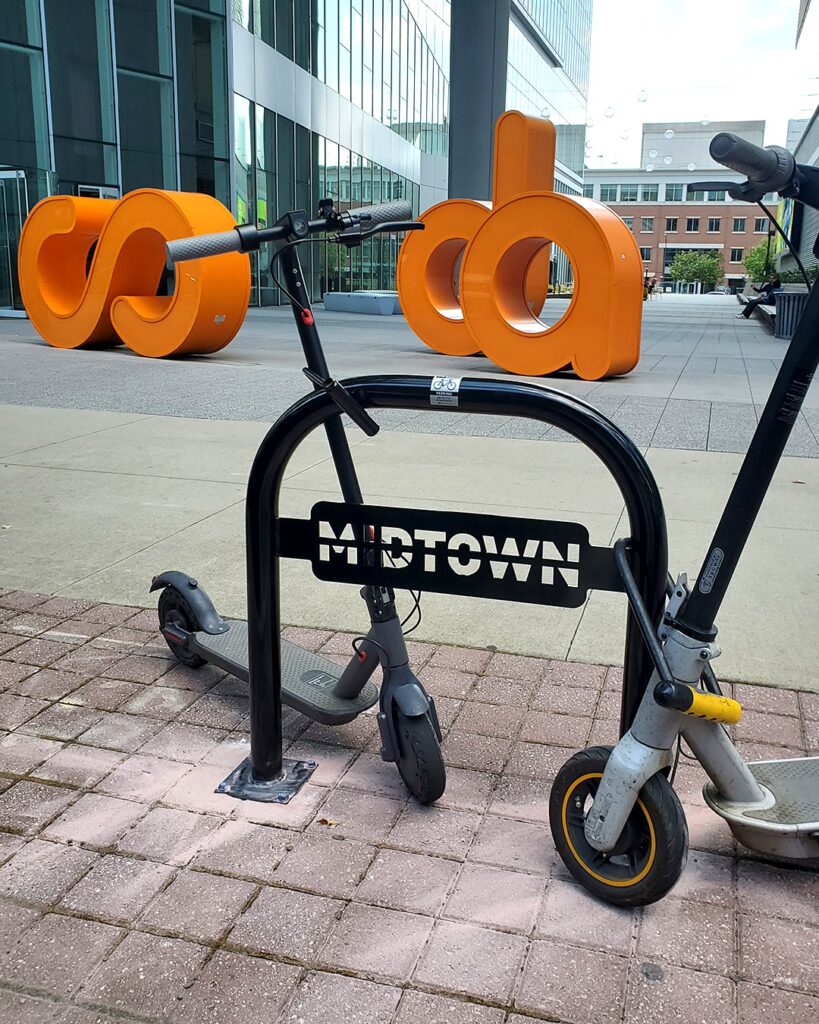
Crime Trends That May Surprise People
Midtown’s reputation can be shaped by perception, but the data tells a more nuanced story. The district has recorded three consecutive years of record-low crime.
- Violent crime is down 17% since 2021
- Property crime has fallen by roughly half over four years
- Only 63 violent incidents were recorded in 2025 in an area with over 100,000 daily users
Much of this is attributed to a layered safety model that combines police presence with private security and dedicated patrol programs. It’s a hybrid approach that some suburban cities are beginning to explore as their own town centers become more active.
Jobs, Density, and a Changing Workforce
Midtown continues to attract major employers. EY alone is bringing 3,000 workers to the district, while firms like HNTB and Reed Smith are also relocating or expanding.
Since 2015, more than 30,000 jobs have been announced in Midtown.
At the same time, the residential population has grown fivefold since 2000, now approaching 30,000 residents.
For North Atlanta suburbs, this shift is already visible in commuting patterns. Hybrid work is now dominant, with about 70% of Midtown workers splitting time between home and office.
That dynamic continues to reshape traffic, housing demand, and even where people choose to live.
The Cultural Layer: Events, Art, and Public Life
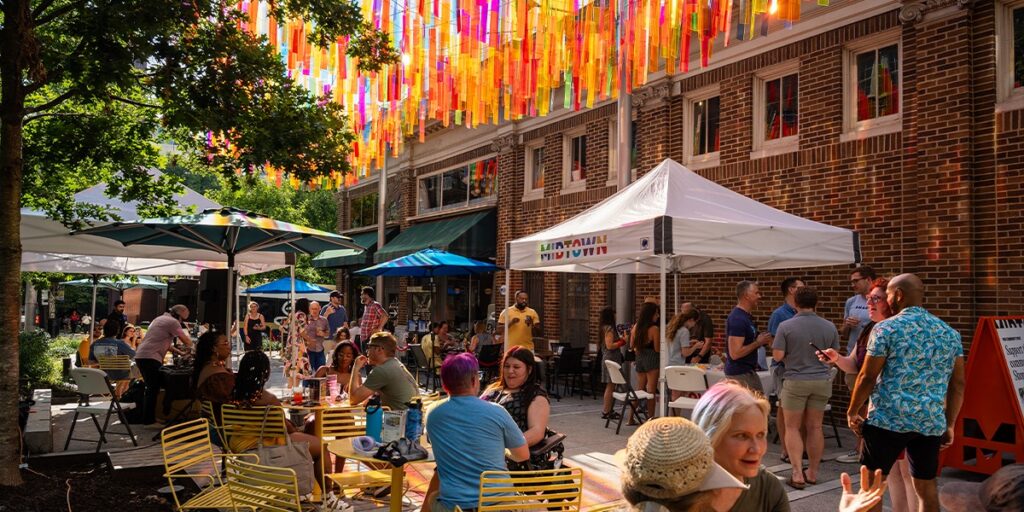
Midtown’s growth isn’t just about buildings. In 2025, the district hosted more than 80 community events — from outdoor yoga to large-scale gatherings like Atlanta Streets Alive, which drew tens of thousands of participants.
Public art has also expanded significantly, with nearly 80 murals and installations concentrated in one square mile.
This emphasis on programming is part of a broader strategy: density alone doesn’t create energy. It needs to be activated.
A Shift in Hospitality and Short-Term Stays
Midtown’s growth is also reshaping how people stay in the city. As more employers relocate and major events return — including the 2026 World Cup — demand for short-term accommodations has continued to rise. Hotels remain central, but the mix is evolving.
Well-established properties like Loews Atlanta Hotel and Four Seasons Hotel Atlanta continue to anchor the district’s higher-end stays, while newer and design-forward options such as Epicurean Atlanta and Moxy Atlanta Midtown reflect a shift toward lifestyle-oriented hospitality. Nearby, The Starling Atlanta Midtown — overlooking Piedmont Park — adds another layer, blending large-scale capacity with a strong location advantage.
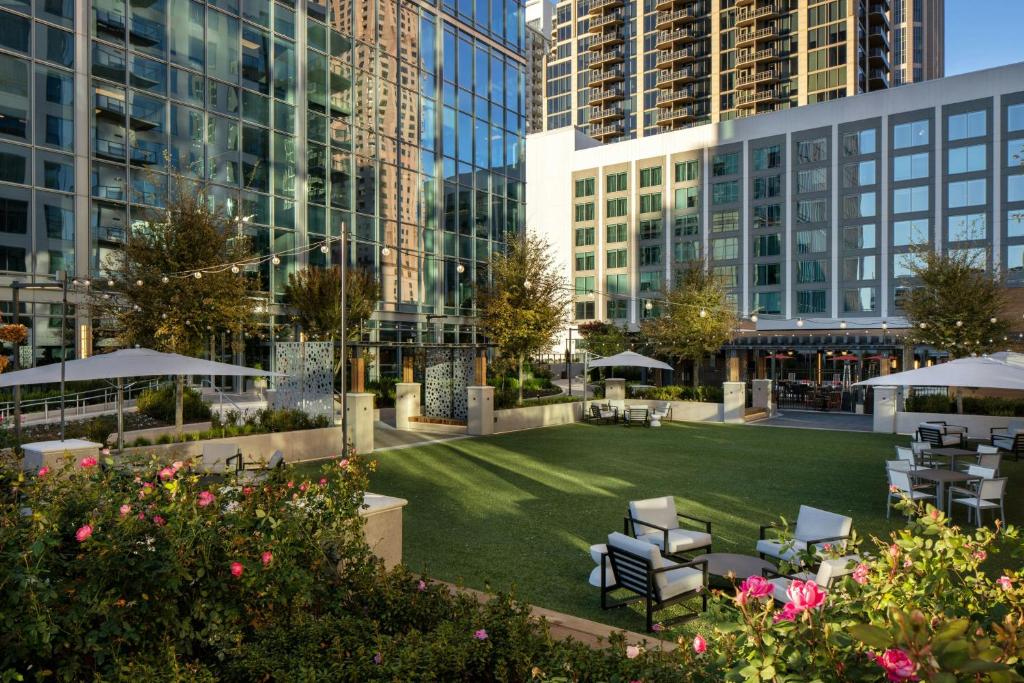
This mix mirrors broader changes in how people use the district. Visitors are no longer just passing through for a night or two. Many are staying longer, combining work, events, and leisure, often within walking distance of restaurants, offices, and cultural institutions.
For North Atlanta residents, this shift is increasingly visible. Midtown is becoming a place not just to visit for a meeting or a show, but to stay overnight — whether for a weekend in the city, a concert at the Fox Theatre, or simply a change of pace.
Where to Stay in Midtown Atlanta
What This Means for North Atlanta
For suburban readers, Midtown can feel like a separate world. But its trajectory has direct implications.
Large employers moving into Midtown influence where high-income workers choose to live — often in North Fulton and South Forsyth. Transportation investments shape commute patterns across the region. And the success of walkable, mixed-use environments continues to influence how suburban downtowns evolve.
There’s also a quieter takeaway. Midtown’s progress shows what sustained, coordinated investment over decades can produce. It’s not one project or one developer — it’s a system.
And increasingly, that’s the model other parts of metro Atlanta are trying to follow.
If you’ve been following growth and change around here, these stories are worth a look too.
About the Author

In North Atlanta
North Atlanta’s Homeownership Divide Spans 31 Percentage Points
5 Coffee Trucks and Mobile Cafés Worth Finding Around North Atlanta
Medley Opens First Access to 133 Townhomes in Johns Creek
North Atlanta Added 11,000 Residents, but the Growth Is Concentrated in Three Cities
North Atlanta’s Job Market Splits as Health Care Grows and Office Work Shrinks
What North Atlanta Should Know Today. Friday, Sept. 11, 2026
IN NORTH ATLANTA