Ready for the World? Atlanta Faces a World Cup Test
Get the week’s major local stories, openings, development news and useful updates in one email.
Nearly thirty years after the 1996 Summer Olympics, Atlanta is again preparing for a global moment—this time as a host city for the FIFA World Cup 2026.
City leaders describe the effort as larger in scope than anything the region has attempted since. But the real question is not whether Atlanta is preparing. It is how complete—and how balanced—that readiness actually is.
A City Rebuilding for a 30-Day Window
The physical transformation underway is extensive. At the center is a $120 million transportation infrastructure program focused on improving the mechanics of movement: resurfaced roads, expanded sidewalks, upgraded lighting, and redesigned crossings built to handle dense pedestrian flows. These are not cosmetic changes. They are meant to manage hundreds of thousands of visitors moving between fan zones, hotels, and stadium areas within tight time windows.
Traffic management has also entered a more sophisticated phase. Systems that once operated independently—traffic signals, digital message boards, and incident reporting—are now being integrated into unified, real-time platforms designed to prevent the kind of gridlock that has historically defined major events in the region. The addition of more than 200 digital kiosks across the city will provide real-time navigation for visitors unfamiliar with Atlanta’s layout .
What distinguishes this cycle of investment is its dual purpose. Officials are not just building for the tournament—they are trying to leave behind systems that will continue to function long after the final match .
Transit as the Pressure Point
If infrastructure is the backbone, transit is the stress test.
The Metropolitan Atlanta Rapid Transit Authority is expected to carry a significant share of World Cup movement. On match days, trains are planned to run at five-minute intervals, a level of frequency rarely sustained in normal operations . Backup fleets of buses and vans will be positioned across key stations to absorb overflow or respond to disruptions.
Technology is playing a central role here as well. The introduction of a contactless payment system—allowing riders to tap a credit card or phone instead of purchasing a ticket—removes one of the biggest barriers for international visitors. Hundreds of transit ambassadors are also expected to assist riders in multiple languages.
Still, the system faces familiar constraints. Some rail upgrades have been delayed, and parts of the network remain under long-term repair. The plan is built on the assumption that temporary operational intensity can compensate for structural limitations. Whether that balance holds under real demand remains one of the central unknowns.
Security at a Different Scale
Public safety planning reflects a post-1996 reality.
More than 700 officers will be deployed downtown, supported by hundreds of personnel from outside agencies. The approach combines visible policing—mounted units, bike patrols, rapid-response teams—with a growing layer of surveillance technology. Drone systems will provide aerial monitoring of crowd flow and incident response, feeding into a centralized command center coordinating local, state, and federal agencies.
At the same time, the city is attempting to introduce a more nuanced approach to non-emergency situations, diverting certain calls away from traditional policing and toward social services. It is a model that reflects broader shifts in urban policy—but one that has yet to be tested under the pressure of a global event.
The reach of these preparations extends beyond Atlanta itself. Suburban departments, including those in North Fulton, are participating through mutual aid agreements, underscoring that this is not simply a downtown operation but a regional one.
The Politics of a Global Event
No modern mega-event arrives without political tension, and Atlanta is no exception.
Mayor Andre Dickens has taken a clear position on one of the most sensitive issues: the role of federal immigration enforcement. His statement that U.S. Immigration and Customs Enforcement is “not invited” reflects an effort to position Atlanta as a welcoming host city, particularly for international visitors and immigrant communities.
That stance has sparked debate. Supporters see it as consistent with Atlanta’s identity. Critics argue it may conflict with federal priorities. Meanwhile, advocacy groups are pressing for stronger protections around housing and civil rights, pointing to lessons from 1996 when vulnerable populations were disproportionately affected.
The city has responded with a Human Rights Action Plan—one of only a few among host cities—but questions remain about how those commitments will play out in practice.
Hospitality and the Fan Experience
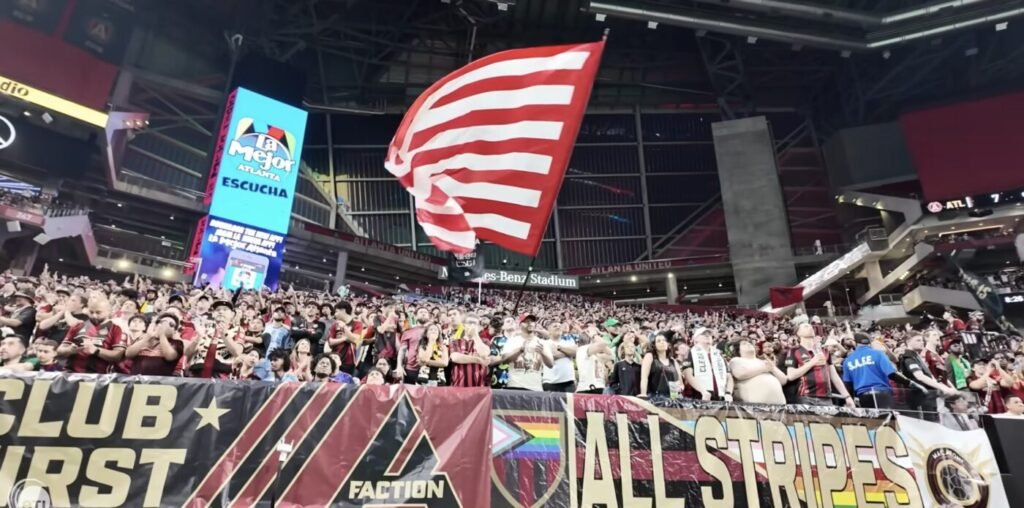
The hospitality sector is already beginning to reflect the pressure of the upcoming tournament. By early 2026, more than one in five downtown hotel rooms had already been booked, with rates expected to climb further as match dates approach. For a city accustomed to major conventions and sporting events, the World Cup represents a different level of sustained demand—spread over weeks rather than a single weekend or series.
To manage that surge, the Atlanta Convention and Visitors Bureau has launched a dedicated World Cup microsite along with a Partner and Vendor Toolkit, aimed at helping local businesses adapt quickly. Restaurants, hotels, and retailers are being encouraged to create tournament-specific offerings, from extended hours to themed menus and curated visitor experiences. The effort reflects a broader push to ensure that the economic lift reaches beyond large venues and into smaller, locally owned businesses.
Where to Stay for the World Cup
For visitors without match tickets, the center of activity will likely shift to Centennial Olympic Park. There, the official FIFA Fan Festival is expected to run for more than a month, turning the park into a daily gathering space for fans. Large-scale match screenings on a 40-foot display, live concerts, and interactive zones are designed to recreate the atmosphere of the tournament outside the stadium walls.
There is also a deliberate sense of continuity in how the space is being used. Centennial Olympic Park, itself a legacy of the 1996 Games, provides both a physical and symbolic backdrop. Its history—rooted in civil rights and a previous global spotlight—is being folded into a broader narrative of southern hospitality, positioning Atlanta once again as a city that welcomes the world while drawing on its past to shape the present .
The Science of the Pitch: Engineering a World Cup Surface
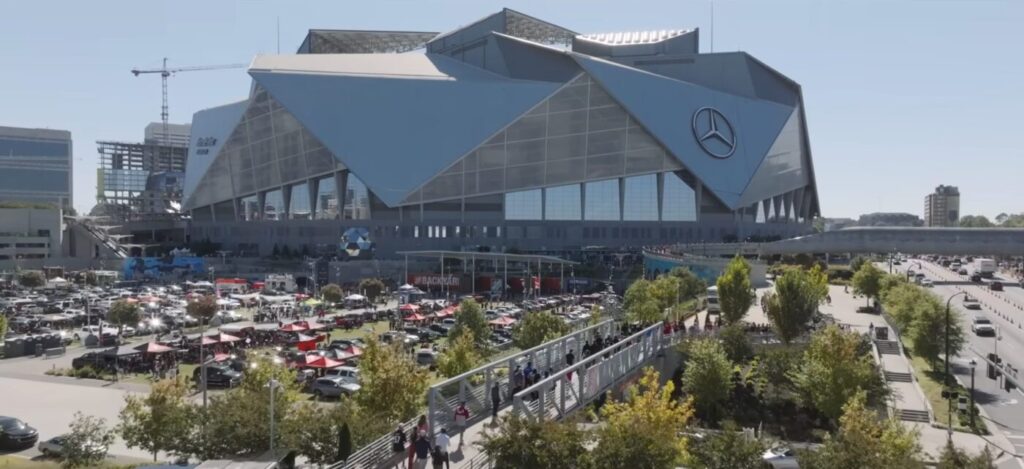
Inside Mercedes-Benz Stadium, one of the most intricate challenges has nothing to do with seating, security, or crowds. It is the field itself.
Because the stadium was built for artificial turf and not for permanent natural grass, preparing it for the FIFA World Cup 2026 has required a full-scale engineering solution. The process began with the removal of the existing turf and even sections of the underlying asphalt, creating space for a specialized SubAir system designed to regulate moisture beneath the surface. The system can clear water dramatically faster than traditional drainage, allowing the pitch to remain stable and playable even under heavy use .
The surface itself is a hybrid—natural ryegrass reinforced with synthetic fibers. This combination allows the grass roots to bind into a stable base, creating a firmer, more consistent playing field than earlier temporary installations, which often suffered from uneven bounce or instability. The goal is not just to meet FIFA standards, but to create a surface that performs like a permanent pitch, even though it exists only for a limited time.
That temporary nature is central to the entire effort. The World Cup field will be installed, tested, and maintained for the duration of the tournament, then removed once matches conclude in July 2026. The stadium will return to artificial turf for its regular tenants, including the Atlanta Falcons and Atlanta United FC.
A Regional Event, Not Just a Downtown One
The World Cup may be centered downtown, but its footprint is regional.
Across North Fulton, Gwinnett, and South Forsyth, communities are preparing their own responses. Watch parties in places like Suwanee and Peachtree Corners will bring the tournament into local parks, while Johns Creek is planning international-themed festivals that reflect its diverse population
Air traffic at smaller regional airports is expected to increase sharply, and suburban hotels and short-term rentals are already seeing early demand. For many residents, the World Cup will not be experienced inside a stadium, but through these distributed, community-level events.
This broader activation also raises a practical reality: the strain—and the opportunity—will not be evenly distributed.
The Economic Promise—and the Unanswered Questions
Estimates place the tournament’s economic impact somewhere between $500 million and more than $1 billion for the region. That range reflects both direct spending—tickets, hotels, dining—and the broader ripple effects tied to tourism and business activity. To capture more of that spending locally, the city has launched targeted programs offering small-business loans typically ranging from $5,000 to $15,000, along with grants and training initiatives designed to help owners scale up ahead of the influx .
For many businesses, preparation is already underway. Restaurants are adding seating and extending hours. Retailers are increasing inventory in anticipation of sustained demand over several weeks, not just isolated event days. Some entrepreneurs are building entirely new offerings—pop-up concepts, themed experiences, and event-driven services—aimed specifically at international visitors.
Even so, the long-term picture remains uncertain.
Large-scale events often generate strong short-term gains, but their lasting economic impact is less predictable. Some investments—particularly in infrastructure and business capacity—can continue to deliver returns. Others risk becoming underused once visitor volumes return to normal levels. The same question that followed the 1996 Olympics now returns in a new form: how much of this economic momentum will remain once the tournament ends, and who will ultimately benefit from it?
Ready, But Still Being Tested
Atlanta is not starting from scratch. It has experience, infrastructure, and a clear sense of what a global spotlight requires.
But readiness is not a single condition. It is a balance of systems—transportation, safety, housing, politics, and community impact—each moving at a different pace.
In some areas, the city appears ahead of schedule. In others, it is relying on coordination and timing to carry it through.
The World Cup will ultimately test not just whether Atlanta can host the world, but how well it can do so while still functioning as a city for the people who live here.
If this caught your attention, these stories may too.
About the Author


In North Atlanta
South Forsyth Roads and Development Take Center Stage at Forsyth County Meeting
What North Atlanta Should Know Today
Roswell Pulls Back Property Tax Proposal, but Higher Rate Remains on Table
Where to Watch Georgia, Georgia Tech and Kennesaw State Football on Sept. 12

Suwanee’s November Tax Vote Could Save Eligible Homeowners About $74 a Year

He Left the Ring. Now Tommy Phillips Is Building a Wrestling Territory in Alpharetta
IN NORTH ATLANTA