Why Offices Are Filling Up Again in Alpharetta and Sandy Springs—But Not the Way They Used To
Alpharetta and Sandy Springs offices are filling up again, but with a new approach that emphasizes hybrid schedules and enriched workplace experiences. Employers are investing in spaces designed for collaboration and engagement rather than daily attendance.
Get major local stories and development updates.
On a weekday morning along Northwinds Parkway in Alpharetta, the pattern is noticeable if you stay long enough. Cars arrive in waves, not all at once. Lobbies are active, but not crowded. Conference rooms fill up mid-morning, while some desks remain empty. The office is no longer a daily obligation. It has become something more intentional.
Across Alpharetta and Sandy Springs, a quiet but significant shift is underway. After several years of uncertainty around remote work, many of the region’s largest employers are not abandoning the office. They are rebuilding its role entirely—turning it into a place people come to for specific reasons, not simply because they have to.
The End of “Fully Remote” as a Default
The idea that offices might disappear has not held up locally. Instead, major employers anchored in North Atlanta have moved in the opposite direction, investing heavily in physical space while redefining how often—and why—employees use it.
The direction is increasingly clear: companies here are stepping back from fully remote work and leaning into structured, in-person collaboration with hybrid support.
A Campus Built for Presence: Jackson Healthcare
At 2655 Northwinds Parkway, Jackson Healthcare has taken one of the clearest positions in the region. The company has doubled down on its Alpharetta campus as the center of its culture, choosing not to move toward permanent remote work.
Instead, it has built an environment designed to bring people in. The campus includes a full fitness center, multiple dining options, a health clinic, and even an on-site childcare center. These are not perks in the traditional sense. They are part of a strategy to make the office function more like a daily ecosystem.
The company’s leadership frames the physical workplace as essential to maintaining its culture, which is built around collaboration, mentorship, and long-term employee development. That approach has helped sustain high engagement levels and consistent recognition as a top workplace.
A Structured Hybrid Model: LexisNexis Risk Solutions
Just a few miles away, LexisNexis Risk Solutions has taken a different approach—but with the same conclusion: the office still matters.
Rather than requiring full-time attendance, the company has developed a structured hybrid system known internally as “Level Up Weeks.” Employees come into the office on a predictable schedule—typically two consecutive days every other week—while spending the majority of their time working remotely.
Expansion Signals Commitment: Mercedes-Benz USA
In Sandy Springs, the shift is even more visible through investment.
Mercedes-Benz USA is expanding its North American headquarters, adding approximately 500 new jobs and centralizing key operations in the area. At the same time, the company is planning a new research and development facility nearby, reinforcing its long-term commitment to the region.
This is not a company preparing for a remote-first future. It is building infrastructure that depends on proximity—teams working together in real time, product development happening on site, and leadership concentrated in one location.
For Sandy Springs, the expansion reflects years of positioning itself as a corporate hub, with access to major highways and proximity to Atlanta’s core.
The Office as Lifestyle: Inspire Brands
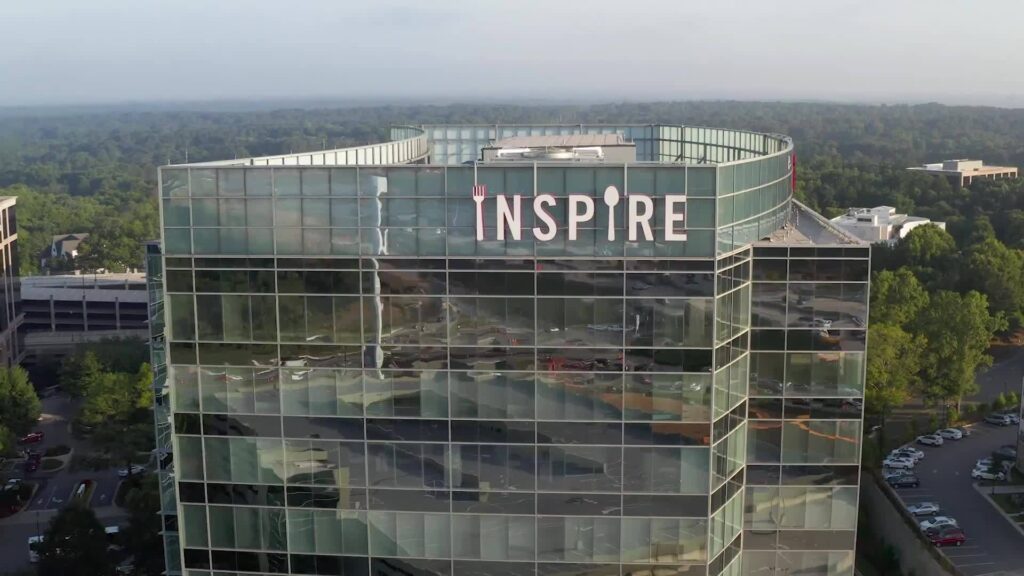
If Jackson Healthcare represents the campus model and LexisNexis represents structured hybrid work, Inspire Brands shows a third direction: the office as a lifestyle destination.
At its Sandy Springs support center, the company has created an environment that blends work, food, and social interaction. Employees have access to on-site restaurants, coffee, ice cream, a fitness center, and even dog-friendly spaces.
The goal is not simply productivity. It is engagement. Employees are encouraged to spend time in the office because it offers something different from home—not just a desk, but a shared experience.
This reflects a broader trend in the region, where companies are designing workplaces that compete directly with the comfort and convenience of remote work.
What This Means for Daily Life in North Atlanta
For residents of Alpharetta, Johns Creek, Roswell, and South Forsyth, the impact is already noticeable.
Traffic patterns are changing. Instead of five-day congestion peaks, there are heavier midweek flows, particularly Tuesday through Thursday. Cafés near office clusters are seeing a return of weekday activity, but with different rhythms. Real estate demand near major employment centers remains strong, especially for professionals who expect to commute occasionally rather than daily.
The shift also affects how people plan their weeks. Office days are now coordinated around meetings, team collaboration, and specific projects. Home days are reserved for focused, independent work.
The office is no longer the default setting for every workday. But it is far from obsolete. Instead, it has become a place designed with intention—where companies invest heavily in space, culture, and experience to justify the commute.
For the region’s largest employers, the message is consistent. Work is no longer tied to a single location. But when people do come together, the environment has to be worth it.
If you’ve been following growth and change around here, these stories are worth a look too.
About the Author

In North Atlanta
North Atlanta’s NHL Race Is No Longer Just Alpharetta vs. South Forsyth
ADP Opens New Alpharetta Roles in AI Content, Product Strategy and Internships
Siemens’ Alpharetta Rail Operation Is Hiring From $20 an Hour to $95,000 a Year
Alpharetta’s NHL Arena Study Forecasts 1.2 Million Visitors—but Leaves Key Questions Unanswered

ANDRITZ Is Hiring Engineers and Project Leaders in Alpharetta
Old Milton Parkway Widening Will Reshape Avalon Corridor Through 2029
IN NORTH ATLANTA