 Exclusive sponsor
Peachtree Corners Moves From Deer Study to Controlled Removal
Peachtree Corners moves to controlled deer removal through a federal partnership after finding a deer population nearly eight times sustainable levels. Property owner consent is required for removal on selected lands.
Major local stories and useful updates, once a week.
Peachtree Corners is moving from studying its deer problem to attempting to reduce it.
USDA Wildlife Services has begun contacting owners of large properties that may qualify for controlled deer removal, opening the implementation phase of a plan the city adopted in February.
The program will focus on selected private properties where federal wildlife professionals determine that removal can be conducted safely. Participation requires the property owner’s written consent, and Peachtree Corners marshals will coordinate with the federal team.
The shift follows a population study that estimated approximately 193 deer per square mile in Peachtree Corners. A density of about 25 per square mile is generally considered more sustainable for a suburban community, putting the city’s estimate at nearly eight times that level.
What residents reported
The population study followed a city survey completed by nearly 800 residents.
The survey results described deer as a daily part of life in many Peachtree Corners neighborhoods:
| Resident response | Share |
|---|---|
| See deer daily or weekly | 87% |
| Reported property damage | 74% |
| Experienced or witnessed a collision or near miss | 53% |
| Typically see at least three deer together | 66% |
Residents most frequently reported damaged gardens, flower beds, trees and irrigation systems. Some estimated losses exceeding $1,000.
East Jones Bridge Road, Spalding Drive and Peachtree Corners Circle appeared repeatedly in reports of vehicle collisions and near misses. Deer activity was most commonly observed during the evening and early morning, when visibility is lower and commuter traffic is still moving through residential corridors.
The survey was based on voluntary responses rather than a random citywide sample. It measures the experience of participating residents, while the separate wildlife study supplied the population estimate.
How the removal program will work
Georgia gives the Department of Natural Resources sole authority over wildlife management. That prevents Peachtree Corners from independently organizing a city hunt or directing municipal employees to remove deer.
Outside regulated hunting, the state-authorized option available to the city is the USDA Wildlife Services Wildlife Damage Management Program.
Peachtree Corners entered a cooperative agreement with USDA Wildlife Services on Nov. 19, 2025, then formally adopted its Deer Management Plan on Feb. 24, 2026.
This is not an open program in which any resident can volunteer a backyard. USDA Wildlife Services identifies properties that may be suitable based on acreage, land use and surrounding conditions, then works directly with owners who agree to participate.
The city has not publicly identified participating locations. Officials also have not announced how many properties have agreed to the program or how many deer may be removed during its first phase.
Why the city is not relocating or sterilizing deer
Residents have raised alternatives including relocation, sterilization and contraceptive treatment.
Those methods are not currently authorized by the Georgia Department of Natural Resources as part of Peachtree Corners’ population-management effort. The city therefore cannot substitute them for the USDA program.
Relocation can also transfer disease, cause significant animal stress and place deer in unfamiliar territory. Fertility-control programs require repeated treatment and are difficult to administer to a large, free-ranging suburban population.
Peachtree Corners’ study also found a low fawn-to-doe ratio. Although fewer surviving fawns might appear to ease population growth, wildlife officials consider it a possible sign that excessive browsing has begun degrading the habitat needed to support a healthy herd.
The city’s stated objective is therefore not only to reduce damaged landscaping and driving hazards. It is also to bring the deer population closer to what the remaining habitat can sustain.
Feeding wildlife may become a city violation
The City Council discussed a separate ordinance prohibiting the feeding of wildlife during its Aug. 11 work session. The proposal appeared alongside the city’s ongoing deer-management work on the official meeting agenda.
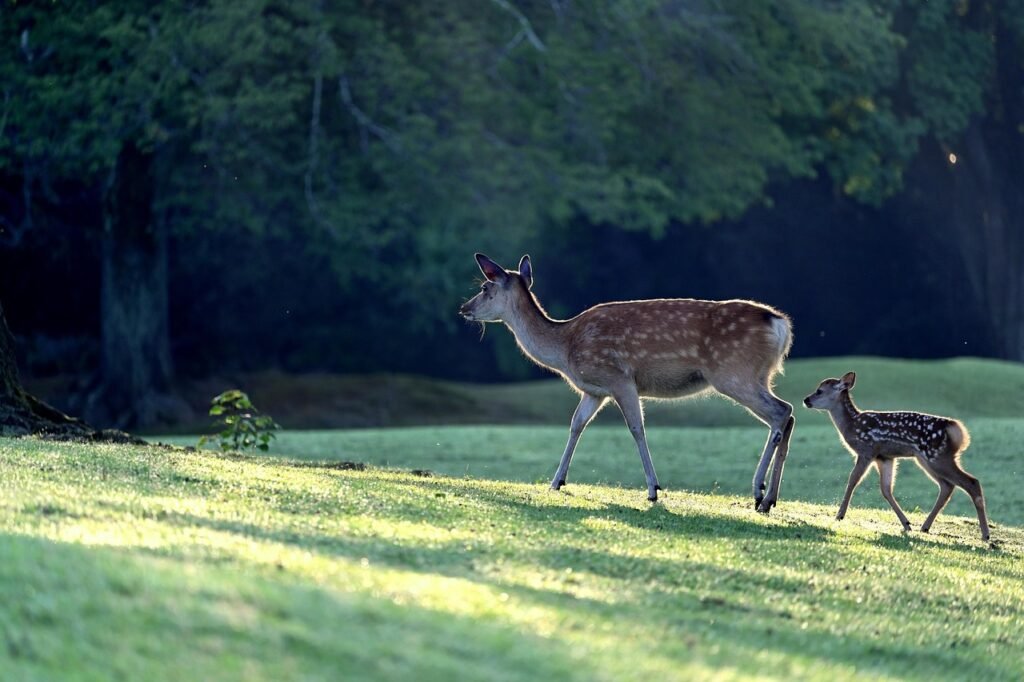
Feeding deer can concentrate animals in residential areas, encourage repeated visits and increase the possibility of disease transmission and vehicle conflicts. It can also undermine population-control work by drawing deer toward homes and neighborhood streets.
The work-session discussion did not itself make feeding wildlife illegal. A prohibition would require formal council action, and the city has not announced a final vote date or published the eventual enforcement details.
Until those details are approved, residents should not assume that a warning or fine has taken effect merely because the ordinance was discussed.
Why Peachtree Corners has so many deer
Peachtree Corners offers unusually favorable suburban habitat. The Chattahoochee River, tributary creeks, wooded private properties, parks and neighborhood buffers give deer water, shelter and multiple routes between feeding areas.
At the same time, ordinary population controls are limited. Hunting opportunities are scarce inside a developed city, large predators are absent and residential landscaping supplies an abundant food source.
As North Atlanta Star previously explained in its look at deer across the northern suburbs, fragmented areas of woods, lawns and ornamental landscaping can support more deer than either a dense urban center or an uninterrupted mature forest.
The result is a population that can remain highly visible even as additional land is developed.
What happens next
The city says its deer-management plan will be reviewed annually using updated resident surveys and population assessments.
Property participation is voluntary, meaning the city cannot guarantee that enough suitable landowners will join to produce a particular population reduction. City leaders have also cautioned that residents may need three to five years before noticing a substantial change, according to Atlanta News First’s coverage of the study.
The first test will be whether USDA Wildlife Services secures enough safe locations to begin meaningful removal. The second will be whether the council adopts a feeding ordinance that reduces the artificial concentration of deer in residential areas.
Peachtree Corners has concluded that its deer population is no longer simply a landscaping nuisance. The city is now treating it as a long-term wildlife, traffic-safety and habitat problem—one that will require several years to measure and manage.
Continuing Coverage
Help us follow this story
North Atlanta Star is continuing to follow this subject as it develops. If you have firsthand experience, a local perspective, information we should examine or a question you believe deserves an answer, we would like to hear from you.
Your response will be sent directly to our editor. It will not appear as a public comment or be published automatically. We may contact you if we would like to learn more.
If this felt close to home, these stories may be worth your time too.
Community Voice
A snapshot of reader views, not a scientific survey.
Explore Community Voice →About the Author


In North Atlanta
Gwinnett Schools Bring Bus Driver Recruiting to Suwanee and Peachtree Corners
North Atlanta’s Commute Divide Adds Up to 61 Hours a Year

Peachtree Corners Gains Major Electrical Training Center as Georgia’s Skilled-Trade Pipeline Expand
Brookhaven Approves $750,000 Land Purchase to Expand Lynwood Park
Sugar Hill Has North Atlanta’s Longest Average Commute

What North Atlanta Should Know Today: 9 Stories for Sunday, July 26
IN NORTH ATLANTA