Salt Lake City Airport Completes $5.1 Billion Rebuild After 12 Years
Salt Lake City International Airport has completed a 12-year, $5.1 billion rebuild, replacing aging terminals and adding new gates while staying fully open. The new airport features improved facilities and increased capacity for travelers.
Get the week’s jobs, development, housing and growth stories from across the Sun Belt in one email.
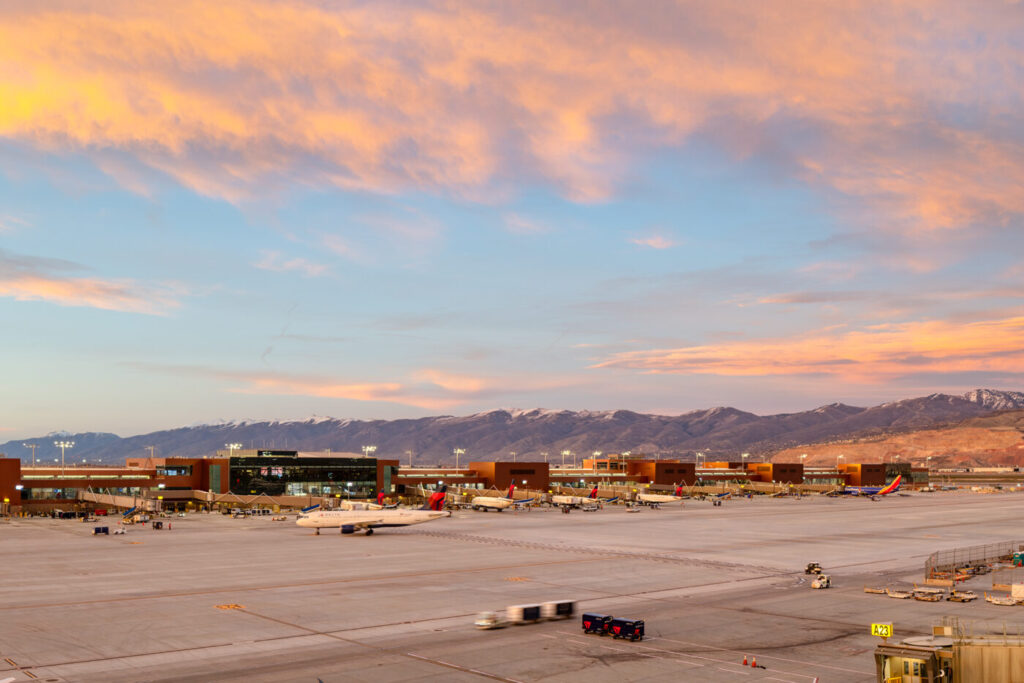
Salt Lake City International Airport has opened the final seven gates of a $5.1 billion rebuilding program that replaced aging terminals while keeping one of the Mountain West’s busiest air hubs in operation.
The last gates and six concessions opened Tuesday, Oct. 27, in Concourse B-east, completing a project launched in July 2014. The finished airport has 94 aircraft gates, 101 concessions and four hardstand aircraft positions, with the new addition occupying approximately 132,000 square feet.
Five of the seven new gates are assigned to United Airlines. Two are available for common use by other carriers. The concessions mix local and national brands, giving travelers additional choices in an airport that serves both Utah residents and connecting passengers traveling across the country.
Rebuilding an airport without shutting it down
Rather than renovate individual aging buildings, Salt Lake City replaced three former terminals with a central terminal and two linear concourses. Construction proceeded in stages as flights continued, with the first major opening in September 2020 and further phases following in 2023, 2024 and 2026.
Nearly 25,000 craft workers contributed more than 18 million hours during construction. The main redevelopment is complete, although changes and expansion may continue as passenger demand grows.
Who paid for the $5.1 billion project?
The rebuild was financed through a combination of airport funds, passenger facility charges, rental-car customer charges, federal grants and airport revenue bonds. Salt Lake City’s general fund was not used to finance the project.
That distinction is important as fast-growing metropolitan areas across the country weigh expansions of their own airports. Passenger fees and airline-related revenue can fund major airport infrastructure, but borrowing still creates long-term obligations that ultimately must be supported by airport operations.
A regional gateway with room to grow
The reconstructed terminal is designed around connections between incoming and outgoing flights as well as the growing number of people beginning or ending their journeys in Utah. New food service, retail and public art are part of the airport experience, but so are the practical challenges of longer walks across large concourses.
For travelers, the most significant change is that the major construction program is now complete. For airport planners elsewhere, Salt Lake City offers a large-scale example of how an operating hub can be replaced over more than a decade without suspending its essential role in national air travel.
Community Voice
A snapshot of reader views, not a scientific survey.
Explore Community Voice →About the Desk

Across the Sun Belt
Louisiana’s $1.6 Billion Energy Hub Will Create 23 Direct Jobs. What Does the State Get in Return?

Charlotte Is Turning a Nearly Empty Office Tower Into 399 Apartments and a W Hotel

Arizona’s $7 Billion Chip Project Just Became a $12 Billion Project

A $5.8 Billion Steel Mill Is Coming to Louisiana. The Average Job Is Expected to Pay $95,000

Texas Gas Prices Ease, but October Was Still a Costly Month for Drivers