 Exclusive sponsor
Sunday Is Finding Its Way Back in North Atlanta
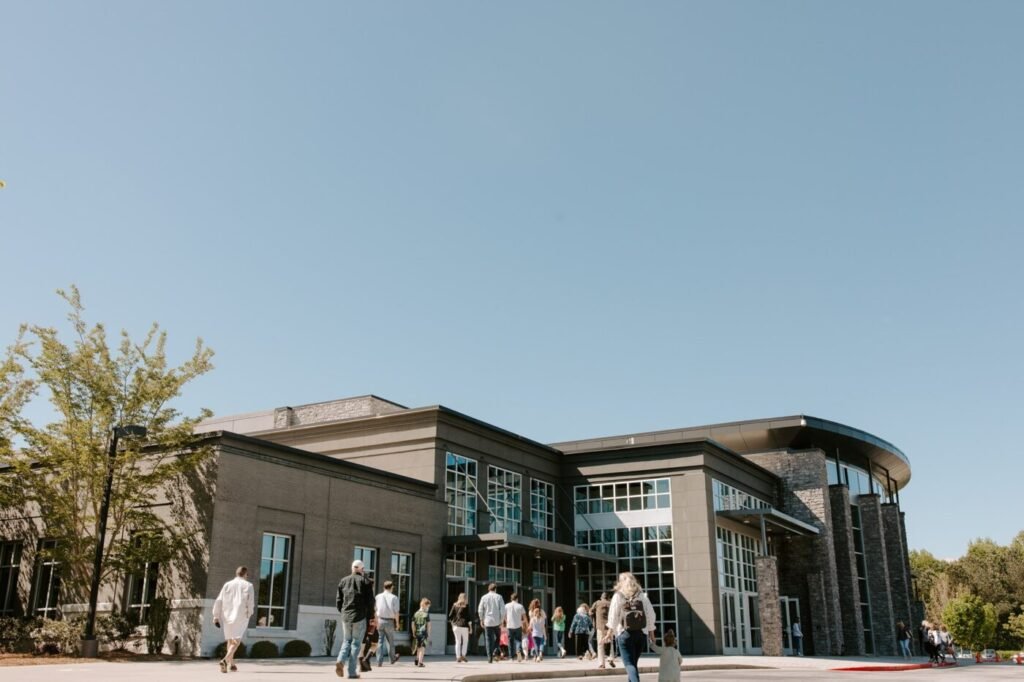
In North Atlanta, young adults are increasingly attending church services and programs that emphasize social connection and regular gatherings. This trend reflects a search for stable community amid busy, fragmented lives.
Major local stories and useful updates, once a week.
For years, the dominant narrative around religion in the United States was decline. Church attendance was falling, particularly among younger generations, and the rise of the religiously unaffiliated seemed steady and irreversible.
That trajectory has not entirely reversed, but it has stabilized—and in some cases, shifted.
Recent data shows that Gen Z adults who identify as Christian are now attending services more frequently than during the pandemic years, averaging close to two Sundays per month. That places them slightly ahead of older generations in attendance frequency, a notable reversal from just a few years ago .
Even more striking is who is returning. Young men, in particular, have shown a sharp increase in religious engagement, with a growing share describing religion as an important part of their lives .
Still, researchers caution against calling this a broad revival. The overall number of Americans without religious affiliation continues to grow, and much of the visible increase in attendance is concentrated in larger, more dynamic congregations rather than spread evenly across all churches .
The Suburban Version Looks Different
What is happening in North Atlanta does not resemble the traditional image of Sunday churchgoing. It is less about obligation and more about structure.
For many young professionals moving into Alpharetta, Johns Creek, and South Forsyth, life is efficient but fragmented. Work is often remote or hybrid. Social circles are thin, especially for newcomers. The familiar patterns that once defined community—neighborhood ties, extended family, long-standing friendships—are not always in place.
In that environment, the appeal of a predictable weekly gathering becomes more obvious.
Church offers something increasingly rare: a standing invitation, a set time, and a room where people show up without needing to coordinate schedules or send multiple texts. It functions, for some, as what sociologists call a “third space”—neither home nor work, but a place where relationships can form naturally .
The Local Infrastructure Is Already There
North Atlanta is uniquely positioned for this kind of shift because the infrastructure has been in place for years.
Large, established congregations have quietly built extensive young adult ecosystems that extend well beyond Sunday services.
At North Point Community Church, the model emphasizes moving people from large gatherings into smaller, more personal group settings. Programs aimed at younger attendees often include shared meals, discussion groups, and recurring meetups designed to create familiarity over time.
At Perimeter Church, young adult programming has become a central part of engagement, with structured entry points like group lunches and dedicated environments tailored to people in their 20s and early 30s.
In Roswell, Home Church Roswell has leaned into a rhythm-based approach, organizing weekly and monthly gatherings that feel closer to social events than traditional ministry programming.
Catholic parishes in the area are also seeing increased participation among younger adults. Saint Brigid Catholic Church and St. Benedict Catholic Church both maintain active young adult communities, often blending social events with service opportunities and informal gatherings.
These are not experimental programs. They are structured, recurring, and in some cases, growing.
The Social Layer Is Hard to Ignore
One of the clearest drivers of this shift is not theological—it is social.
Young adults consistently describe a need for connection that feels more stable than what is offered by apps, nightlife, or occasional events. In surveys, a majority of younger churchgoers say that community matters more to them than the content of the service itself .
There is also a practical side.
A typical night out in Alpharetta or at Halcyon can easily run $75 to $100 per person. That makes regular socializing expensive, especially for those managing rent, student loans, and rising living costs.
Church, by contrast, offers a recurring social environment at little to no cost. Coffee, conversation, group events, and even childcare are often built into the experience. Over time, it becomes one of the few consistent and accessible ways to maintain a social routine.
There is also a quieter dynamic at play: dating. While rarely discussed openly in formal settings, churches have long functioned as spaces where relationships begin. For young adults increasingly frustrated with dating apps, the appeal of meeting people through shared values—and repeated, in-person interaction—has grown.
Not Without Limits
For all the visible momentum, the trend comes with constraints.
The gender divide remains significant. While young men are returning in greater numbers, many young women report concerns about leadership opportunities and cultural dynamics within certain denominations .
There is also the question of depth. Some analysts suggest that participation may be driven more by social needs than long-term religious commitment. If that is the case, engagement could shift again as new forms of community emerge.
And suburban geography presents its own challenges. Unlike dense urban neighborhoods, North Atlanta’s car-dependent layout makes spontaneous interaction more difficult. The experience remains organized rather than organic, requiring intentional planning even within a structured setting.
A Subtle but Meaningful Shift
What is happening across North Atlanta is not a return to the past. It is something more adaptive.
Church is not reclaiming its role as the center of civic life. But for a growing number of young adults, it is becoming one of the few places where community feels consistent, accessible, and grounded in real-world interaction.
In a region defined by growth, relocation, and constant movement, that kind of stability carries weight.
Sunday is not what it used to be. But it may be becoming something again.
If this felt close to home, these stories may be worth your time too.
Community Voice
A snapshot of reader views, not a scientific survey.
Explore Community Voice →About the Author


In North Atlanta

North Atlanta Schools Start Next Week. What Families Need to Know Before the First Bell
What North Atlanta Should Know Today. Sunday, Aug. 16, 2026
Atlanta’s World Cup Hotel Boom May Not Arrive the Way Many Expected
North Atlanta Early Voting Starts Oct. 13. Registration Closes Monday.

Your Mailing Address May Not Be Your City
At Home, North Atlanta Speaks Many Languages
IN NORTH ATLANTA