How Religious Are North Atlanta’s Suburbs?
Religion remains a significant presence in North Atlanta’s suburbs, where a variety of faiths coexist amid changing participation patterns. Institutions continue to impact community life with education and social services.
Get major local stories and development updates.
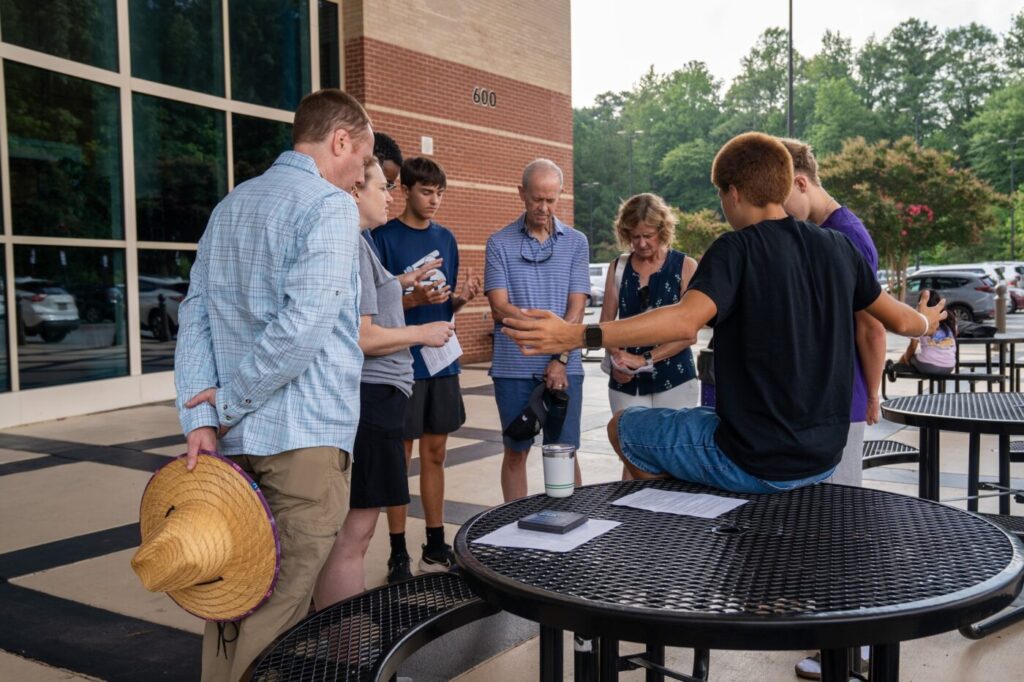
Photo: Courtesy of Perimeter Church Facebook page
Across the northern arc of metro Atlanta — including Johns Creek, Alpharetta, Roswell, Milton, Duluth, Suwanee, and South Forsyth around Cumming — religion remains a visible part of everyday suburban life. Churches line major roads, temples and mosques have appeared in growing immigrant corridors, and large religious campuses function as community hubs.
At the same time, the region’s religious landscape has evolved dramatically over the past two decades. North Atlanta still sits inside one of the most religious metropolitan regions in the United States, but it is no longer defined by a single tradition. Evangelical megachurches, Catholic parishes, Jewish congregations, mosques, Hindu temples, and Buddhist communities now coexist within a relatively small geographic area.
The result is a suburban religious environment that is both highly institutionalized and increasingly diverse.
A Region Still Built Around Religious Institutions
One way to measure religious presence is through institutional affiliation, sometimes called adherence. This refers to the number of people counted as members or participants by religious congregations.
According to the 2020 U.S. Religion Census, compiled by the Association of Religion Data Archives, the Atlanta region continues to show relatively strong religious infrastructure.
In Fulton County, which includes both the city of Atlanta and the North Fulton suburbs, about 67.2 percent of residents were counted as religious adherents in 2020. That represents 716,915 adherents out of a population of 1,066,710.
In Gwinnett County, home to Duluth and Suwanee, the adherence rate was 49.5 percent, or 474,200 adherents out of 957,062 residents.
In Forsyth County, which includes South Forsyth and the Cumming area along GA-400, the rate was 42 percent, representing 105,614 adherents out of 251,283 residents.
Across the broader Atlanta–Sandy Springs–Alpharetta metropolitan area, the census counted 3,128,928 adherents out of 6,089,815 residents, producing a regional adherence rate of 51.4 percent.
These figures place the Atlanta metro area firmly within the more religious regions of the United States, though the strength of institutional religious life varies across counties.
A Dense Network of Churches and Worship Centers
Another way to understand religious infrastructure is simply to count congregations.
The 2020 Religion Census lists:
Fulton County: 798 congregations
Gwinnett County: 629 congregations
Forsyth County: 134 congregations
When adjusted for population, that translates to approximately:
Fulton County: 7.48 congregations per 10,000 residents
Gwinnett County: 6.57 per 10,000 residents
Forsyth County: 5.33 per 10,000 residents
For residents, this often means religious institutions are never far away. In North Fulton and Gwinnett especially, churches, temples, synagogues, and mosques frequently appear within short driving distances of one another.
Forsyth County’s per-capita count is somewhat lower, largely because the county’s population has grown extremely rapidly over the past decade.
Participation Is Changing
While the physical infrastructure of religion remains strong, participation patterns are shifting.
The Pew Research Center’s 2023–2024 Religious Landscape Study found that 27 percent of adults in Georgia say they attend religious services at least once a week.
At the same time, 43 percent say they seldom or never attend services.
Despite these declines, Georgia remains more religious than the national average. Pew’s broader “religiousness” scale shows 38 percent of Georgia adults in the highest category of religious commitment, compared with 30 percent nationwide.
In other words, religious participation is gradually changing — but religion continues to play a larger role in daily life in Georgia than in many other states.
Different Religious Profiles Across the Northern Suburbs
Although the counties north of Atlanta share a broadly Christian foundation, their religious composition differs noticeably.
The 2020 Religion Census shows that Fulton County has the most balanced distribution of Christian traditions. Adherents are spread across Catholic, evangelical Protestant, mainline Protestant, and historically Black Protestant churches.
That diversity reflects the county’s mix of older Atlanta congregations and newer suburban communities in Johns Creek, Alpharetta, Roswell, and Milton.
Forsyth County and Gwinnett County, by contrast, lean more strongly toward evangelical Protestant churches. Both counties also have significant Catholic populations.
Gwinnett County, however, stands out for its growing number of non-Christian religious communities.
Researchers sometimes measure this using a religious diversity index, which estimates how evenly adherents are distributed across traditions.
Using county data from the Religion Census, the results show:
Fulton County diversity index: 0.789
Gwinnett County: 0.717
Forsyth County: 0.671
Higher values indicate greater diversity. By that measure, Fulton County has the most evenly distributed mix of religious traditions, while Forsyth County remains more concentrated within a smaller number of Christian denominations.
Major Religious Traditions in the Region
The Religion Census also highlights the largest religious groups operating across the three counties.
The Catholic Church has become an increasingly prominent suburban presence.
In Fulton County, Catholic parishes reported 22 congregations serving about 174,520 adherents in 2020.
In Gwinnett County, there were 29 Catholic congregations with about 83,100 adherents.
In Forsyth County, the census lists 4 congregations serving roughly 18,890 adherents.
Evangelical Protestant churches form the largest institutional block in both Forsyth and Gwinnett counties.
In Forsyth County, the Southern Baptist Convention reported 47 congregations with 44,618 adherents, while non-denominational Christian churches reported 14 congregations with 11,760 adherents.
In Gwinnett County, the Southern Baptist Convention reported 163 congregations serving about 128,591 adherents, while non-denominational churches reported 87 congregations with approximately 73,570 adherents.
Jewish congregations are particularly visible in North Fulton suburbs such as Johns Creek and Alpharetta. The Religion Census lists Reform Judaism in Fulton County with 6 congregations and 12,328 adherents, and Conservative Judaism with 6 congregations and 7,757 adherents, along with smaller Orthodox and Chabad communities.
Immigration Is Expanding Religious Diversity
One of the biggest changes in North Atlanta’s religious landscape has been the influence of immigration.
Cities such as Johns Creek, Duluth, and Suwanee have some of the highest foreign-born populations in Georgia. According to recent Census estimates:
Johns Creek: 34.8 percent foreign-born residents
Alpharetta: 27.8 percent
Milton: 23.3 percent
Duluth: 30.9 percent
Suwanee: 27.0 percent
These figures are dramatically higher than the Georgia average of about 11.2 percent.
This demographic shift has contributed to the expansion of religious institutions serving immigrant communities.
The BAPS Shri Swaminarayan Mandir in Lilburn, inaugurated in 2007, is one of the most prominent Hindu temples in the Southeast and serves worshippers from across Gwinnett, North Fulton, and Forsyth.
Nearby, Shiv Mandir of Atlanta in Sugar Hill also serves the region’s growing Indian-American population.
Muslim communities have established several mosques across the northern suburbs, including the Islamic Center of Duluth and Suwanee Masjid, both of which host educational programs and community events alongside regular prayer services.
These institutions illustrate how immigration has transformed parts of Gwinnett and North Fulton into some of the most religiously diverse suburban areas in the Southeast.
Large Churches Still Shape Suburban Religious Life
Even as diversity grows, large churches continue to play a central role in the region’s religious culture.
One of the most influential is North Point Community Church, part of North Point Ministries, which has reported average weekly attendance of more than 30,000 people across its campuses.
Other major institutions include Perimeter Church in Johns Creek, a prominent North Fulton congregation that serves a wide portion of the northern metro area.

These large churches often function as community hubs, hosting youth programs, counseling services, volunteer networks, and large-scale service initiatives.
Religion as Community Infrastructure
Religious institutions across North Atlanta frequently operate schools, childcare programs, and social organizations that extend far beyond Sunday worship.
For example, Saint Brigid Catholic Church in Johns Creek was founded in the late 1990s as North Fulton’s population expanded. The parish began holding Mass at Centennial High School in Roswell before opening its permanent campus and growing into a large suburban parish with thousands of registered families.
The parish also operates a preschool program, while nearby Holy Redeemer School, opened in 1999, reflects the broader expansion of Catholic education in North Fulton.
Protestant institutions also contribute to the region’s educational landscape. Mount Pisgah Christian School in Johns Creek, for example, is a well-known private school serving students from preschool through high school.
Across the suburbs, many religious institutions also organize food drives, volunteer programs, and community events that function much like civic organizations.
A Religious Landscape Still Evolving
Taken together, the data suggests that religion in North Atlanta’s suburbs is not disappearing — it is evolving.
Weekly participation is declining, following a national pattern. Yet the region still has a dense network of religious institutions, and immigration has introduced new traditions that continue to reshape the religious map.
The result is a suburban religious environment where megachurch campuses, Catholic parishes, Jewish congregations, mosques, and Hindu temples often exist within just a few miles of one another.
For communities like Johns Creek, Duluth, Suwanee, Alpharetta, and South Forsyth, that diversity is now a defining feature of suburban life.
Read Also:
About the Author


In North Atlanta

Is the SAT Still Worth Taking? Georgia’s Admissions Rules Have Changed

North Atlanta’s New School Phone Rules: What Parents Need to Know This Fall
Is Soccer Taking Over North Atlanta? The Numbers Say Something Is Changing
Roswell Approves Champions Place Expansion for Adults With Physical Disabilities
What North Atlanta Should Know Today. Sunday, Sept. 13, 2026
LIIV Atlanta Sets Sept. 27 Opening at Longtime Peachtree Corners Church
IN NORTH ATLANTA