 Exclusive sponsor
North Atlanta Property Tax Survival Guide
North Atlanta homeowners face new property tax rules under Georgia’s tax cap system. Understanding exemptions, assessments, and appeals can clarify bills in Johns Creek, Alpharetta, and nearby towns.

Major local stories and useful updates, once a week.
A Practical Guide for Homeowners in Johns Creek, Alpharetta, Milton, South Forsyth, Suwanee and Duluth
Property taxes in North Atlanta are no longer something homeowners can afford to glance at once a year and ignore.
With Georgia’s new property tax cap system, local opt-outs, school tax decisions, reassessments, exemptions and appeal deadlines, the bill that arrives in the mail is now the result of several moving parts. For homeowners in Johns Creek, Alpharetta, Milton, South Forsyth, Suwanee, Duluth and nearby suburbs, understanding those parts can make the difference between simply paying what arrives and knowing whether the number deserves a closer look.
Georgia’s new House Bill 581 framework limits how quickly taxable home values can rise for many owner-occupied homes, tying growth to inflation rather than the full increase in market value. But the protection depends on where you live, which government body is taxing you, and whether your local jurisdiction opted into or out of the state system.
Start With Your Homestead Exemption
The first rule is simple: make sure your homestead exemption is properly filed.
A homestead exemption is the foundation for most property tax relief. Without it, homeowners may miss out on the very protections designed to limit taxable value increases. Under Georgia’s newer system, the exemption can create a growing gap between a home’s market value and its taxable value, often called a floating exemption.
For longtime homeowners, that gap can become meaningful over time. For new buyers, the taxable value generally resets when the home is sold, which means two neighbors on the same street may eventually pay very different tax bills on similar homes.
Read the Assessment Notice Carefully
Do not look only at the total value.
Your assessment notice usually includes several important figures: fair market value, assessed value, exemption amount, taxable value and, under the newer framework, rollback-rate information. That rollback rate matters because it shows the millage rate that would produce roughly the same revenue as the previous year, after accounting for property value growth.
If values rise and the millage rate does not fall, your local government may collect more revenue even without calling it a tax increase.
Know Which Part of the Bill Changed
A property tax bill is not one tax. It is usually several taxes stacked together.
A homeowner in North Fulton may see county taxes, city taxes and school taxes. A homeowner in South Forsyth may see county and school components governed by different rules. In Gwinnett, county protections may differ from school district decisions.
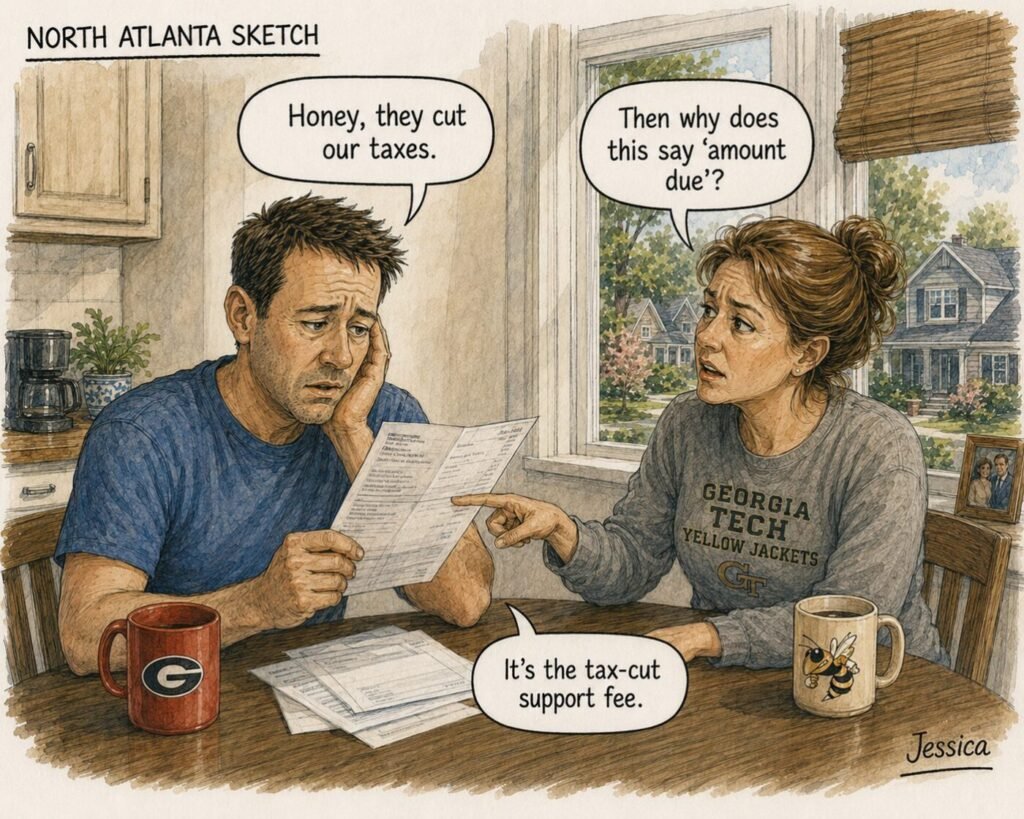
That distinction matters because many school systems opted out of the new statewide cap structure due to concerns about long-term revenue for classrooms, transportation and staffing.
So a homeowner may receive protection on one part of the bill while another portion continues under a different system.
Compare This Year Against Last Year
The most useful question is not only, “Did my bill go up?”
The better question is: where did it go up?
Look separately at:
County tax
City tax
School tax
Bond taxes
Special districts
Exemptions applied
Assessed value versus taxable value
This is where many homeowners find the real story. Sometimes the market value rose sharply, but the taxable value was capped. Sometimes the millage rate changed. Sometimes a school portion rose while the city portion stayed relatively stable.
Appeal When the Market Value Looks Wrong
The new tax cap does not eliminate the need for appeals.
If your home’s fair market value appears too high compared with recent neighborhood sales, condition, lot size, location, repairs needed or other factors, an appeal may still be worth considering. A successful appeal can lower the starting point from which future calculations are made.
For North Atlanta homeowners, that is especially important in neighborhoods where homes vary widely by age, renovation level, school zone, lot size and proximity to major corridors.
Watch the School Tax Line
For many homeowners, the school portion is one of the largest parts of the property tax bill.
School districts across Georgia warned that strict caps could reduce future revenue growth, and Gwinnett County Public Schools estimated that the state cap could eventually mean tens of millions of dollars in reduced revenue growth.
That is why school boards became one of the biggest battlegrounds in the tax-cap debate. For homeowners, it means any serious review of a tax bill should pay close attention to the school line, not just the county or city line.
Understand the New-Buyer Penalty
One of the quietest effects of the new system may be a widening divide between longtime owners and recent buyers.
When a home sells, the taxable value generally resets closer to current market value. That means a family buying into Johns Creek, Alpharetta, Milton or South Forsyth today may carry a much higher tax basis than someone who bought years earlier and stayed in place.
Over time, this could make moving more expensive, discourage downsizing and create larger tax differences within the same subdivision.
Keep a Simple Annual Tax File
Every homeowner should keep a small digital folder with:
Last year’s tax bill
This year’s assessment notice
This year’s tax bill
Homestead exemption confirmation
Recent comparable sales
Any appeal documents
Photos showing property condition, if relevant
This does not need to be complicated. But when appeal season arrives, having documents ready can save time and prevent rushed decisions.
When to Ask for Professional Help
A homeowner may want to speak with a property tax appeal professional, real estate attorney or local tax consultant if the assessment jumped sharply, the home has condition issues not reflected in the value, comparable sales appear lower, the homeowner recently bought or inherited the property, or the tax bill changed in a way that is difficult to explain.
For many routine cases, homeowners can review and appeal on their own. But in higher-value North Atlanta homes, even a modest reduction in assessed value can make professional help worth considering.
The New Tax Reality
The new Georgia property tax system gives many North Atlanta homeowners more protection than they had before, but it does not make property taxes simple.
The homeowners who benefit most will be the ones who know whether their homestead exemption is active, read their assessment notice carefully, separate county, city and school taxes, and appeal when the underlying value does not match the market.
In North Atlanta’s expensive housing market, property tax literacy is becoming part of homeownership.
Who North Atlanta Homeowners Usually Call for Help
When a property tax bill suddenly jumps, homeowners across Johns Creek, Alpharetta, Milton, South Forsyth, Suwanee and Duluth often end up speaking with one of several types of professionals.
Property tax appeal firms can help homeowners review assessments, compare nearby sales and file formal appeals when values appear inflated. Real estate attorneys may become useful in more complicated situations involving inherited homes, trusts, disputed valuations or legal questions tied to exemptions. Some homeowners also work with experienced local Realtors who closely track neighborhood sales and can help identify whether an assessment looks unusually high compared with recent comparable homes.
CPA firms and tax professionals may also help homeowners understand how property taxes interact with retirement planning, investment properties, business ownership or relocation decisions.
In North Atlanta’s higher-value housing markets, even relatively small changes in assessed value can translate into meaningful annual savings over time.
If this felt close to home, these stories may be worth your time too.
Community Voice
A snapshot of reader views, not a scientific survey.
Explore Community Voice →About the Author


In North Atlanta

What North Atlanta Should Know Today. Sunday, Aug. 16, 2026
What North Atlanta Should Know Today: 10 Stories for Saturday, July 25
Brookhaven’s Proposed 40% Tax-Rate Jump Is Not a 40% Increase in the Total Tax Bill

The Quiet Tax War Between Sugar Hill, Suwanee, Buford and Cumming
How City Limits Affect Your Property Taxes in North Atlanta (2026 Buyer Guide)

Sandy Springs Residents Can Weigh In on Property Taxes Tuesday
IN NORTH ATLANTA