 Exclusive sponsor
Atlanta May Soon Become the First U.S. Metro Where Outer Suburbs Cost More Than the City
Major local stories and useful updates, once a week.
The old “move farther out to save money” rule is breaking down
For decades, the housing math in most American metro areas was simple. Homes farther from the city were cheaper. Buyers accepted longer commutes in exchange for lower prices, larger houses, and bigger yards.
That formula is starting to break down in metro Atlanta.
A recent report by The Wall Street Journal found that metro Atlanta may soon become the first major U.S. metropolitan area where homes on the far suburban edge cost as much as — or even more than — homes closer to the city.
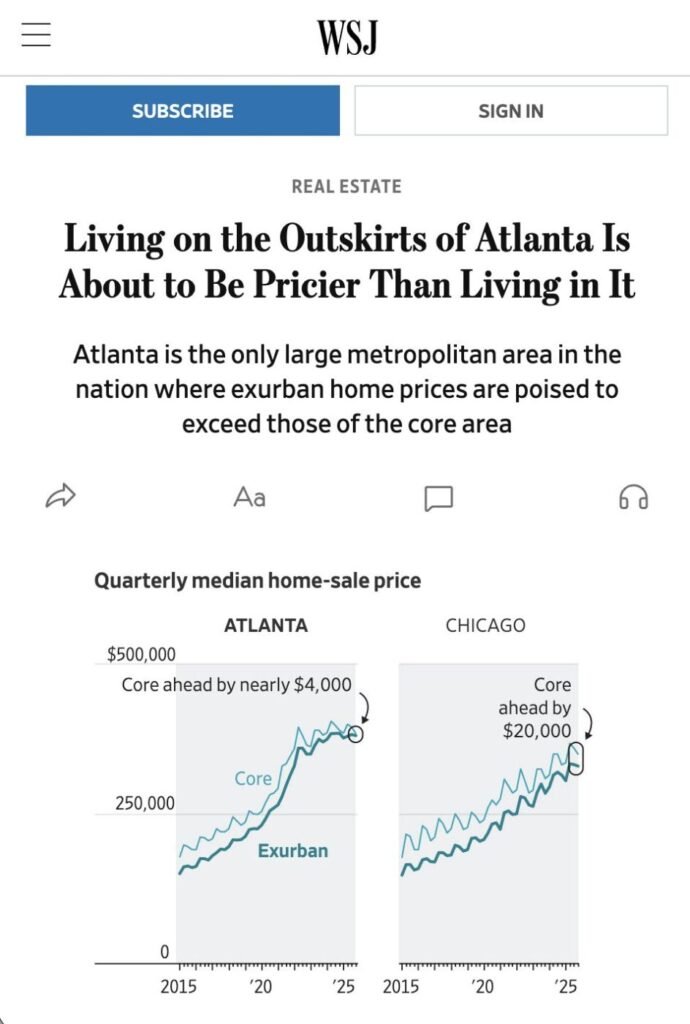
The shift reflects several powerful forces reshaping where people want to live: hybrid work, strong school systems, newer housing stock, and a growing concentration of amenities in suburban communities.
In North Fulton and South Forsyth — including Alpharetta, Johns Creek, Milton, Roswell, Cumming, Duluth, and Suwanee — the trend is already visible.
Home prices on Atlanta’s north side are already far above the city median
Median home prices illustrate the contrast clearly.
In the city of Atlanta, the typical home recently sold for about $378,000.
Across North Atlanta suburbs, prices are much higher:
Johns Creek: about $670,000
Alpharetta: about $678,000
Roswell: about $600,000
Milton: about $1.15 million
Cumming (South Forsyth): about $548,000
Suwanee: about $551,000
Duluth: about $427,000
Outer counties in the northern arc of the region have also surged. Forsyth County’s median home price is around $585,000, while Cherokee County sits near $480,000.
These numbers show that the traditional idea of the “cheap outskirts” no longer fits much of North Atlanta. Instead, many of the region’s most expensive housing markets now sit well beyond the city limits.
Outer counties have appreciated faster than the core
Long-term housing data shows the same pattern.
Since 2019, several counties on the outer edge of metro Atlanta have experienced significantly faster home price growth than Fulton County, which includes the city and many close-in job centers.
Forsyth County home values have risen roughly 69 percent since 2019.
Cherokee County has climbed about 72 percent.
Paulding County has increased nearly 70 percent.
Fulton County, by comparison, has risen closer to 49 percent over the same period.
That faster appreciation in outer counties explains why the historical “exurb discount” is disappearing. Prices in the outer ring are catching up quickly.
Good to Know: What Is an Exurb?
An exurb is a community at the outer edge of a metropolitan area where housing density is low, population growth is relatively high, and at least 20% of residents commute to jobs in the metro region.
The term is often used for fast-growing outer counties that are beyond the traditional suburbs but still economically connected to the city.
Hybrid work changed the commuting equation
One of the biggest drivers of the shift is how work has changed. Before 2020, daily commuting strongly shaped where people chose to live. Distance from downtown Atlanta or Buckhead had a direct impact on home prices. Hybrid work has softened that constraint.
A growing share of workers now commute only a few days per week. In the Atlanta region, telework has increased dramatically since 2019, while average commute times have actually fallen.
For many households, this changes the calculation. If commuting happens two or three days per week instead of five, a longer drive becomes easier to accept — especially if the trade-off includes better schools, larger homes, or newer neighborhoods.
In practical terms, a house 20 miles farther out may only add a handful of longer drives each month. For many families, that is an acceptable compromise.
Newer housing is concentrated in outer suburbs
Another factor shaping the numbers is the type of housing available.
Many outer suburbs contain newer homes — often larger single-family houses built in master-planned communities.
New construction typically sells at a premium compared with older housing stock. That means suburbs where most homes were built recently tend to show higher median prices.
Across South Forsyth and parts of north Gwinnett, large subdivisions built in the last decade have added thousands of newer homes to the market.
Those homes frequently include modern layouts, larger lots, and access to neighborhood amenities such as trails, parks, and community centers.
The result is a housing mix that naturally commands higher prices.
Migration into Atlanta is bringing higher buying power
Another important driver is who is moving into the region. Metro Atlanta continues to attract residents from higher-cost markets, particularly cities such as New York, Los Angeles, Washington, D.C., and San Francisco.
Buyers relocating from those regions often arrive with larger home equity or higher down payments.
That buying power allows them to compete aggressively for homes in desirable suburban communities — especially areas with strong schools and high quality of life.
North Atlanta suburbs frequently rank high on those criteria.
Suburban town centers are creating “city living” outside the city
North Atlanta’s growth is also increasingly centered around large mixed-use districts that replicate many urban amenities.
Projects like Avalon helped redefine suburban development in the region, combining retail, offices, housing, and public gathering spaces in a walkable environment.
In South Forsyth, Halcyon offers a similar model, linking restaurants, residences, and entertainment to the nearby Big Creek Greenway.
Further north, Cumming City Center is emerging as a new downtown-style district for Forsyth County. These developments add amenities that once required a trip to Midtown or Buckhead.
As suburban communities build their own centers of activity, the incentive to live closer to the traditional urban core becomes weaker.
Land constraints in established suburbs are pushing growth outward
Ironically, some of the strongest demand is concentrated in communities that have very little land left to build. Cities like Alpharetta and Johns Creek are largely built out. Most remaining development opportunities involve redevelopment or infill projects rather than new large subdivisions.
That scarcity naturally limits housing supply. When demand remains strong but land becomes scarce, prices tend to rise. At the same time, new family housing often shifts farther outward — into South Forsyth or neighboring counties where larger tracts of land remain available.
Rapid growth is putting pressure on infrastructure
Population growth in the northern suburbs has been rapid.
Forsyth County’s population has more than doubled since 2000, making it one of the fastest-growing counties in Georgia. That growth brings both opportunity and pressure.
Local governments are investing heavily in roads, parks, and public facilities to keep up with the expanding population. Transportation planning cycles are shortening, and school systems continue adding new campuses to accommodate rising enrollment.
Forsyth County Schools alone has added numerous new schools over the past decade while expanding existing campuses.
These infrastructure investments reflect the reality that demand for the area continues to grow.
The affordability question is becoming more complicated
If the historic exurb discount disappears, the region’s housing ladder becomes harder to climb. For many years, moving farther from Atlanta offered a reliable way for buyers to find more affordable homes.
As outer suburbs become more expensive, that escape valve shrinks. First-time buyers increasingly turn to townhomes, smaller lots, or homes in more distant counties. Others stretch budgets in order to remain within desirable school districts.
The result is a housing market where affordability pressures ripple outward through the region.
What to watch next
Several trends will determine how the region’s housing geography evolves. If outer counties continue appreciating faster than the core, the price gap could fully reverse in the coming years. School enrollment growth, infrastructure expansion, and new development projects will also play important roles.
For residents of North Fulton and South Forsyth, one reality is already clear. The northern suburbs of metro Atlanta are no longer the cheaper alternative to the city. In many cases, they have become the region’s most sought-after — and most expensive — places to live.
Read Also
Community Voice
A snapshot of reader views, not a scientific survey.
Explore Community Voice →About the Author


In North Atlanta
New Model Home Opens as Coal Mountain’s Mixed-Use Community Takes Shape
North Atlanta’s Housing Divide: Homeownership Ranges From 48% to 80%

New Dining, Live Music and Small Shops Planned for Downtown Alpharetta
Two Cumming Homes See Price Cuts Exceeding $160,000 After a Year on the Market

Toll Brothers Starts Site Work on Cloverhill at Cumming City Center

Johns Creek Approves 48-Home Subdivision on Church Campus
IN NORTH ATLANTA